Kaja Kallas says EU mission Aspides raised its alert level in the Red Sea
 Yemen Herald News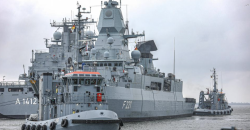
BRUSSELS, Belgium — The European Union’s naval mission in the Red Sea has raised the alert level for its vessels, the bloc’s foreign policy chief said Friday.
Kaja Kallas, the EU High Representative for Foreign Affairs and Security Policy, said Operation Aspides took the step after conditions in the area worsened.
She did not say what the higher alert level requires of the mission’s ships.
Kallas said she had spoken with Saudi Foreign Minister Prince Faisal bin Farhan Al-Saud. The two discussed diplomatic efforts to end the fighting in Yemen and to restore freedom of navigation, she said.
“Houthi attacks on Saudi Arabia are unacceptable and sabotage the global economy,” Kallas said in a post on the social media platform X.
Europe is helping protect maritime traffic in the Red Sea from Houthi attacks, she added.
The account of the change in alert posture rests on Kallas’s statement. No independent confirmation has been published, and Yemen Herald could not verify the decision separately.
Kallas did not link the alert change to any single incident. She also did not say whether the mission had asked for additional ships.
Aspides is a defensive operation. Its mandate bars it from carrying out strikes on land.
The EU Council established the mission on Feb. 8, 2024, and launched it 11 days later.
Its tasks are to accompany merchant vessels, to build maritime situational awareness across its area of operation, and to protect ships against attacks at sea.
That awareness work includes collecting information on arms trafficking and on shadow fleets, according to the European External Action Service.
The mission contributes to maritime security along the main sea lines of communication in the region, working alongside other naval forces there, the service says.
The area of operation covers the Bab al-Mandab Strait and the Strait of Hormuz.
It also takes in international waters in the Red Sea, the Gulf of Aden, the Arabian Sea, the Gulf of Oman and the Persian Gulf.
Houthi attacks on merchant and commercial shipping in those waters began in October 2023.
The European External Action Service says the attacks jeopardise the lives of civilian crews on merchant ships and directly affect maritime trade.
It describes them as a breach of the freedom of the high seas and of the right of transit passage through straits used for international navigation, rights set out in the UN Convention on the Law of the Sea.
The UN Security Council adopted Resolution 2722 on Jan. 10, 2024. It condemned the attacks and demanded that the group stop them immediately.
The resolution stressed the importance of navigational rights and freedoms for vessels of all states in the Red Sea, including merchant ships transiting Bab al-Mandab.
It also noted the right of states to defend their vessels under international law.
Aspides operates in line with that resolution and with Resolution 2768, adopted in 2025.
The EU approved a crisis management concept for a maritime security operation on Jan. 29, 2024, with an initial duration of one year.
The Council extended the operation’s mandate in February 2025.
Saudi Arabia has come under repeated attack in recent days.
The Saudi Civil Defense issued early warning alerts in Riyadh, al-Kharj, Khamis Mushait, Jeddah, Taif, Yanbu, AlUla, Jazan, Farasan and Abha, sounding sirens in those cities and governorates.
It declared the danger had passed on Saturday.
Khamis Mushait and Abha lie in Asir province, near the Yemeni border. Jazan sits on the Red Sea coast opposite Yemen’s northwestern governorates.
Yanbu is a Red Sea port and refining centre on the kingdom’s west coast.
The agency urged residents to take information on emergencies from official sources and to avoid circulating video from unknown accounts.
Gulf Cooperation Council Secretary-General Jasem Mohamed Albudaiwi condemned a drone attack on Taif, calling it a “heinous assault.”
Falling debris from the drone killed one person and injured others, the Saudi Press Agency reported. Yemen Herald could not independently confirm the casualty figure.
The Taif attack drew condemnation from Syria, Mauritania, Jordan, Bahrain, Qatar, Kuwait and Kenya, the agency said.
Those statements described attacks on civilian areas as a violation of international law and called for international action to stop them.
They also affirmed support for measures taken by Saudi Arabia to protect its territory.
On the ground in Yemen, government forces are resisting Houthi attempts to take the highlands east of Bab al-Mandab and west of Taiz.
The group is trying to secure its positions around the strait, Perim Island and the western coast, Asharq Al-Awsat reported.
Control of the mountains there would give it depth inland and protect its supply lines.
A military source in the Taiz Military Axis said clashes had killed 30 Houthi fighters and wounded more than 60.
The same source said six combat vehicles and two tanks were destroyed.
That account comes from one side of the fighting. The Houthis have not commented on it, and Yemen Herald could not verify the figures.
The Houthis have not responded publicly to Kallas’s remarks.
Perim Island sits in the Bab al-Mandab Strait, splitting the waterway into two channels.
The strait carries traffic between the Red Sea and the Gulf of Aden. Aspides has been operating there since 2024.
About the Author