Government unit says nearly 147,000 people were displaced in Yemen in 18 days
 Yemen Herald News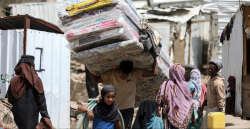
ADEN, Yemen — Nearly 147,000 people were displaced across eight Yemeni provinces in the first 18 days of September, a government body said Sunday.
The Executive Unit for the Management of Displaced Persons Camps documented 21,583 families, comprising 146,943 people, displaced between Sept. 1 and Sept. 18.
It attributed the movement to deteriorating security conditions.
The unit is the government body responsible for registering displaced people and managing their camps.
Taiz took the largest number.
The unit recorded 11,534 families, or 80,792 people, arriving across 15 districts of the province.
Within Taiz, more than 25,000 displaced people are in Al Ma’afer district, about 15,000 in Ash Shamayatayn and more than 11,000 in Jabal Habashi, according to the report.
Lahj ranked second, with 5,472 families, or 38,304 people, across nine districts.
More than 23,000 of them are in Al-Mudharabah and Ras Al-Arah.
Ras Al-Arah and Al-Mudharabah sit on the Lahj coast, on the road running north from Bab al-Mandab.
Taiz and Lahj together account for more than 119,000 of the total, or about four fifths of the new arrivals.
Al-Hudaydah recorded 1,471 families, or 10,297 people, who moved to the districts of Hays and Al Khawkhah.
Abyan received 1,278 families, comprising 8,946 people.
Aden recorded 1,622 families, or 7,162 people, most of them taken in by local families rather than housed in camps.
The unit logged 110 displaced families in Hadhramout, 70 in Al Mahrah and 26 in Shabwa, the smallest numbers of the eight provinces.
The account rests on the Executive Unit’s report. No independent verification of the provincial figures has been published, and Yemen Herald could not confirm them separately.
Some families have moved a second time.
Households that first fled to Hays and Al-Khawkhah have since travelled on towards Aden and other southern areas as fighting neared their new locations, the report said.
Displacement is continuing, particularly from western Taiz and along the western coast, according to the unit.
It called on international and local organisations to provide “urgent, life-saving assistance”.
Delays in the response could “exacerbate the crisis and increase pressure on host communities”, it said.
The unit listed shelter, food, drinking water, health care, sanitation and protection among the needs.
It asked UN agencies, aid organisations and donors to prepare for further waves of displacement if the clashes continue.
The unit did not say how many of the displaced are children. It gave no figure for people displaced within their own districts.
UN aid agencies gave a lower count last week.
They told a briefing in Geneva on Friday that more than 112,000 people had been displaced in two weeks of fighting. That figure covered four provinces and a shorter period.
The National reported on Sept. 16 that the fighting had forced more than 125,000 civilians from their homes.
Al Jazeera reported on the same day that camps in Taiz were overflowing with people fleeing the Houthi offensive.
Anadolu Agency photographed families from the Kadha area of western Taiz living in temporary camps in Al Ma’afer on Sept. 16, where it reported basic necessities were scarce.
Kadha lies in western Taiz, near the fighting on the coastal approaches.
The International Organization for Migration said earlier this month that displacement had passed 104,000, and called for urgent action.
The rise follows a military escalation along Yemen’s western coast and in parts of Taiz province.
The Houthis have advanced there and taken positions previously held by government forces.
Fighting has resumed on fronts in Taiz, Marib and Al Jawf in the north and Al Bayda in central Yemen.
Marib and Al Jawf lie in Yemen’s north, Al Bayda in the centre.
The escalation began in early July. It is the worst since a UN-brokered truce took effect in April 2022.
The fighting intensified in September.
The Houthis took several positions in Al-Hudaydah and Taiz provinces during the month, including the city of Mokha, and extended as far as Mayun Island in the Bab al-Mandab Strait.
Mokha is a Red Sea port in Taiz province, north of the strait. Mayun is also known as Perim.
Al-Hudaydah is the main entry point for commercial and humanitarian imports into Houthi-held northern Yemen.
Yemen has been at war since the Houthis seized Sanaa and several provinces in September 2014.
A Saudi-led coalition intervened in March 2015 in support of the internationally recognised government, which is seated in Aden.
The new displacement adds to a caseload that was already among the world’s largest.
The UN Office for the Coordination of Humanitarian Affairs said in its March 2026 response plan that more than 22 million people in Yemen need assistance.
It put the number who are acutely food insecure at 18.3 million.
More than 2.2 million children under five are acutely malnourished, the plan said, including 516,157 with severe acute malnutrition.
The plan recorded 5.2 million people already internally displaced. It sought USD 2.16 billion to reach 12 million people.
Hays and Al Khawkhah lie on Al-Hudaydah’s southern coastal strip.
Al Ma’afer and Ash Shamayatayn are south and southwest of Taiz city. Jabal Habashi is west of it.
Abyan and Shabwa lie east of Aden along the southern coast.
About the Author