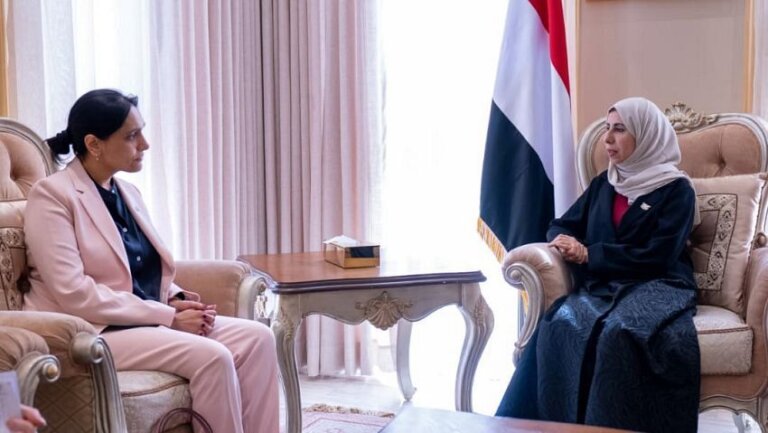
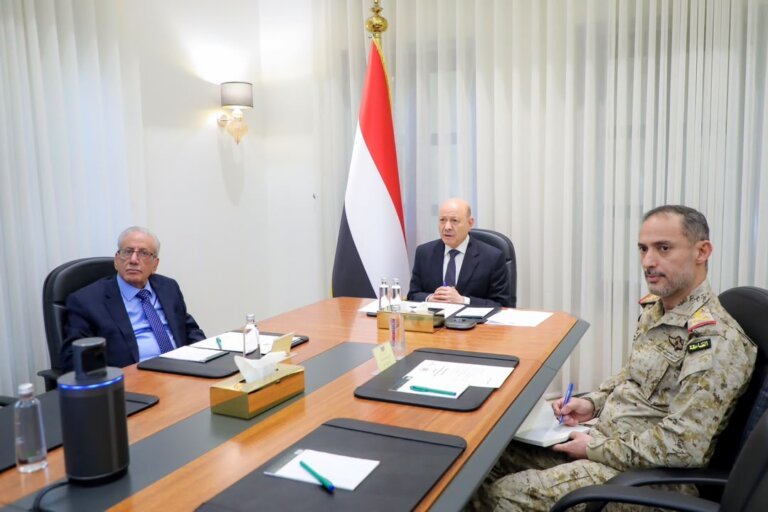
State minister Waleed al-Abara discusses displacement response with Danish Refugee Council
 Yemen Herald News
ADEN, Yemen — Yemen’s state minister for displacement and irregular migration discussed the response to the latest wave of displacement with the Danish Refugee Council in Aden, the state news agency said.
Waleed al-Abara met Hisham Ahmed, the council’s representative in Yemen. Saba, the government’s news agency, reported the meeting on Sunday.
The two discussed strengthening cooperation and coordination on displacement and irregular migration, Saba said.
Al-Abara set out the government’s priorities. They include plans to establish a higher national committee on irregular migration, according to the agency.
He also called for closer coordination with international partners, Saba said.
Al-Abara reviewed the humanitarian situation of displaced people in Aden, Taiz, Lahj and Abyan. Saba attributed that displacement to what it called the escalation by the Houthi militia.
The Houthis dispute government accounts of the fighting and its consequences.
Ahmed set out the council’s programmes in economic recovery, mine action, sanitation and camp construction, Saba said.
He said the council works directly with the Executive Unit for Displaced Camps in Lahj, according to the agency.
The account of the meeting rests on Saba. No independent confirmation of it has been published, and Yemen Herald could not reach either participant.
The meeting follows three weeks of displacement across southern and western Yemen.
Yemen’s government-run Executive Unit for the Management of Displaced Persons Camps said about 147,000 people were displaced to eight provinces between 1 and 18 September.
The Executive Unit is the government body that registers and manages displacement camps. Its count covers the period from the start of September.
UN agencies put the figure at 112,000 over the first two weeks of the month.
The International Organization for Migration counted 85,818 people who had left their homes. More than 2,000 of them reached Djibouti, the organisation said.
The local authority in Taiz has counted 65,845 people displaced since August.
The refugee agency asked donors for $14 million for its Yemen response last week. It said a camp in Djibouti taking in people who had crossed the Gulf of Aden was close to capacity.
Other ministers have approached aid agencies over the same three weeks. Planning Minister Mohammed al-Faqmi met the International Organization for Migration’s chief of mission, Abdusattor Esoev, in Aden on Sept. 14. Both called for more humanitarian funding.
Health Minister Qasim Buhaibeh asked the International Committee of the Red Cross to expand emergency and surgical support. He discussed the same subject with a Médecins Sans Frontières mission this week.
Education Minister Adel al-Abbadi signed a school feeding partnership with the World Food Programme this month.
The UN refugee agency allocated $2 million in emergency funding for the new displacement. Its acting representative in Yemen, Armen Yedgarian, gave the figure to Planning Minister Mohammed al-Faqmi in Aden, Saba said.
Al-Abara’s brief also covers migration into Yemen from the Horn of Africa.
The International Organization for Migration recorded 97,174 irregular migrant arrivals in Yemen in the first six months of this year.
Arrivals in January and February came to 40,387, a 30% increase on the same two months of 2025, according to the organisation’s figures.
The monthly pace then fell. March brought 17,027 arrivals, down from 19,337 in February.
April brought 14,834 and May 11,587, the lowest monthly total recorded this year. June rose again to 13,339.
About 68% of arrivals set out from Djibouti before crossing the Gulf of Aden, the organisation said. Most landed in Taiz and Abyan.
Ethiopians made up 86% of those arriving in March, or 16,370 people, according to the same figures.
Taiz and Abyan are two of the four governorates al-Abara reviewed with Ahmed.
Mine action, another of the council’s stated programmes, has expanded with the fighting. Masam, the Saudi-funded demining project, said it cleared 2,166 mines and other munitions in Yemen in the first 11 days of September.
Fighting has run across Taiz, Marib, al-Jawf, al-Bayda and Lahj, Anadolu Agency reported.
The escalation began in early July. It is the most intense round of fighting since a truce took hold in April 2022, according to that reporting.
Houthi forces took the port city of Mokha and Perim Island this month.
They also took the Greater and Lesser Hanish islands as government forces withdrew.
The wider caseload predates the current fighting. The UN humanitarian plan for Yemen, published in March, said more than 22 million people needed assistance.
It put the number of acutely food insecure at 18.3 million.
More than 2.2 million children under five are acutely malnourished, the plan said. It recorded 516,157 of those cases as severe.
The plan counted 5.2 million internally displaced people. It sought $2.16 billion to reach 12 million of them.
The UN Office for the Coordination of Humanitarian Affairs said aid agencies reached 10.83 million people in Yemen between January and July.
The World Health Organization puts the number needing health assistance at close to 20 million.
Access has narrowed in places. Yemen’s health ministry said this month that looting of aid facilities in Khokha was depriving patients of care.
The government has asked UN agencies to expand their operations from Aden, the seat of Yemen’s internationally recognised government.
Saba did not say when the higher national committee on irregular migration would be formed.
About the Author