Masam says it cleared 3,887 mines and explosive remnants in Yemen in 18 days
 Yemen Herald News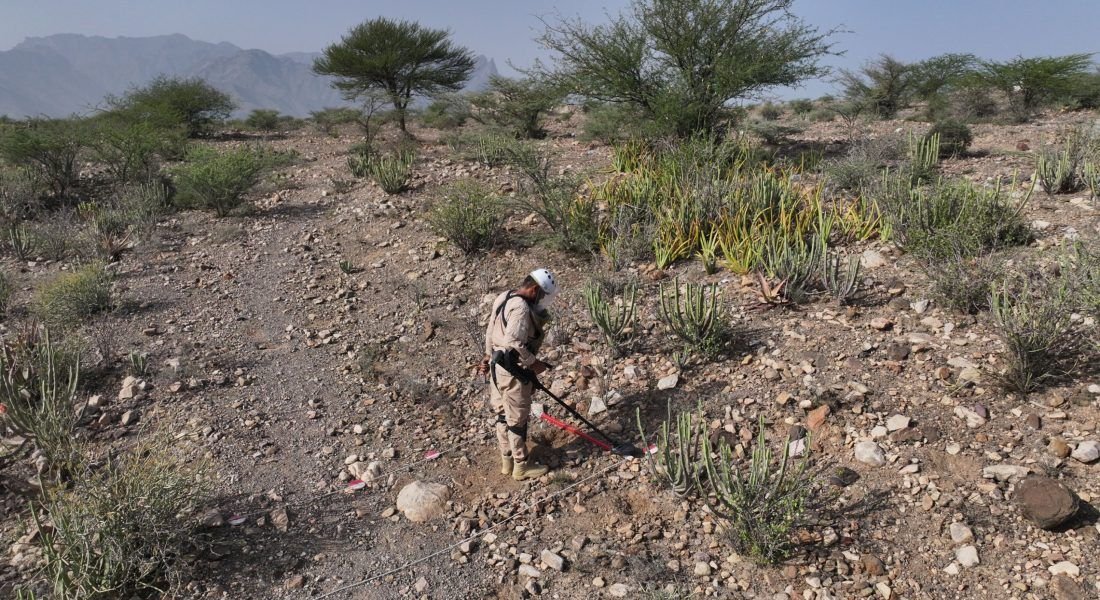
ADEN, Yemen — The Saudi-funded Masam project said it removed 3,887 mines and explosive remnants in Yemen during the first 18 days of September.
The project said it cleared more than 611,000 square meters of contaminated land over the same period.
The figures came from Masam’s operations room. Saba, the Yemeni government’s news agency, carried them.
Masam set out the total by type. It listed 3,252 items of unexploded ordnance, 573 anti-tank mines, 51 anti-personnel mines and 11 improvised explosive devices.
Unexploded ordnance accounted for most of what teams recovered.
The project gave a separate figure for the past week. Teams removed 1,721 explosive remnants over those seven days, it said.
That weekly count included 1,592 items of unexploded ordnance, 85 anti-tank mines and 44 anti-personnel mines.
Teams cleared 167,346 square meters during the week, according to the project.
Masam singled out Midi district, in Hajjah governorate on Yemen’s Red Sea coast.
Teams there have removed 13,217 mines and explosive devices since work began in the district, the project said. They have cleared 4,888,143 square meters.
Masam Project Director Osama al-Qusaibi put the cumulative total at 592,212 mines, unexploded ordnance and explosive devices removed across Yemen.
That count runs from the launch of operations in late June 2018 through September 18, al-Qusaibi said.
He broke the cumulative figure down as 422,760 items of unexploded ordnance, 153,049 anti-tank mines, 7,726 anti-personnel mines and 8,677 improvised explosive devices.
Anti-tank mines outnumber anti-personnel mines by about twenty to one in that count.
The project has cleared 85,614,461 square meters of Yemeni territory since operations began, according to al-Qusaibi. Midi accounts for about 6% of that area.
The September figures work out at an average of roughly 216 items a day.
The account rests on Masam’s own reporting. Yemen Herald found no independent verification of the figures, and no monitoring body has published a separate count for the period.
Masam runs under KSrelief, the Saudi aid agency. Its teams have worked in Marib, Aden, al-Jawf, Shabwa, Taiz, Hodeidah, Lahj, Sanaa, al-Bayda, al-Dhale and Saada.
The weekly haul of 1,721 items accounts for about 44% of the 18-day total.
The 611,000 square meters cleared this month represent less than 1% of the ground the project has covered since 2018.
Saudi statements describe the devices its teams recover as mines laid by the Houthis. Yemen Herald found no Houthi response to the September figures.
Arab News has reported earlier weekly tallies from the project this year, among them 2,164 and 1,609 explosive devices cleared.
The work carries a cost for the crews. Thirty demining staff have been killed and 47 wounded since operations began in 2018, according to figures reported for the project.
Five foreign explosive-ordnance specialists were among the dead. Yemen Herald could not confirm a current casualty figure with Masam.
Al Jazeera reported in April that Yemen’s landmine problem has persisted despite the 2022 truce and years of clearance work.
Masam is funded by Saudi Arabia and runs under the King Salman Humanitarian Aid and Relief Centre. It began work in June 2018 and deploys teams in areas held by the internationally recognised government.
The project reported 568,961 items cleared through 19 June 2026, alongside more than 81.7 million square meters of land.
The United Nations Mine Action Service describes Yemen as one of the most heavily contaminated countries in the world.
The service says contamination is concentrated along the west coast. It says explosive remnants there threaten civilians, aid workers and UN personnel.
The west coast has seen renewed fighting this month between Houthi forces and government troops.
Yemen’s Executive Unit for the Management of Displaced Persons Camps said nearly 147,000 people were displaced across eight provinces in the first 18 days of September. Taiz took the largest share.
Displaced families often move onto land that has not been surveyed.
The Landmine Monitor has recorded at least 11,807 civilian casualties from landmines in Yemen. It lists 4,262 deaths and 7,491 injuries.
Save the Children said more children were killed by landmines and unexploded ordnance in the first half of 2026 than in all of 2025.
The organisation recorded 45 children killed or wounded between January and July, a breakdown of 20 killed and 25 injured.
That marked a 61% rise on the same period in 2025, according to Save the Children.
At least 339 children have been killed and 843 wounded by landmines and other explosives since the truce of 2022, the organisation said.
Yemen Herald could not independently confirm those casualty counts.
The UN Office for the Coordination of Humanitarian Affairs said in its March plan that more than 22 million people in Yemen need assistance.
OCHA put the number of acutely food insecure at 18.3 million. It recorded more than 2.2 million children under five as acutely malnourished, including 516,157 severe cases.
The agency counted 5.2 million internally displaced people. It sought USD 2.16 billion to reach 12 million of them.
Clearance work runs ahead of that response. Cleared ground reopens roads for aid convoys and returns farmland to use.
Masam has not said how many teams it currently fields in Midi.
About the Author