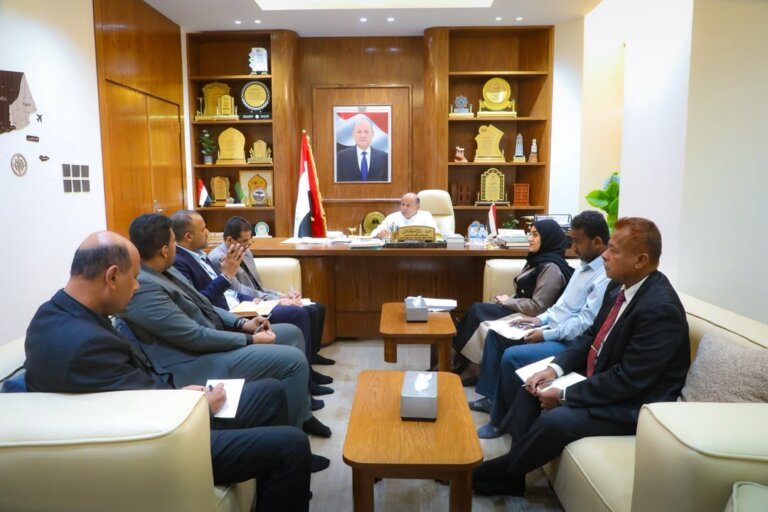
Planning Minister Mohammed al-Faqmi and OCHA discuss aid for Yemen’s displaced in Aden
 Yemen Herald News
ADEN, Yemen — Yemen’s planning minister and the head of the UN humanitarian office in the country discussed aid for people displaced by fighting on the west coast.
Mohammed al-Faqmi, minister of planning and international cooperation, met Karen Perrin, head of office for the UN Office for the Coordination of Humanitarian Affairs in Yemen, in Aden on Monday.
The state news agency Saba reported the meeting.
The two discussed closer coordination and the growing needs of displaced people, the agency said.
Talks covered emergency assistance, shelter materials and food supplies.
They also covered coordination between government authorities and humanitarian organisations working in the south.
Al-Faqmi chaired a separate meeting the same day with representatives of international and local organisations on displaced families in Abyan governorate, Saba said.
That meeting sought to mobilise urgent assistance and identify available funding.
The account of both meetings rests on Saba, which is run by the internationally recognised government. Yemen Herald found no independent confirmation of what was discussed.
OCHA has not published its own readout.
Perrin took up the Yemen post in August 2025. She has more than 25 years of experience in humanitarian affairs, with a focus on conflict and post-conflict settings, according to the United Nations in Yemen.
Zeina Ali is the acting humanitarian coordinator for the country.
Al-Faqmi has held talks on the same subject with other agencies. He met the representative of the UN refugee agency to discuss displacement in Aden, Taiz, Lahj and Abyan, Yemen Monitor reported.
Afrah al-Zouba held the planning portfolio before moving to the foreign ministry in July.
The displacement follows a Houthi advance along Yemen’s Red Sea coast.
Al Jazeera reported on 11 September that the group had taken control of the coastline and the shipping lane beside it.
Houthi fighters seized the port city of Mokha, then moved onto Perim Island, also called Mayyun, which divides the Bab al-Mandab strait into two shipping lanes, Euronews reported on 12 September.
Government forces withdrew from the island. Houthi units also took the Hanish Islands in the middle of the Red Sea.
The International Organization for Migration said 18,500 people were displaced in 72 hours as fighting spread across the west coast earlier this month.
The agency’s chief of mission in Yemen, Abdusattor Esoev, said its resources were very limited and its stocks would be depleted soon.
UN News reported on 18 September that the humanitarian situation was deteriorating by the hour as displacement rose.
UN agencies counted 112,000 people displaced in the first two weeks of the fighting.
A government displacement unit later put the figure at nearly 147,000.
OCHA said 18,000 displaced families had received assistance on the west coast.
The UN refugee agency said it had allocated 2 million dollars for the latest wave, and has sought 14 million dollars as a camp in Djibouti nears capacity.
A local authority in Taiz counted 65,845 people in camps it said were beyond capacity.
Need in Yemen was already among the largest in the world before the coastal fighting.
The United Nations humanitarian needs and response plan published in March said more than 22 million people require assistance.
It put the number who are acutely food insecure at 18.3 million.
The plan counted more than 2.2 million children under five as acutely malnourished, of whom 516,157 were severely malnourished.
It recorded 5.2 million internally displaced people.
Aid agencies sought 2.16 billion dollars under the plan to reach 12 million of those in need.
Abyan lies east of Aden on the Gulf of Aden coast and has absorbed families moving south from Taiz and Lahj.
Aden has served as the interim seat of government since 2015 and hosts most UN agency offices in the south.
The Houthis dispute the government’s account of the fighting and describe their forces as a national army.
The Group of Seven foreign ministers and the European Union’s High Representative said this month that the situation in Yemen was an unacceptable threat to regional stability and to maritime security in the Red Sea and Bab al-Mandab.
Their statement condemned Houthi strikes in Yemen and against Saudi Arabia, including those affecting civilians and civilian infrastructure.
It called on Iran to end its arming of and support for the group, citing Security Council resolutions 1747, 2140 and 2216. Iran denies arming the Houthis.
The ministers restated their backing for Hans Grundberg, the United Nations special envoy for Yemen.
The Security Council condemned Houthi attacks on Saudi Arabia this month.
President Donald Trump reviewed options for strikes on Yemen at Camp David on Sunday and called off a prepared strike package by the middle of the day, The National reported.
Secretary-General Antonio Guterres and Jasem Albudaiwi, the Gulf Cooperation Council’s secretary-general, issued their own condemnations.
Yemen’s war began in 2014, when Houthi forces took the capital, Sanaa. A Saudi-led coalition intervened the following March.
The Presidential Leadership Council has governed the internationally recognised side since April 2022, when Abdrabbuh Mansur Hadi transferred his powers to it. Its seat is in Aden.
Yemen’s foreign minister raised displacement on the west coast at a ministerial dialogue at the UN General Assembly in New York the same week, Saba reported.
About the Author