Prime Minister Shaya al-Zindani discusses Houthi escalation and Red Sea shipping with Britain’s Stephen Doughty
 Yemen Herald News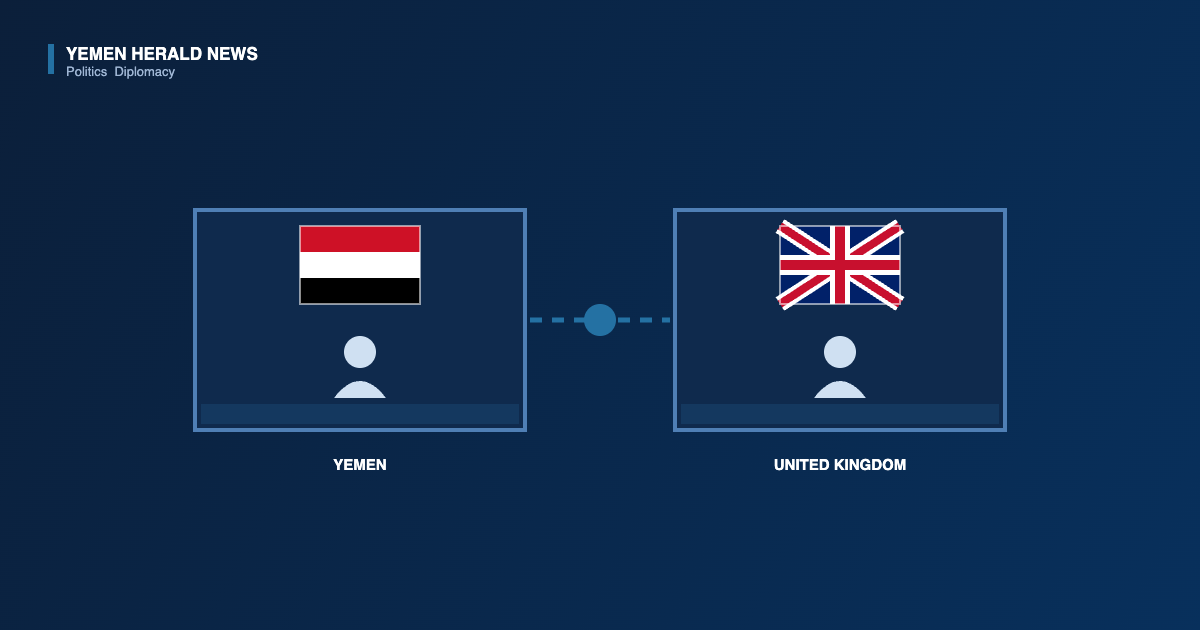
ADEN, Yemen — Yemen’s prime minister and a British minister discussed the Houthi military escalation and its effect on Red Sea shipping in a video call on Tuesday.
Prime Minister Shaya al-Zindani spoke with Stephen Doughty, Britain’s minister of state for the Middle East and North Africa, the state news agency Saba reported.
The two men reviewed what the agency described as rapidly evolving developments in Yemen and the wider region.
They discussed the economic and humanitarian consequences of the escalation, Saba said.
Protecting international maritime routes was also on the agenda.
The readout listed support for the government’s reform programme, the response to new waves of displacement and the delivery of basic services.
Al-Zindani said the escalation was no longer a threat to Yemen and the region alone, according to the agency. He said it had become a direct threat to regional and international security.
He pointed to attacks on Saudi Arabia and to threats against shipping in the Red Sea and the Bab al-Mandab strait.
Continued threats required a more effective international stance, the prime minister said.
He asked for support for his government in protecting civilians and restoring state authority across the country.
Al-Zindani praised British political, security and humanitarian assistance, Saba reported. He said it reflected the depth of the partnership between the two countries.
Doughty said Britain would continue to support the Yemeni government, according to the same readout.
He reiterated British support for Yemen and Saudi Arabia and condemned the Houthi attacks, the agency said.
Yemen Herald could not independently verify the account of the call. It rests on the readout issued by Yemen’s government through Saba, and the British government has not published its own account of the conversation.
The Houthis have not commented on the call. The group disputes government descriptions of the fighting and of its own conduct.
Doughty took the Middle East brief on 20 July 2026. He replaced Hamish Falconer as minister of state for the Middle East, North Africa, Afghanistan and Pakistan.
On taking the job he said he was “honoured to take on responsibility for our work in the Middle East and North Africa, Afghanistan, Pakistan and sanctions”. Britain’s foreign secretary is Ed Miliband.
The call came on the same day the Group of Seven published a joint statement on the strait. Foreign ministers of Canada, France, Germany, Italy, Japan, Britain and the United States signed it, with the European Union’s high representative.
They said the situation in Yemen was an unacceptable threat to regional stability, to global energy security and to navigational rights and freedoms. The text was published by Britain’s Foreign, Commonwealth and Development Office on Tuesday morning.
The escalation the two men discussed began at the start of the month.
Houthi forces opened an offensive on 3 September with a push against the road linking Taiz to the port of Mokha.
They took Mokha on 10 September. By the following day the town of Dhubab and the island of Mayyun, at the mouth of the strait, were also under their control, Al Jazeera reported.
Mayyun is also known as Perim. Houthi forces also took the Hanish Islands during the campaign, according to reporting on the offensive.
The advance covered about 2,100 square miles, according to reporting on the campaign. The United Nations said more than 100,000 people fled.
Yemen’s front lines had not moved on that scale since a UN-brokered truce froze them in April 2022.
The truce took effect on 2 April 2022 and was renewed twice before it lapsed that October. Fighting resumed at a lower level and the lines held until this month.
Mokha lies on the Red Sea coast of Taiz governorate, south of the port of Hodeidah.
The road between Taiz and Mokha carried commercial traffic and aid between the interior and the coast.
The strait carries a share of the world’s seaborne oil. Estimates of that share vary, and analysts quoted by CNN and Time this month put the flow at roughly 8.8 million barrels a day.
Time reported that Iran’s closure of the Strait of Hormuz during this year’s war pushed Saudi Arabia onto its Red Sea export route. It said Saudi seaborne crude exports through Bab al-Mandab from March to mid-July were eight times their level in the same period of 2025.
The displacement the two men discussed adds to a caseload already counted in millions.
The United Nations humanitarian plan for Yemen published in March said more than 22 million people needed assistance. It put the number who were acutely food insecure at 18.3 million.
The plan recorded more than 2.2 million children under five as acutely malnourished, of whom 516,157 were severely malnourished. It counted 5.2 million people displaced inside the country.
The appeal sought 2.16 billion dollars to reach 12 million people.
Britain is among the governments that have backed the Aden-based administration since the Presidential Leadership Council was formed in April 2022.
The council took power from President Abd Rabbu Mansour Hadi under a transfer announced in Riyadh that month.
Rashad al-Alimi chairs the council.
Al-Zindani took office as prime minister on 6 February 2026. He had previously served as foreign minister.
That post is now held by Afrah al-Zouba.
About the Author