G7 foreign ministers condemn Houthi attacks on Saudi Arabia and urge Iran to stop arming the group
 Yemen Herald News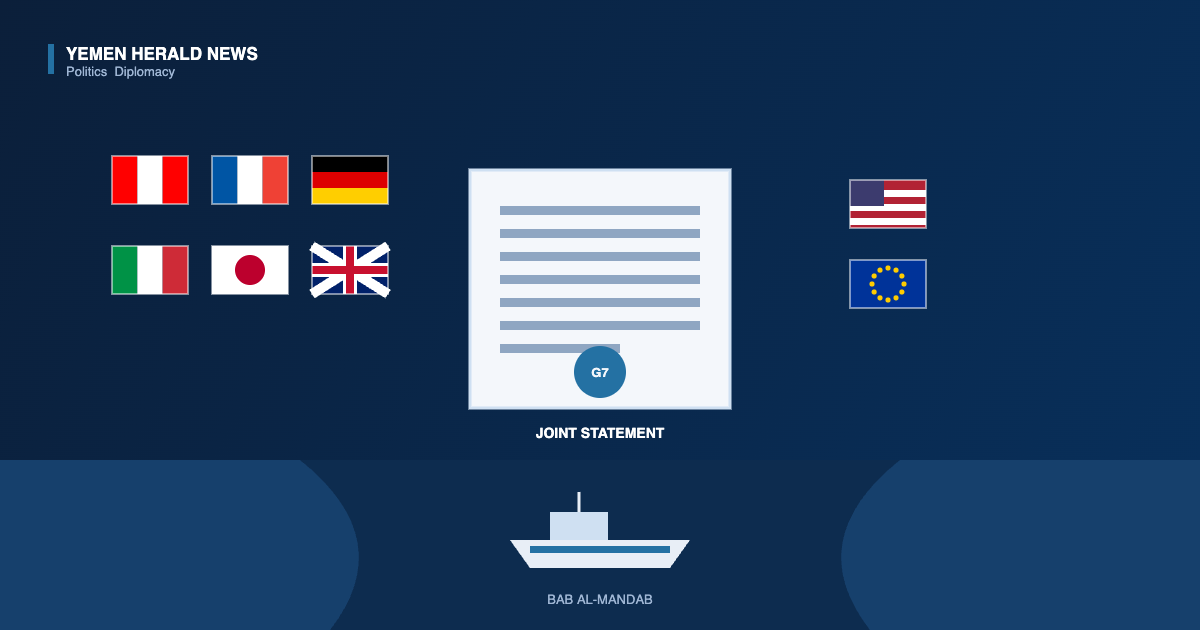
NEW YORK, United States — G7 foreign ministers condemned Houthi attacks on Saudi Arabia and called on Iran to stop arming the group.
The ministers issued a joint statement after an informal meeting on the sidelines of the UN General Assembly on 21 September.
The 81st session of the UN General Assembly opened this month, bringing foreign ministers to New York.
Canada, France, Germany, Italy, Japan, the United Kingdom and the United States signed it, along with the European Union’s high representative for foreign affairs.
The statement was reported by Al Jazeera, The National and other international outlets, and carried in Yemen by the state news agency Saba.
The ministers said the situation in Yemen posed what they called an unacceptable threat to regional stability and security.
They extended that to global energy security and to rights and freedoms of navigation and maritime safety in the Red Sea and the Bab al-Mandab strait.
The group condemned attacks by the Houthis in Yemen and against Saudi Arabia, singling out those aimed at civilians and civilian infrastructure.
The ministers said such attacks added to the suffering of the population.
They urged the Houthis to halt military action and threats and attacks against civilian shipping.
The statement called on the group to return to the political process in good faith.
It asked Iran to stop arming and supporting the Houthis, citing Security Council resolutions.
The Security Council imposed a targeted arms embargo covering Houthi leaders in April 2015, under resolution 2216. A UN panel of experts reports to the council on compliance.
The ministers described Tehran’s backing as a pattern of escalation that risked damaging international trade.
They restated support for Yemen’s unity, sovereignty, independence and territorial integrity.
The statement expressed solidarity with the Yemeni government and with Saudi Arabia.
Iran denies arming the Houthis. The group says it acts independently of Tehran.
Yemen has been a standing item on the Security Council agenda through the war. The council renews the UN mission monitoring the Hodeidah agreement each year.
The Houthis reject the G7 characterisation of their campaign, and present their operations as a response to Saudi and Western action.
The statement followed three weeks of Houthi advances on Yemen’s western coast.
The group opened an offensive against the Presidential Leadership Council on 3 September. The first clashes were in Taiz governorate.
The Houthis broke into al-Waziyah district on 9 September and took Jabal al-Nar, a mountain east of Mokha, along with the Khalid ibn al-Walid camp.
That camp is the second-largest military base in Yemen.
They captured the port city of Mokha on 10 September, Al Jazeera reported. Mokha sits on the Red Sea coast in Taiz governorate.
Perim Island, which lies in the Bab al-Mandab strait, followed on 11 September.
The Hanish Islands were taken afterwards, leaving the Red Sea coast in Houthi hands apart from Midi district.
The Houthis named the campaign Operation God is Stronger in Might and More Severe in Punishment.
Bab al-Mandab links the Red Sea and the Gulf of Aden. Traffic between Europe and Asia passes through it toward the Suez Canal.
Egypt has reported lower Suez Canal revenue since attacks on Red Sea shipping began in late 2023, as carriers rerouted around southern Africa.
The Houthis later declared a blockade on shipping they associate with Saudi Arabia.
They said they attacked Riyadh and an Aramco facility at Yanbu. The Saudi-led coalition said it intercepted a ballistic missile aimed at the Saudi capital.
The UN Security Council condemned Houthi attacks on Saudi Arabia earlier in the month.
The European Union naval mission Aspides raised its alert level in the Red Sea this month.
The bloc launched Aspides in February 2024, after attacks on merchant shipping in the corridor. It escorts vessels through the Red Sea and the Gulf of Aden.
Displacement has risen since the offensive began. UN agencies reported about 112,000 people displaced in two weeks of fighting.
A Yemeni government unit put the figure at close to 147,000 over 18 days.
The UN refugee agency allocated 2 million dollars for the latest wave.
More than 22 million people in Yemen need assistance, according to the UN humanitarian office’s March 2026 response plan.
That plan recorded 18.3 million people as acutely food insecure.
It counted more than 2.2 million children under five as acutely malnourished, including 516,157 with severe acute malnutrition.
It listed 5.2 million internally displaced people, a count that predates the September fighting.
The plan sought 2.16 billion dollars to reach 12 million people.
The World Health Organization has said nearly 20 million people in Yemen need health assistance.
The internationally recognised government has operated from Aden since it lost Sanaa to the Houthis in September 2014. A Saudi-led coalition intervened in March 2015.
The Presidential Leadership Council took power in April 2022, when Abd Rabbu Mansour Hadi transferred his authority to the eight-member body. Rashad al-Alimi chairs it.
The G7 groups Canada, France, Germany, Italy, Japan, the United Kingdom and the United States. The European Union takes part in its meetings. The bloc has no permanent secretariat and issues statements by consensus.
The statement did not announce any new measure against the Houthis or Iran. It set no deadline.
About the Author