Planning Minister Mohammed al-Faqmi presses WFP and UN agencies on camp funding
 Yemen Herald News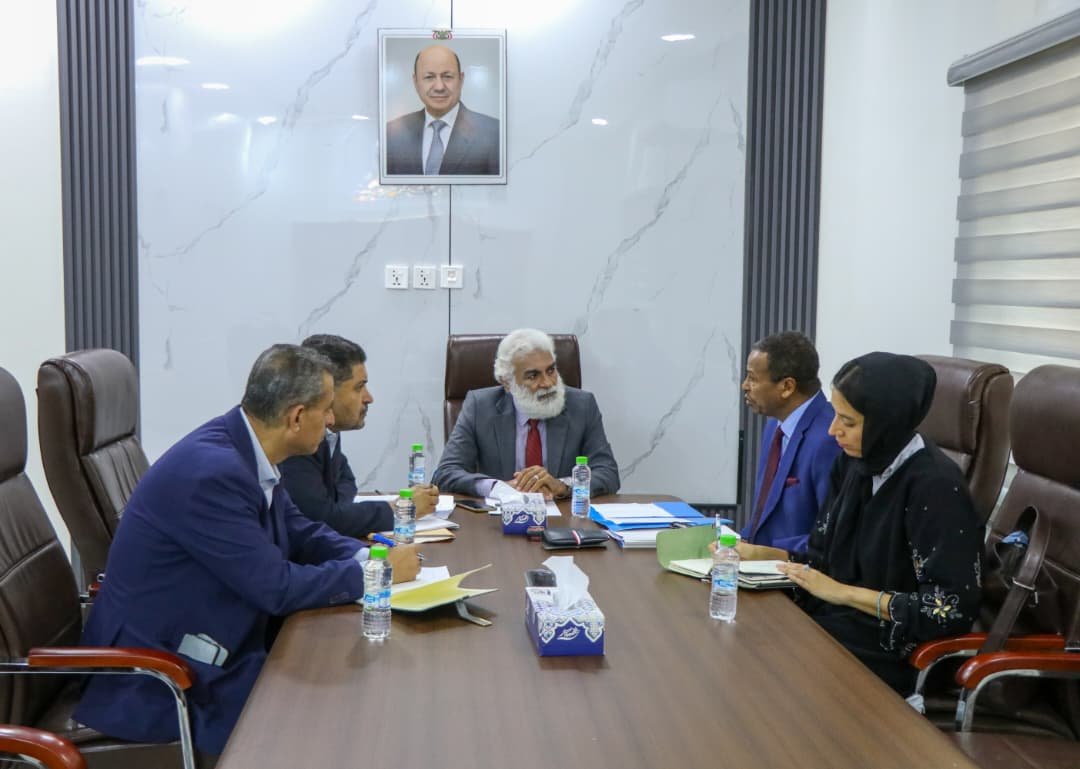
ADEN, Yemen — Yemen’s planning minister asked the World Food Programme on Wednesday to raise funding for camps sheltering people displaced by fighting on the west coast.
Mohammed al-Faqmi met El-Khidir Daloum, the agency’s representative and country director in Yemen, in Aden, the state news agency Saba reported.
The Ministry of Planning and International Cooperation published its own readout of the meetings. No independent account has appeared, and the agencies involved have not issued summaries of their own.
Al-Faqmi asked for more money for humanitarian and development work, with food security, livelihoods and vulnerable groups as the priorities, according to the ministry.
Talks covered food assistance and cash support for families living in camps.
The two also discussed directing available funding towards priority projects, the ministry said.
Al-Faqmi said government agencies and international partners needed closer coordination to respond quickly.
He asked for better basic services in the camps, naming food, water, health care and protection.
Aid should reach those most in need, he said.
The minister held two further meetings the same day.
He met UNICEF’s acting representative in Yemen, whom Saba named in a transliteration Yemen Herald could not verify against the agency’s own listings.
UNICEF names Peter Hawkins as its representative in the country.
That meeting covered expanding UNICEF programmes in line with humanitarian needs and government priorities, according to the ministry.
Multi-sector programmes and cooperation with government bodies were discussed, it said.
Al-Faqmi also met Dina Zorba, UN Women’s representative in Yemen.
They discussed support for women through development programmes and projects, the ministry said.
Both sides said women’s needs should be built into development and humanitarian response plans.
They also discussed women’s participation in economic and social recovery, particularly among the displaced.
Zorba has headed UN Women’s office in Yemen since December 2014 and also serves as its country representative in Iraq.
Daloum, a Sudanese national, took up the Yemen post in March.
He was WFP’s country director in Somalia from September 2021 until January, and in Uganda from November 2016 to July 2021.
WFP said this month it was scaling up its response in Yemen as fighting displaced thousands of people.
The agency has sought 274 million dollars in urgent funding to sustain its Yemen operations.
It estimated that 125,000 people had been displaced in a matter of days.
WFP said it had delivered food assistance to 45,000 of them at that point.
It later put the number reached with hot meals and food commodities at about 60,000.
The agency said it was preparing to assist a further 1.5 million people should the fighting widen.
Its Yemen operation is running on critically low funding, which the agency said could limit how quickly and how widely it responds.
WFP says more than 18 million people in Yemen, about half the population, face acute food insecurity.
It puts the number of acutely malnourished children under five at 2.2 million, half a million of them severely.
The meetings follow a sharp rise in displacement on the Red Sea coast.
A government unit said nearly 147,000 people were displaced in 18 days.
UN agencies put the figure at 112,000 over two weeks.
The UN refugee agency said this week that nearly 100,000 more people could be displaced within three months.
It has allocated 2 million dollars for the current wave.
The UN humanitarian office said 18,000 displaced families had received assistance on the west coast.
Al-Faqmi met Karen Perrin, the head of that office in Yemen, in Aden on Monday.
That meeting covered emergency assistance, shelter materials and food supplies, Saba reported at the time.
The wider relief operation remains one of the largest anywhere.
More than 22 million people need humanitarian assistance, according to the UN humanitarian needs and response plan published in March.
The plan puts the number of acutely food insecure at 18.3 million and the number of people displaced inside the country at 5.2 million.
More than 2.2 million children under five are acutely malnourished, it says, 516,157 of them severely.
Aid agencies are seeking 2.16 billion dollars this year to reach 12 million people.
UNICEF is asking for 146.3 million dollars of that to reach 5.2 million people, among them 3.5 million children.
Its request is 31 per cent smaller than the one it made in 2025.
Funding shortfalls have narrowed aid operations across the country.
Aid delivery in the north is further constrained by the detention of humanitarian staff.
Human Rights Watch said 73 United Nations employees remained in Houthi custody as of February, all of them Yemeni nationals.
Seven of those held had been released by June, according to the group.
The war began in 2014, when the Houthis took Sanaa. A Saudi-led coalition intervened the following March.
Zorba is Jordanian and worked with UNIFEM, UNFPA and UNESCO before joining UN Women.
She has worked on gender equality and human rights for more than 20 years.
The planning ministry is the government’s channel for donor coordination in Aden.
Al-Faqmi has held the planning portfolio in the government seated in Aden.
The Ministry of Planning and International Cooperation coordinates the government’s dealings with donors and UN agencies.
Aden has served as the seat of the internationally recognised government since 2015.
About the Author