Abdullah al-Alimi Bawazir asks UNICEF to widen child protection work in Yemen
 Yemen Herald News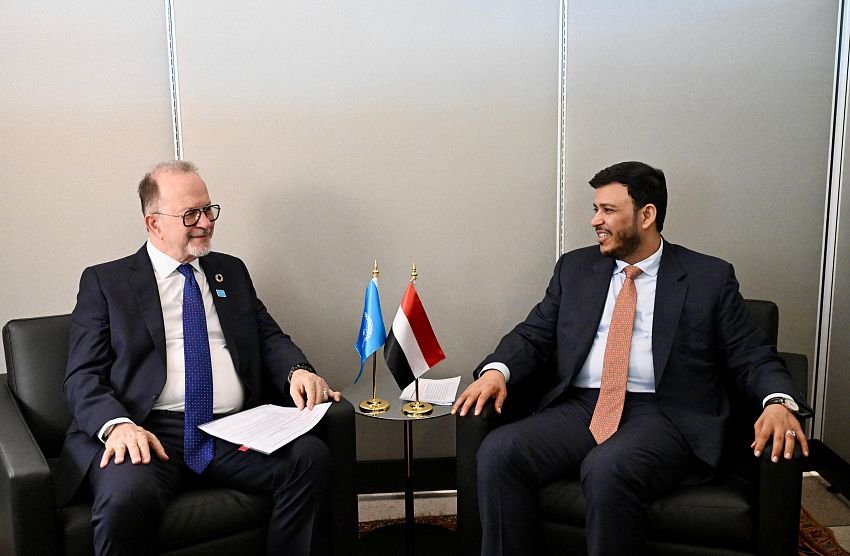
NEW YORK, United States — A member of Yemen’s Presidential Leadership Council asked UNICEF to widen its child protection work in areas hit by fighting, at a meeting in New York.
Abdullah al-Alimi Bawazir met Ted Chaiban, UNICEF’s deputy executive director for humanitarian action and supply operations, the state news agency Saba reported.
The account of the meeting rests on Saba, which carried the Yemeni readout. UNICEF has not issued a summary of its own and no independent account has been published.
Al-Alimi praised the agency’s work in child protection, health, nutrition, education and water, Saba said.
He asked for closer cooperation with the government, and for more attention to areas affected by fighting and to displacement camps.
He also asked for support to national institutions so services could be sustained, according to the agency.
He said escalation by the Houthis had caused casualties and displacement and had added pressure on host communities and basic services.
The Houthis dispute the government’s account of the fighting and describe their operations as a response to foreign-backed aggression.
Children, women and displaced people were among those worst affected, al-Alimi said.
He called for more effort to prevent the recruitment of children and to keep schools out of the conflict, Saba reported.
He asked for stronger monitoring and documentation of child protection cases.
He called for safe, sustained and unhindered humanitarian access across the country.
He also asked for the immediate and unconditional release of detained UN and humanitarian staff.
Chaiban said UNICEF would continue its work in Yemen, according to the agency.
He said the response should move from short-term relief toward longer-term work that links humanitarian and development programmes.
He named health, nutrition, education and child protection as the areas for that shift.
Chaiban said he was concerned about the continued detention of more than 73 UN personnel by the Houthis, among them 10 UNICEF staff, Saba reported.
Human Rights Watch put the number of UN staff held at 73 as of February 2026, all of them Yemeni nationals.
The detentions began with raids from 31 May 2024, when 13 UN staff and at least 50 staff of Yemeni and international organisations were taken, the group said.
Seven had been released by June 2026, according to Human Rights Watch.
UN Secretary-General Antonio Guterres has condemned the detentions and demanded that those held be freed.
UNICEF says 10.8 million children in Yemen needed humanitarian assistance at the start of 2026.
About 500,000 children are projected to suffer severe wasting this year, according to the agency’s appeal.
The same document puts the share of children affected by wasting at 17 per cent, stunting at 49 per cent and underweight at 41 per cent.
More than 7 million children face protection risks including violence, exploitation and explosive ordnance, UNICEF says.
It puts the number of children out of school at 4.5 million.
The agency is seeking 146.3 million dollars this year to reach 5.2 million people in Yemen, among them 3.5 million children.
That request is 31 per cent smaller than its 2025 appeal.
The United Nations verified 742 grave violations against 652 children in Yemen during 2025.
Those included the killing of 150 children and the maiming of 281.
The UN verified the recruitment and use of 262 children over the same period.
It attributed 135 of those cases to the Yemen Armed Forces and affiliated forces and groups, and 127 to the Houthis.
Fifty-two boys who had been recruited were later killed or maimed, according to the verification.
Armed forces and groups released 115 children.
The UN also verified the rape of 12 children, 10 attacks on schools and hospitals, and the military use of 71 schools and hospitals.
It recorded 27 incidents in which humanitarian access was denied.
The Secretary-General’s 2026 annual report on children and armed conflict lists the Houthis for killing and maiming and for the recruitment and use of children.
It also lists al-Qaida in the Arabian Peninsula and pro-government militias for recruitment and use.
The wider relief operation is larger still.
More than 22 million people need humanitarian assistance, according to the UN humanitarian needs and response plan published in March 2026.
That plan puts the number of acutely food insecure at 18.3 million and the number of people displaced inside the country at 5.2 million.
More than 2.2 million children under five are acutely malnourished, it says, 516,157 of them severely.
The appeal seeks 2.16 billion dollars to reach 12 million people.
Al-Alimi Bawazir is one of eight members of the Presidential Leadership Council, the body formed in April 2022 to lead the internationally recognised government.
The council took over the powers of President Abed Rabbo Mansour Hadi in April 2022 and is chaired by Rashad al-Alimi.
Yemen’s war began in 2014, when the Houthis took Sanaa. A Saudi-led coalition intervened the following March.
UNICEF runs nutrition, water and immunisation programmes in areas held by both sides, according to its appeal documents.
Yemeni officials have held a series of meetings in New York this week.
Chaiban, a Lebanese national, was appointed to his post by Guterres in May 2023.
He previously served as UNICEF’s regional director for the Middle East and North Africa.
About the Author