Masam says it cleared 5,164 mines and explosive remnants in Yemen in 25 days
 Yemen Herald News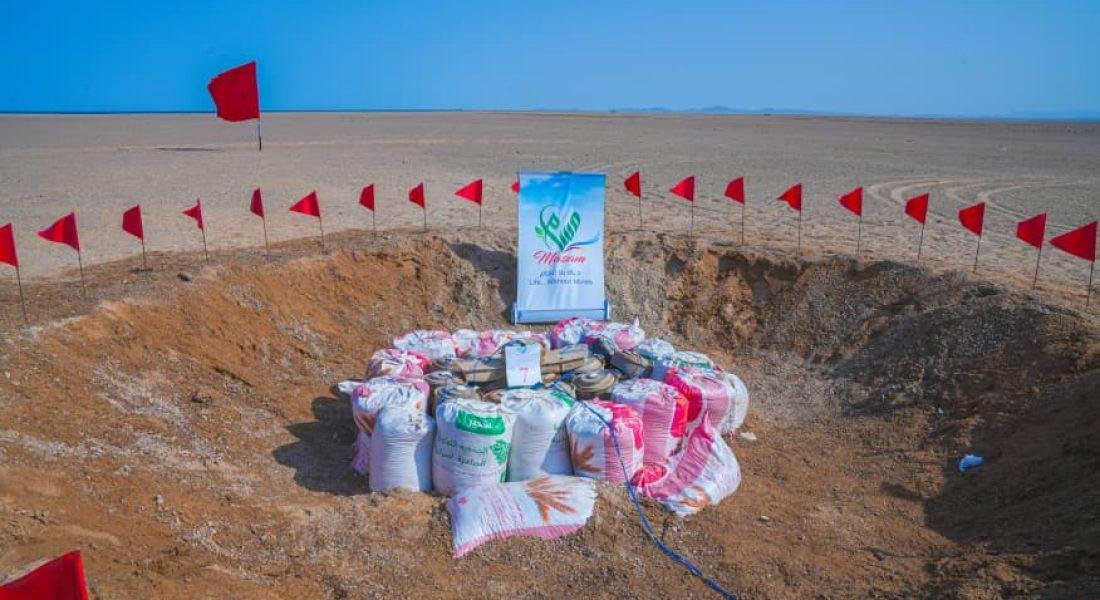
ADEN, Yemen — A Saudi-funded demining project said it cleared 5,164 landmines, unexploded shells and improvised explosive devices from Yemeni land in the first 25 days of September.
The Saudi Project for Landmine Clearance in Yemen, known as Masam, gave the figure in a statement carried by the state news agency Saba on 28 September.
The breakdown was 4,452 items of unexploded ordnance, 631 anti-tank mines, 60 anti-personnel mines and 21 improvised explosive devices.
The project publishes running tallies through the month. It reported 2,166 items on 13 September and 3,887 on 20 September before the figure reached 5,164.
Masam said its teams have removed 593,489 explosive items since the project began work in mid-2018. It put the total area cleared over that period at 85,812,262 square metres.
Its cumulative count stood at 590,491 on 11 September and 592,212 a week later.
The project is funded by the King Salman Humanitarian Aid and Relief Centre, the Saudi government’s aid agency, which describes Masam as its landmine clearance programme in Yemen.
Ousama Algosaibi, the project’s managing director, said the number of operational teams was increased to 42 last year in response to demand for clearance work.
“There is not a single part of Yemeni territory that can be considered safe from the threat of Houthi mines,” Algosaibi said in remarks published by the project.
That characterisation is contested. Yemen Herald found no public response from the Houthi administration in Sanaa to the project’s account of who laid the mines.
Algosaibi said mines had been found in schools, on farms, at water wells and on roads. He said the victims were often children, women and elderly people.
The managing director said Masam had lost 33 of its personnel in eight years of work.
The project’s recent field reports name Hajjah, including Midi district, along with Marib and Taiz among the areas where teams have worked this year.
Masam says it operates in what it calls Yemen’s liberated areas, the territory held by the internationally recognised government and forces aligned with it. It does not work in areas under Houthi control.
The project’s own published accounts put clearance between June 2018 and June 2026 at 567,182 items.
That total included 151,554 anti-tank mines, 7,358 anti-personnel mines, 8,464 improvised explosive devices and 399,806 items of unexploded ordnance. Teams had cleared 81,343,277 square metres of land by the end of that period, the project said.
The September figures were not independently verified. The account rests on Masam and on the Saudi relief centre that funds it, and no independent confirmation of the monthly tally has been published.
Other bodies have recorded the toll the ordnance takes. Save the Children said in July that more children were killed by landmines and unexploded ordnance in the first half of 2026 than in the whole of 2025.
The organisation put the number of children killed or wounded between January and June at 45, of whom 20 died. Its account cited cases in Aden and Taiz.
“No child should have to risk their life to help feed their family or lose a limb because deadly weapons contaminate the areas where they live, play, and are forced to work,” said Inger Ashing, the group’s chief executive.
The Yemen Executive Mine Action Centre, the national demining body, has put the number of civilians killed by landmines over the course of the war at about 10,000. That figure has not been independently audited.
The centre has also said its clearance work continues despite a shortage of funding.
Al Jazeera reported in April that Yemen’s landmine problem had persisted through a truce and years of clearance operations.
Yemen has been at war since 2014, when Houthi forces took Sanaa. A Saudi-led coalition intervened the following March. Front lines have shifted repeatedly since, leaving ordnance behind each time.
Yemen is a party to the Anti-Personnel Mine Ban Convention. It ratified the treaty in September 1998, and the convention entered into force for the country in March 1999.
Article 5 of the convention obliges states to clear mined areas in their territory. Yemen has sought four extensions to that obligation.
The first, granted in 2008, moved the deadline from 2009 to 2015. Later requests pushed it to 2020 and then to 2023.
States parties granted a fourth extension in November 2022, setting a deadline of 1 March 2028. Yemen filed an updated work plan in April 2024.
The United Nations Office for the Coordination of Humanitarian Affairs said in its March 2026 plan that more than 22 million people in Yemen need aid.
It put the number of acutely food insecure at 18.3 million, and the number of children under five who are acutely malnourished at more than 2.2 million, of whom 516,157 are severely malnourished.
The office recorded 5.2 million people displaced inside the country, and appealed for 2.16 billion dollars to reach 12 million of them.
Fighting this month has added to that figure. The International Organization for Migration said nearly 130,000 people had been displaced by the escalation, drawing on its own displacement tracking data.
Mines and unexploded ordnance obstruct the return of displaced families to farmland and villages once fighting moves on.
The project runs its Yemen operations from Aden.
About the Author