Drone Attacks on UAE Consulate in Erbil Draw Condemnation Across the Region
 Yemen Herald News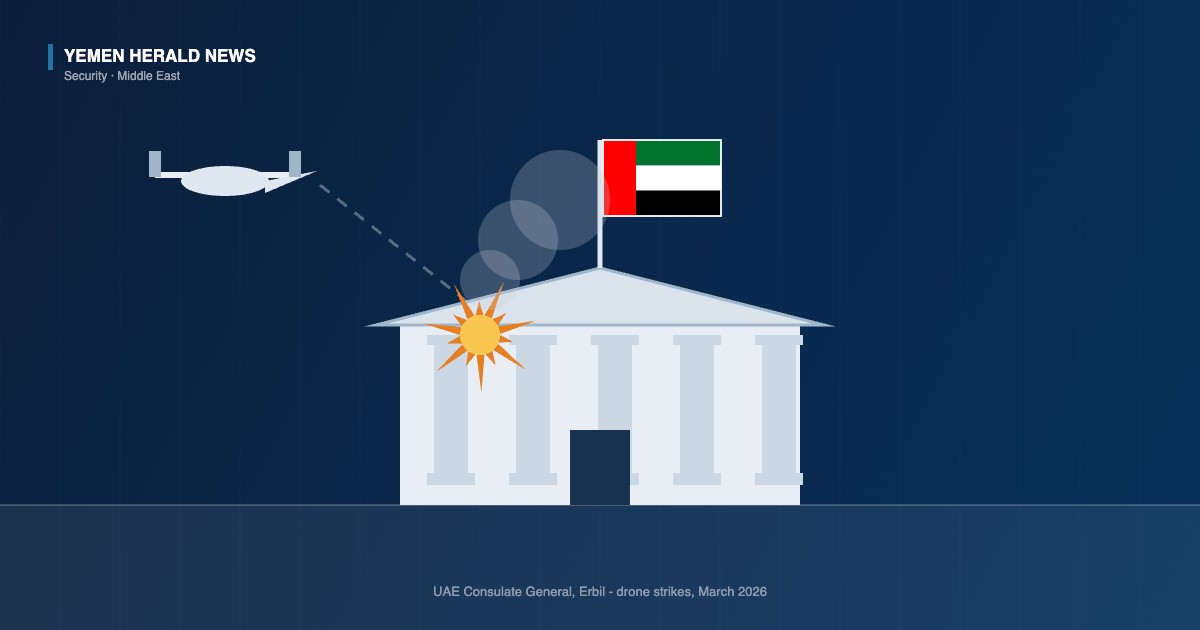
The United Arab Emirates’ consulate general in Erbil was struck by drones twice in less than a week in March 2026, injuring two members of its security staff, damaging the building and drawing condemnation from Gulf and Arab governments as well as from the Kurdistan Regional Government and the Gulf Cooperation Council.
The first strike came early on 10 March. The Emirati foreign ministry said the mission in the capital of Iraq’s Kurdistan Region had been targeted by a drone, causing material damage but no casualties. The second attack followed on 14 March and was more serious: two members of the consulate’s security detail were wounded and the building sustained significant structural damage. Abu Dhabi described the second strike as a treacherous and unprovoked terrorist act and a flagrant violation of the Vienna Convention on Diplomatic Relations, and called on both the Iraqi federal government and the Kurdistan Regional Government to investigate, identify those responsible and prosecute them.
The Kurdistan Regional Government denounced the attacks in unusually direct terms, characterising them as a terrorist act and a sabotage operation and describing them as a blatant violation of international law and of the sovereignty of the Kurdistan Region and of Iraq. Prime Minister Masrour Barzani condemned the strike publicly, saying such attacks were unacceptable and would not deter the region. The regional authorities urged the federal government in Baghdad to take responsibility for the activities of what they called illegal groups and militias operating across Iraq.
Condemnation from other capitals followed quickly. Saudi Arabia and Jordan both issued strong statements, stressing that attacks on diplomatic missions violate international law and long-standing diplomatic conventions; Jordan’s foreign ministry noted the injuries to the two security personnel and the damage to the building and expressed solidarity with the UAE. Qatar’s foreign ministry called the incident an unacceptable act that breached the conventions protecting diplomatic premises and warned that it represented a dangerous escalation in an already strained regional environment.
Jasem Mohamed Albudaiwi, the secretary-general of the Gulf Cooperation Council, condemned the assault as a grave violation of the Vienna Convention and a serious threat to the safety of accredited diplomats, and reiterated the council’s solidarity with the UAE against violence and terrorism. The uniformity of the responses reflected how little ambiguity states allow themselves on this particular question, whatever their other disagreements.
The legal framework is unusually clear. Under Article 22 of the 1961 Vienna Convention on Diplomatic Relations, the premises of a mission are inviolable, and the state hosting that mission carries a specific duty to take all appropriate steps to protect the premises against intrusion or damage. Consular posts enjoy comparable protection under the parallel 1963 convention on consular relations. An attack on a consulate is therefore not merely an assault on a building but a breach of an obligation owed by the host state, which is why the Emirati statements were addressed as much to Baghdad and Erbil as to the unidentified attackers.
No group publicly claimed responsibility for either strike in the immediate aftermath, and the available reporting did not attribute them to a named party. Erbil has been a recurring target for years. In March 2022 Iran’s Revolutionary Guard claimed a ballistic missile attack on the city, saying it had struck an Israeli-linked site, and facilities in and around Erbil International Airport hosting international forces have been hit repeatedly by rockets and armed drones. The pattern has generally involved deniable, low-cost systems launched from Iraqi territory, which is precisely what makes attribution slow and formal accountability rare.
The choice of weapon matters as well. Small one-way attack drones have become the default instrument for strikes of this kind across Iraq, Syria and the Gulf because they are cheap, difficult to trace back to a launch site and hard to intercept over a city without risking debris on the streets below. Conventional air defences are built around faster, higher-flying threats, while the systems that work best against slow, low-altitude drones are short-range and must be positioned close to whatever they are protecting. Defending a consulate in a crowded urban centre is therefore a political and practical problem as much as a technical one.
The timing placed the attacks inside a far wider regional confrontation. By March 2026 Israeli and American strikes on Iran that had begun at the end of February were under way, Iranian forces had declared the Strait of Hormuz closed, and attacks on shipping and on installations across several countries had multiplied. Iraq sits between those pressures, and Erbil’s relative stability and its role as a base for foreign missions and companies have repeatedly made it a place where regional scores are settled at someone else’s expense.
For the UAE the practical question after March was whether a diplomatic presence in Erbil could be maintained safely. Abu Dhabi has cultivated commercial and political ties with both Baghdad and the Kurdistan Region, and withdrawing a mission would concede something to whoever launched the drones. The Emirati response, demanding investigation and prosecution rather than announcing any drawdown, indicated an intention to stay. Whether the investigations it called for produced findings remained, at the time of reporting, unresolved.
About the Author