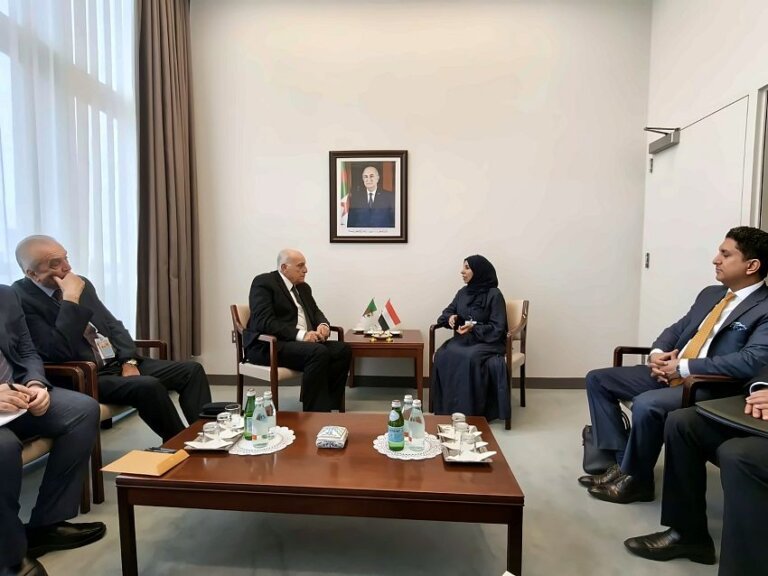
Displacement minister Waleed al-Abara discusses policy frameworks with IOM’s Abdusattor Esoev
 Yemen Herald News
ADEN, Yemen — Yemen’s minister of state for displacement met the International Organization for Migration’s head of mission in the country on Thursday, the state news agency Saba said.
Waleed al-Abara held the talks with Abdusattor Esoev, according to that report.
The two discussed strengthening cooperation and coordination and developing the institutional and legal frameworks that govern displacement and irregular migration, Saba said.
Yemen Herald could not independently confirm the meeting. The account rests on Saba, Yemen’s state news agency, and no independent confirmation has been published.
The meeting reviewed IOM’s humanitarian work in Yemen, according to the agency. That included the organisation’s programmes for collecting and analysing displacement data and its work on irregular migration.
Al-Abara said the government is committed to addressing both issues, Saba reported.
He said the next phase would focus on establishing clear institutional frameworks to coordinate government efforts. He said it would also strengthen cooperation among the authorities and organisations involved.
The minister said Yemen plans to review and develop its national displacement policies. He said the government would prepare a comprehensive law regulating the issue.
Saba did not say when that law would be drafted or which body would write it.
The talks follow a rise in displacement reported by UN agencies this month.
More than 112,000 people were displaced across Aden, Hodeidah, Abyan and Taiz in the two weeks after clashes broke out between government forces and the Houthis, aid agencies said at a briefing in Geneva on 18 September.
Nearly 4.8 million Yemenis had already been displaced by years of conflict, economic collapse and environmental disaster, according to UNHCR, the UN refugee agency.
Esoev said at that briefing that IOM’s supplies were running down. “Our resources are very, very, very limited and our stocks will be depleted very soon,” he said.
He called on the international community “to come to Yemen’s aid” with food, shelter, health, water and sanitation for those uprooted by the fighting.
Esoev described a woman with four small children who was displaced in Taiz and gave birth in the open, “without shelter, medical care and any other assistance”.
Her family found a torn piece of plastic tarpaulin “barely covering their heads”, he said. “These are the real cases that we are seeing in the field.”
More than 3,000 people have crossed the Bab al-Mandab strait to Djibouti since the escalation, according to the UN. Most arrivals were reported at Obock, Khor Angar, Moulhoule and Godoria.
Alexandre Coissac, IOM’s chief of mission in Djibouti, said those arrivals were a challenge to “a generous country that is already hosting a large number of refugees”.
Sandrine Desamours, UNHCR’s representative in Djibouti, said arrivals at reception centres described fleeing bombardment, shelling and gunfire. She said some were arriving for a second time, having already left Yemen during the 2015 crisis.
Many of the men who arrived had left relatives behind and hoped to return for them, Desamours said. She said a fuel shortage in Yemen was preventing those journeys.
The Djibouti coast guard has supplied fuel to some boats stranded at sea and towed others to shore, according to Desamours.
Francesco Galtieri, UNFPA’s country representative, said the agency was concerned for households in which mothers are the sole breadwinners. He cited a woman in Ras al-Ara who fled Mokha with four daughters under shelling and was burned as she ran.
Shabia Mantoo, a UN spokeswoman, called on all parties and those with influence over them to de-escalate, protect civilians and allow humanitarian access. She said preventing further loss of life must take precedence.
Before the latest escalation, nearly half of Yemen’s 41 million people needed aid, according to the Integrated Food Security Phase Classification platform. It found one in two people in government-controlled areas facing high levels of hunger.
The UN humanitarian response plan for Yemen, issued in March, records more than 22 million people in need of assistance.
The plan lists 18.3 million people as acutely food insecure. It records more than 2.2 million children under five as acutely malnourished, of whom 516,157 are severe cases.
It counts 5.2 million internally displaced people. The appeal seeks 2.16 billion dollars to reach 12 million of them.
The World Health Organization said Yemen faces concurrent health risks including cholera, measles, dengue, diphtheria, malnutrition and trauma.
In an assessment carried out before the escalation, only 60 of more than 5,000 health service delivery units were fully functioning, WHO spokesman Tarik Jasarevic told reporters in Geneva.
Aid delivery in Houthi-controlled areas has become “untenable”, Alessandra Vellucci, director of the UN Information Service in Geneva, said this month. She said UN staff had been detained and UN premises occupied.
Vellucci said 73 UN personnel remain arbitrarily detained by the Houthi authorities, some of them since 2021. She said five former UN staff and dozens of personnel from non-governmental organisations, civil society groups and diplomatic missions were also held.
Al-Abara’s portfolio covers irregular migration as well as displacement. Yemen sits on a route used by migrants travelling from the Horn of Africa toward Gulf states.
Esoev came to Yemen from Bangladesh, where he headed IOM’s largest mission in the Asia Pacific region. That operation supported more than a million Rohingya refugees in Cox’s Bazar.
About the Author