Afrah al-Zouba tells LDC ministers Yemen needs recovery aid, not only emergency relief
 Yemen Herald News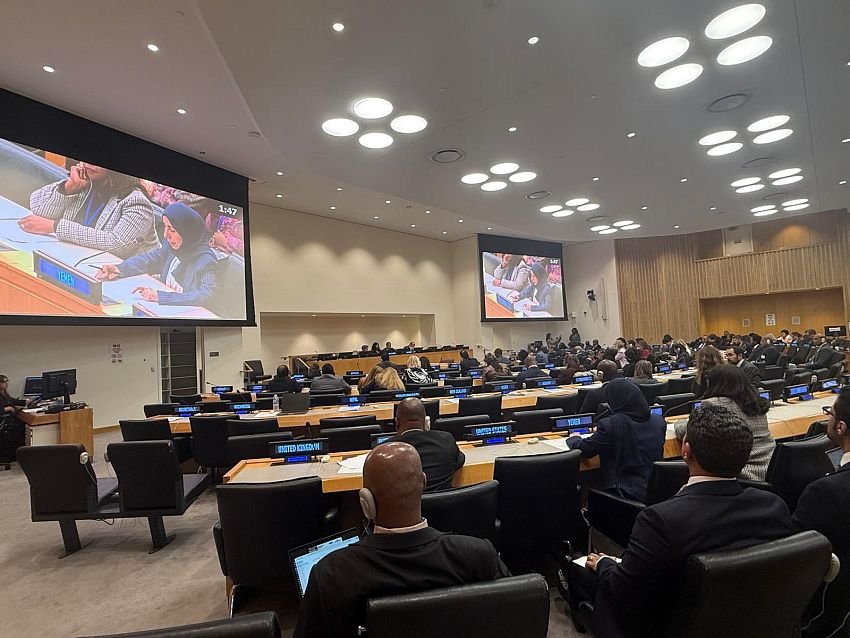
NEW YORK, United States — Yemen’s foreign minister asked an annual meeting of least developed countries for reconstruction and recovery aid, not only emergency humanitarian relief.
Afrah al-Zouba headed Yemen’s delegation to the yearly ministerial meeting of foreign ministers of the least developed countries, held on the sidelines of the 81st session of the UN General Assembly in New York. The state news agency Saba reported her remarks on Sept. 24.
She said economic, humanitarian and development pressures on Yemen and on other countries in the group were growing, according to the agency.
Al-Zouba called for assistance that extends beyond emergency aid to economic recovery, reconstruction, institutional support and development, Saba said.
She said sustainable development in Yemen depends on restoring state institutions, strengthening the rule of law and achieving security and stability.
The minister described the effect of the Houthi takeover and the conflict on Yemen’s infrastructure, public services, economy and living conditions, the agency reported.
She said the country continues to face one of the world’s largest humanitarian crises.
The account rests on Saba, which is run by the internationally recognised government. Yemen Herald found no independent confirmation of the remarks, and no record of the meeting’s proceedings has been published.
Al-Zouba was appointed foreign minister on July 23, Al Jazeera reported. She is the first woman to hold the post.
She has kept a full schedule at this year’s assembly. Saba said she also took part in a coordination meeting of foreign ministers of the Organisation of Islamic Cooperation.
The agency said she joined a high-level meeting on the threats posed by rising sea levels, and discussed humanitarian response and food security in Yemen with the World Food Programme.
On Sept. 22 she called for the disarmament of non-state armed groups, including the Houthis, at a ministerial dialogue at the United Nations, Saba reported at the time.
Saba also said she restated Yemen’s support for Palestinian rights during the week, and praised Morocco’s positions on Yemen’s unity and territorial integrity.
Yemen sent a wider delegation to the assembly. Abdullah al-Alimi Bawazir, a member of the Presidential Leadership Council, held a series of meetings in New York, according to Saba.
The agency said Bawazir discussed Yemen and bilateral relations with Kuwait’s crown prince, and asked Britain to support Yemen’s coast guard.
He raised escalation around Bab al-Mandab with international officials and asked UNICEF to widen its child protection work in Yemen, Saba reported.
The least developed countries are a UN category of states judged to face the deepest structural obstacles to development.
The group’s current framework is the Doha Programme of Action for the decade 2022 to 2031. It was adopted on March 17, 2022, and endorsed by the General Assembly the following month.
The programme sets out commitments between the least developed countries and their development partners, including governments, the private sector and civil society.
The European Union mission to Yemen said this week it had signed three projects worth 24 million euros for the country’s farm sector.
Germany announced new environmental aid for Yemen at a cooperation conference in Berlin.
The ministers meet each year on the margins of the assembly’s general debate. The 2025 session was held on Sept. 26 and was addressed by the president of the General Assembly.
Yemen’s humanitarian position is set out in the UN humanitarian needs and response plan published in March. It puts more than 22 million people in need of assistance.
The plan records 18.3 million people as acutely food insecure. It says more than 2.2 million children under five are acutely malnourished, 516,157 of them severely.
It counts 5.2 million internally displaced people. The appeal seeks 2.16 billion dollars to reach 12 million of those in need.
The displacement figures have moved since the plan was published. The UN refugee agency said this month that nearly 100,000 more Yemenis could be displaced within three months.
A government unit reported nearly 147,000 people displaced in an 18-day period. The UN humanitarian office said aid agencies had reached 10.83 million people in Yemen this year.
The meeting came during a period of fighting on Yemen’s west coast. Al Jazeera reported on Sept. 11 that Houthi forces had taken control of the Red Sea coastline.
That advance gave the group Perim Island and the Hanish Islands and a position on the Bab al-Mandab strait, according to the same report. The Houthis seized the port city of Mokha in the same push.
Mokha sits on the Red Sea coast north of the strait. It had been held by forces aligned with the internationally recognised government.
Yemen’s foreign ministry welcomed statements on Bab al-Mandab issued during the assembly. Saba said 80 countries warned about the consequences of Houthi control of the strait for international navigation.
The Houthis reject the government’s account of the fighting and describe their coastal operations as a response to foreign intervention.
The assembly’s general debate opened in New York last week. Yemen’s delegation used the session to press for support for state institutions, according to Saba’s reporting through the week.
Al-Zouba did not give a figure for the assistance Yemen is seeking. Saba did not say which other ministers spoke at the meeting.
About the Author