Yemeni air defences say they downed a Houthi drone over Jabal Habashi in Taiz
 Yemen Herald News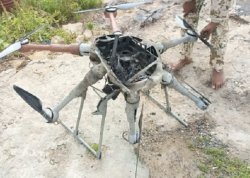
TAIZ, Yemen — Yemeni government air defences shot down a Houthi suicide drone over Jabal Habashi district, west of Taiz, on Thursday, the armed forces said.
The drone was destroyed before it reached its target, according to the account carried by 26 September, the newspaper of Yemen’s Defence Ministry.
No casualties were reported.
The statement did not identify the intended target, the model of the aircraft or the unit that engaged it.
That account rests on the Yemeni armed forces’ own statement, carried by the Defence Ministry newspaper 26 September and relayed by other outlets. No confirmation from an independent party has been published, and the Houthi authorities in Sanaa did not comment on it.
Jabal Habashi sits immediately west of Taiz city, on ground that has changed hands repeatedly since 2015.
The district lies along the approaches linking the city to the Red Sea coast.
Government forces said Houthi units launched coordinated attacks on Wednesday night against a road connecting three governorates.
Colonel Majid al-Nuzaili, a spokesman for the government forces, said the attacks struck the Wadi al-Maqatirah and Al Ahkum areas, Al Jazeera reported.
Government forces said they killed and wounded dozens of Houthi fighters at Al Ahkum. The Houthis dispute such tallies and publish their own.
Neither side’s figures for that engagement have been independently verified.
The army also said it turned back a Houthi infiltration attempt near the road connecting Taiz city to Lahj and Aden provinces.
Al-Nuzaili said government units struck Houthi elements in Mokha and Taiz and secured the Wadi al-Maqatra area and the Hayjat al-Abd road.
Clashes were reported the same week on the Haifan front.
The fighting around Taiz forms part of a wider escalation that began on 6 August.
The World Health Organization has recorded 674 people killed and nearly 3,000 wounded since that date, according to figures cited by Al Jazeera.
The United Nations has documented 32 civilian deaths since August, among them 15 children and three women.
At least 158,000 people have been displaced by the fighting.
Across the Taiz, western coast, al-Jawf, Marib and Dhalea fronts, Al Jazeera reported at least 194 people killed and 880 wounded over a two-week period to 10 September.
Taiz and the western coast lie roughly 60 kilometres from Bab al-Mandab, the strait linking the Red Sea to the Gulf of Aden.
Control of the heights and roads between Taiz and Mocha has been the immediate object of the fighting, according to the same report.
Heavy fighting this month has centred on the al-Barah and Maqbanah areas of Taiz, Al Jazeera reported.
Houthi forces captured a military base on high ground in the governorate during that period, according to the same report.
The Taiz to al-Makha corridor is a main supply route for government troops.
Al Jazeera reported that Houthi forces took Mocha on 9 September. The government has not confirmed losing the coastal town, and the claim has not been independently established.
Houthi commanders have sought to cut the supply routes between the coastal district and the Taiz military axis, the report said.
The Houthis have fired dozens of missiles and drones at Saudi Arabia in recent weeks, including a strike on Riyadh on Saturday, Al Jazeera reported.
Yahya Saree, the Houthi military spokesman, said the group had launched strikes on the Jazan region of Saudi Arabia against command centres and weapons depots.
Turki al-Maliki, spokesman for the Saudi-led coalition, said six ballistic missiles aimed at Taif and Yanbu were intercepted and destroyed.
Saudi aircraft flew five strikes on Kamaran Island in Hodeidah and four on the Qatabir and Marran districts of Saada, one of them hitting telecommunications infrastructure in Qatabir.
The two sides’ accounts of those exchanges have not been reconciled.
Bloomberg reported this month that the group is assembling missiles and drones inside Yemen from components sourced in China. The Houthis have not responded publicly to that report.
The government flew at least 15 strikes against Houthi positions, gatherings and vehicles in Taiz and Hodeidah on 5 September, Al Jazeera reported.
Earlier government strikes were reported on 13 July and 25 July.
More than 120 fighters had been killed since the Houthi offensive began, the broadcaster reported at the start of September.
Four civilians were killed and nine wounded on the Saturday that followed, according to the same account.
Mohammed al-Basha, a Yemeni American analyst and former embassy spokesman, told the broadcaster the strikes marked a change in how the government was using its remaining air capability.
Yemen’s air force flew MiG-21, MiG-29, Su-22 and F-5 aircraft before the war. How much of that fleet still flies has not been disclosed.
The humanitarian position has deteriorated as the fighting has widened.
The United Nations Office for the Coordination of Humanitarian Affairs said in its March 2026 plan that more than 22 million people in Yemen need assistance.
The same plan put 18.3 million people at acute food insecurity and more than 2.2 million children under five at acute malnutrition, 516,157 of them severely malnourished.
It counted 5.2 million internally displaced people and sought 2.16 billion dollars to reach 12 million of those in need.
Taiz has been among the governorates worst affected by displacement since the war began.
Aid agencies have reported disrupted access to clinics in districts near the front lines.
The armed forces published their account of the interception on Thursday. It ran to two sentences.
About the Author