Bawazir and Arab League chief Nabil Fahmy discuss Yemen and Red Sea security in New York
 Yemen Herald News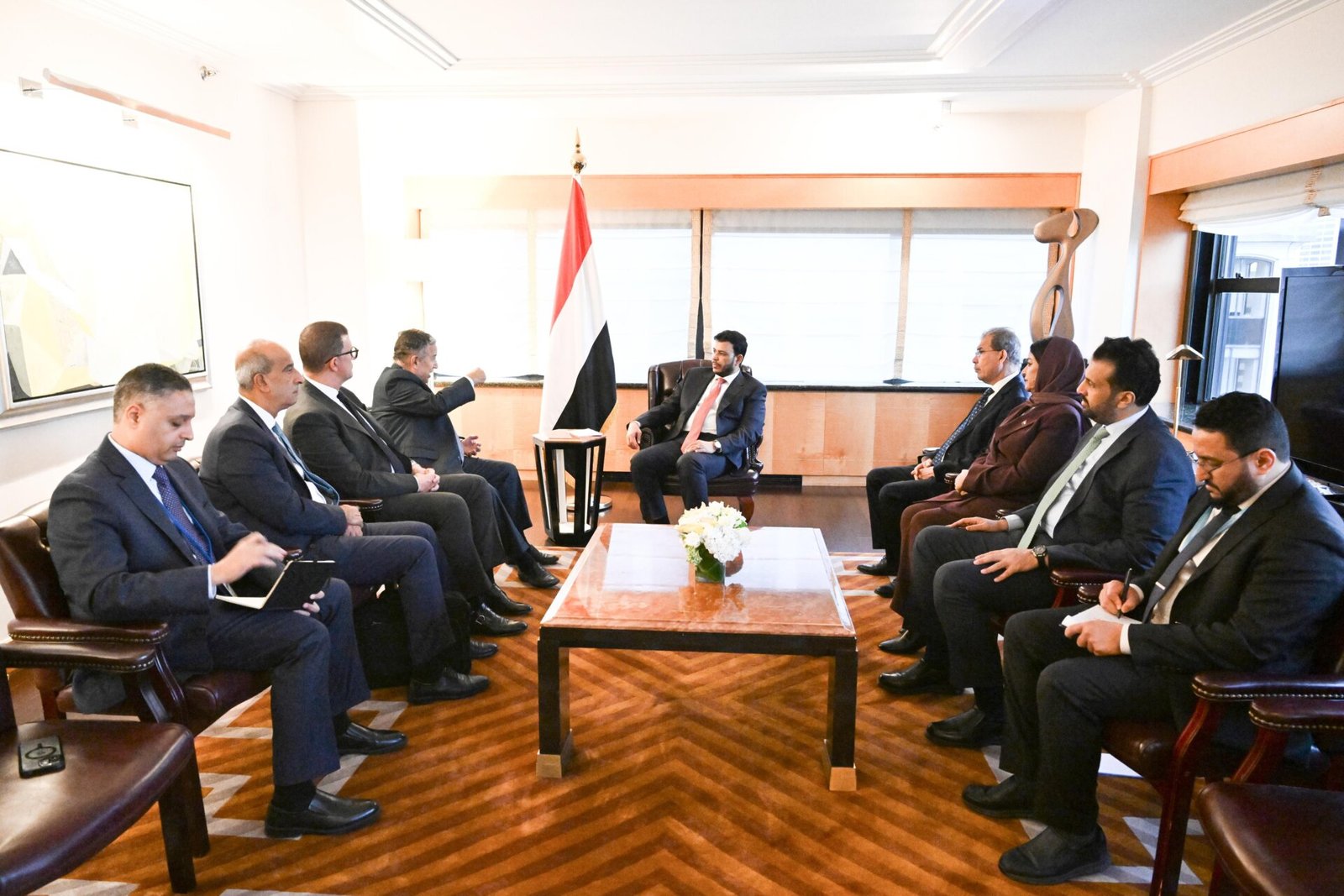
NEW YORK, United States — A member of Yemen’s Presidential Leadership Council told the Arab League’s secretary-general that Red Sea security is an Arab concern, not Yemen’s alone.
Abdullah al-Alimi Bawazir met Nabil Fahmy in New York, the Yemeni state news agency Saba reported Friday.
The two discussed Yemen’s political, security and military situation, regional stability, and what the agency described as Iranian interference in Arab affairs.
Bawazir said continued Iranian military, financial and technical support had allowed the Houthis to expand their capabilities beyond Yemen’s borders, according to Saba.
He said the security of the Red Sea, Bab al-Mandab and the Gulf of Aden formed an integral part of Arab national security, the agency reported. He argued the waterways could not be treated as a separate Yemeni concern.
Bawazir also called for rejecting the use of militias as instruments for pursuing external agendas at the expense of state institutions, Saba said.
Iran rejects such accounts. It has denied supplying weapons to the Houthis and says its support for the group is political.
The Houthi administration disputes the government’s characterisation of the fighting.
Fahmy reaffirmed the Arab League’s support for Yemen’s state institutions, according to the agency. It quoted him as rejecting attempts to impose realities by force or to undermine the authority of the state.
He stressed the importance of continued Arab coordination and joint action in support of Yemen and its national institutions, Saba said.
The account of the meeting rests on Saba, which is run by the internationally recognised government. Yemen Herald found no independent confirmation of the talks, and no second origin for the remarks attributed to either man.
Fahmy took over at the Arab League in July, succeeding Ahmed Aboul Gheit. He served as Egypt’s foreign minister earlier in his career.
He has spoken on Iran before. In July he said Iranian missile and drone attacks on Gulf Arab states and Jordan violated international law and the UN Charter and threatened regional security, stability and the freedom of international navigation.
He called then on the UN Security Council to take effective steps to halt the violations and to ensure respect for international law.
Those attacks struck United States military facilities in six Gulf Arab states and in Jordan.
The meeting took place during the 81st session of the UN General Assembly.
Yemen has drawn attention from other governments meeting in New York. G7 foreign ministers issued a statement on 22 September calling on Iran to end its arming of and support for the Houthis.
The ministers, from Britain, Canada, France, Germany, Italy, Japan and the United States, said they were alarmed by Houthi seizures of territory near Bab al-Mandab, which they called the gateway to a key global shipping route.
They said the escalation risked exacerbating the conflict, undermining international trade and creating global economic instability. The statement was issued on the sidelines of the assembly.
The statement came before Iranian President Masoud Pezeshkian was due to address the assembly.
Bawazir joined the Presidential Leadership Council on 7 April 2022, when Abdrabbuh Mansour Hadi transferred his powers to the eight-member body.
He had run Hadi’s office since November 2016. He was born in 1979 in Bayhan, in Shabwa governorate.
Earlier in his career he taught at the University of Aden and headed the Islah party’s political department in Aden governorate.
Bawazir comes from the Bawazir tribe. He holds a bachelor’s degree in general medicine and a master’s in management from Malaysia.
Inside the presidential office he had headed the department for local and civil society organisations in 2012 and served as deputy director in 2015.
The humanitarian picture behind the diplomacy was set out in the response plan published in March. It counted more than 22 million people in Yemen needing assistance and 18.3 million who were acutely food insecure.
The plan recorded 5.2 million internally displaced people. It sought 2.16 billion dollars to reach 12 million of them.
It put the number of children under five facing acute malnutrition at 2.2 million, with 516,157 of them severely malnourished.
Displacement has risen since. UNICEF said on Friday that nearly 130,000 people had been forced from their homes in the previous three weeks, among them an estimated 71,000 children.
More than one in four of nearly 2,900 children screened by the agency’s mobile teams in recent weeks were acutely malnourished, it said. More than 200 of them had severe acute malnutrition.
Akhil Iyer, UNICEF’s country representative in Yemen, gave the figures at a press briefing at the Palais des Nations in Geneva. He spoke by video link from Aden.
Iyer said children across Yemen were “yet again at the sharpest end of escalating conflict”.
The screening covered only areas where safe humanitarian access was possible, UNICEF said.
The agency said at least 15 children had been killed since 3 September, with 14 injured and three reported missing.
It said it was expanding its response around the fighting to reach up to 231,000 people.
UNICEF also counted 243 schools closed or with classes suspended, affecting more than 137,000 students.
Bawazir held other meetings in New York during the assembly. Saba reported separate talks with British officials and with Kuwait’s crown prince.
About the Author