Foreign Minister Afrah al-Zouba briefs OIC secretary-general on Yemen escalation
 Yemen Herald News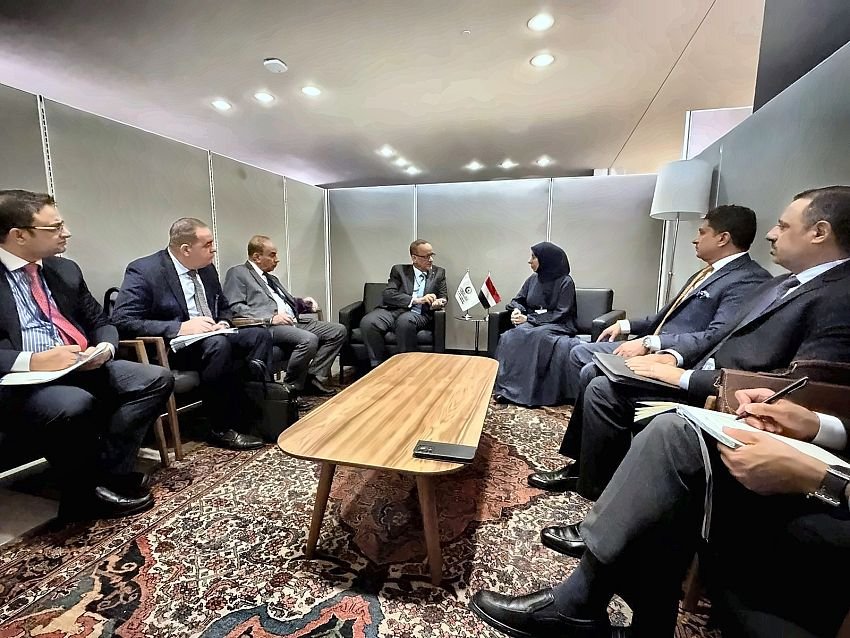
NEW YORK, United States — Yemen’s foreign minister, Afrah al-Zouba, briefed the head of the Organisation of Islamic Cooperation on the war in her country on Saturday.
She met Secretary-General Ismail Ould Cheikh Ahmed on the sidelines of the 81st session of the UN General Assembly, Yemen’s state news agency Saba reported.
The two discussed developments in Yemen and efforts to reach peace, security and stability, the agency said. They also discussed cooperation between Yemen and the organisation.
Al-Zouba set out the consequences of continued Houthi escalation for the humanitarian and economic situation in Yemen, according to Saba.
She also raised its consequences for regional security and for the safety of international navigation.
The minister praised the organisation’s positions in support of Yemen’s unity, sovereignty and territorial integrity, the agency said.
Ould Cheikh Ahmed affirmed the organisation’s support for Yemen’s internationally recognised government and for the Yemeni people, according to the same account. He backed efforts to reach peace.
The account of the meeting rests on Saba, the Yemeni government’s own news agency. Yemen Herald found no independent confirmation of it, and the organisation had published no readout of its own.
Ould Cheikh Ahmed took office on 28 August. He succeeded Hissein Brahim Taha of Chad.
The Mauritanian diplomat knows the file. He served as the UN special envoy for Yemen from 2015 to 2018.
The Organisation of Islamic Cooperation groups 57 member states. Its general secretariat is in Jeddah, Saudi Arabia.
The meetings come during an escalation that began in early September.
The UN Security Council issued a press statement on 18 September. Members condemned in the strongest terms continued Houthi attacks on Saudi Arabia, including attacks affecting civilian and energy infrastructure.
They expressed solidarity with Saudi Arabia and affirmed its inherent right to self-defence in accordance with international law.
Members said at least 125,000 people had been displaced across Yemen since early September, and that continued escalation would further exacerbate the humanitarian situation.
They stressed the importance of fully implementing Resolution 2216, adopted in 2015, and called for preventing the Houthis from acquiring arms and military assistance.
Council members reiterated their condemnation of attacks and threats against commercial shipping in the Red Sea and Bab al-Mandab.
They demanded the unconditional release of 73 detained UN personnel. They backed UN Special Envoy Hans Grundberg in his efforts towards a negotiated, inclusive, Yemeni-led and Yemeni-owned political settlement.
The Houthis reject the characterisation of the fighting offered by the government and its backers. They accused Saudi Arabia on 18 September of carrying out 26 airstrikes on areas under their control within 24 hours, and about 300 attacks across their territory in the previous week, Al Jazeera reported.
Yemen’s government said its forces killed 30 Houthi fighters and wounded more than 60 in clashes in the al-Waziiyah district of Taiz province over the same period, according to the same report. Yemen Herald has not independently verified either set of figures.
The Saudi-led coalition said on Saturday it had intercepted two ballistic missiles headed for Khamis Mushait and two drones aimed at the Riyadh region. Maj. Gen. Turki al-Maliki, its spokesman, announced the interceptions. No casualties were reported.
Abdullah al-Alimi Bawazir, vice-president of Yemen’s Presidential Leadership Council, addressed the General Assembly on 24 September.
Russian Foreign Minister Sergey Lavrov met al-Alimi Bawazir in New York on Saturday, both governments said. Russia’s foreign ministry said the talks covered the situation in Yemen and the escalation of tensions in the Persian Gulf region and the Red Sea.
“An entire generation was born amid war, grew up amid hunger, fear and weapons,” he told delegates.
“The path to a secure sea requires a stable Yemen. There is no stability in Yemen without restoring the state,” he said.
UNICEF said on 25 September that at least 15 children had been killed and 14 injured in Yemen since 3 September, and that three more were reported missing.
An estimated 71,000 children had been displaced in three weeks, the agency said. Akhil Iyer, its country representative in Yemen, gave the figures at a briefing at the Palais des Nations in Geneva. Yemen Herald has not independently verified the casualty count.
UNICEF said 243 schools had closed or suspended classes, affecting more than 137,000 students. It said more than 2.2 million children under five were projected to be acutely malnourished this year, more than half a million of them severely.
The UN humanitarian response plan for 2026, issued in March, puts more than 22 million people in Yemen in need of assistance and 18.3 million as acutely food insecure.
The plan records 5.2 million internally displaced people. It seeks USD 2.16 billion to reach 12 million of them.
Britain announced 10 million pounds in emergency aid for Yemen on 25 September, to be split between the World Food Programme, UNICEF and the International Organization for Migration.
Stephen Doughty, the UK minister for the Middle East, announced that package. The World Food Programme will receive 5.5 million pounds, UNICEF 3.5 million and the International Organization for Migration 1 million.
Grundberg has held the special envoy post since 2021.
The organisation was founded in 1969. It describes itself as the second largest intergovernmental body after the United Nations.
About the Author