Bawazir discusses Yemen and bilateral ties with Russian Foreign Minister Sergey Lavrov in New York
 Yemen Herald News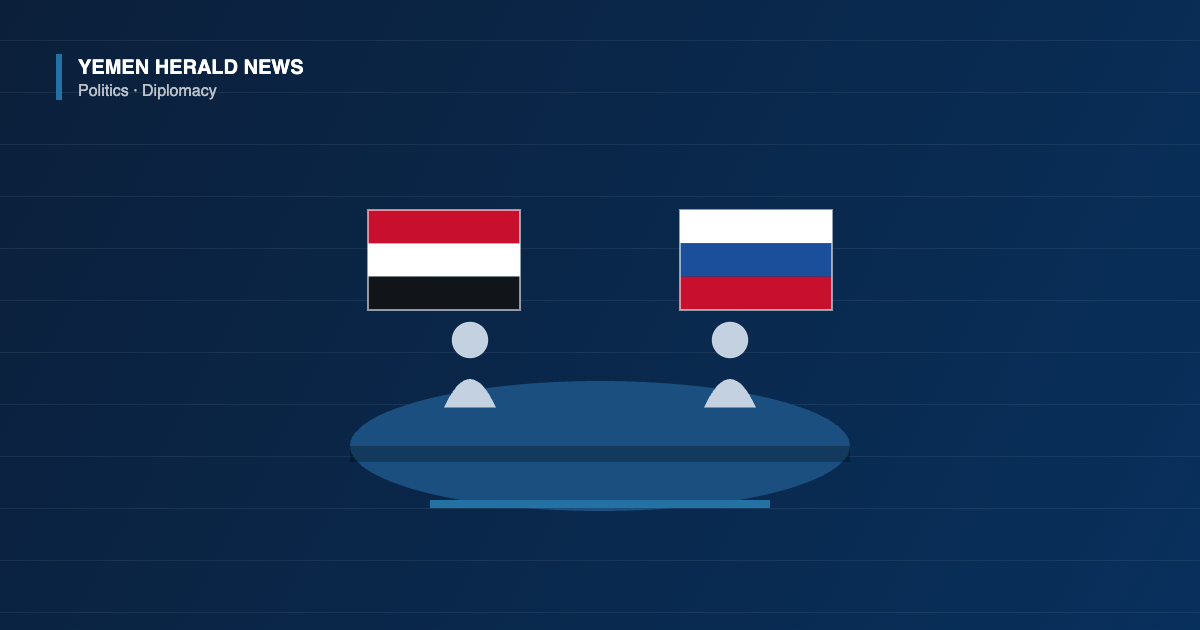
NEW YORK, United States — The deputy chairman of Yemen’s Presidential Leadership Council has discussed the war and bilateral relations with Russia’s foreign minister in New York.
Abdullah al-Alimi Bawazir met Sergey Lavrov on the sidelines of the UN General Assembly.
Saba, the state news agency of Yemen’s internationally recognised government, reported the meeting on 26 September.
TASS reported it the same day. The Russian agency placed it at the end of a round of bilateral talks Lavrov held at the assembly, which it said ran to 14 meetings.
Both the Yemeni and the Russian accounts place the meeting on 26 September.
The two discussed the situation in Yemen against a background of regional tension in the Gulf and the Red Sea, according to TASS.
They also discussed international support for a sustainable inter-Yemeni dialogue under UN auspices.
Lavrov said he would be glad to hear his counterpart’s position on international affairs, the agency reported.
Russia’s foreign ministry said it had stressed the importance of developing mutually acceptable compromise solutions in Yemen’s internal negotiations.
It said the aim was to bring the opposing sides closer together.
The two sides discussed the development of Russian-Yemeni relations and coordination at the UN and other international bodies.
Bawazir has been deputy chairman of the council since 7 April 2022.
He was born in 1979 in Bayhan, in Shabwa governorate.
He holds a bachelor’s degree in general medicine from the University of Aden and a master’s in management from the National University of Malaysia.
He also holds a bachelor’s degree in Sharia and law from the University of Science and Technology in Yemen.
Bawazir directed the office of former President Abdrabbuh Mansur Hadi from November 2016 to April 2022.
He is a member of the Islah party.
He addressed the general debate of the 81st session of the General Assembly this month.
Russia has kept relations with Yemen’s internationally recognised government while maintaining contacts across the conflict.
It is a permanent member of the Security Council.
The Council condemned continued Houthi attacks on Saudi Arabia in a press statement on 18 September.
Members demanded the group halt its military escalation and backed the work of UN envoy Hans Grundberg.
Jerome Bonnafont of France, who held the Council presidency, released that text.
Al-Monitor described the statement as a rare show of unity from the Council.
The Council met in emergency session on Yemen on 10 September.
UN News said the session followed reported Houthi attacks on Saudi Arabia and the capture of another port on Yemen’s Red Sea coast.
The group also seized eight UN vehicles from an aid hub at that port, according to UN News.
Fighting in Yemen intensified at the start of September.
Houthi missile and drone attacks on Saudi Arabia on 8 September set fires at oil installations and wounded 73 people, according to reports by international news organisations.
The Gulf Cooperation Council condemned further missile and drone attacks on Riyadh and Khamis Mushait on Saturday.
The Saudi-led coalition said it had intercepted two ballistic missiles and two drones.
Yemen Herald could not independently verify the interception claims.
UNICEF said on 25 September that close to 130,000 people had been displaced over three weeks, most of them from Taiz governorate.
The agency said 71,000 of those displaced were children.
It said 243 schools had closed or suspended classes over the same period, affecting about 140,000 students.
UNICEF reported 15 children killed and 14 injured since early September, with three others missing.
Yemen’s humanitarian response plan for 2026, published in March, records more than 22 million people in need of assistance.
It puts 18.3 million people in acute food insecurity and 5.2 million displaced before the current fighting.
More than 2.2 million children under five are acutely malnourished, 516,157 of them severely, the plan says.
The plan seeks 2.16 billion dollars to reach 12 million people.
Britain announced 10 million pounds in emergency humanitarian aid for Yemen on 25 September.
Yemen’s war began in 2015, when the Houthis took the capital and a Saudi-led coalition intervened on the government’s side.
The Presidential Leadership Council was formed in April 2022, when Hadi transferred his powers to it.
It is chaired by Rashad al-Alimi and has eight members.
They include Aidarous al-Zubaidi, who leads the Southern Transitional Council.
Tariq Saleh, who commands forces on the west coast, is also a member, as is Sultan al-Aradah, the governor of Marib.
Hadi had ruled since 2012.
The internationally recognised government is based in Aden.
Grundberg has held the UN envoy post since 2021.
CNN reported on 21 September that the Houthis had begun a new phase of their campaign while the United States stayed out of the fighting.
The Houthis control Sanaa and much of northern Yemen.
Taiz lies in south-western Yemen and has seen repeated front-line fighting.
Bab al-Mandab links the Red Sea to the Gulf of Aden and carries a large share of trade between Europe and Asia.
Shipping companies rerouted vessels around southern Africa during earlier rounds of Red Sea attacks.
Yemen and the Soviet Union established diplomatic relations decades before unification, and Moscow kept an embassy in Sanaa through much of the war.
Russia has called repeatedly for a negotiated settlement rather than military pressure.
Lavrov has been Russia’s foreign minister since 2004.
About the Author