Al-Alimi meets governors and commanders on carrying out mobilisation and safe return decisions
 Yemen Herald News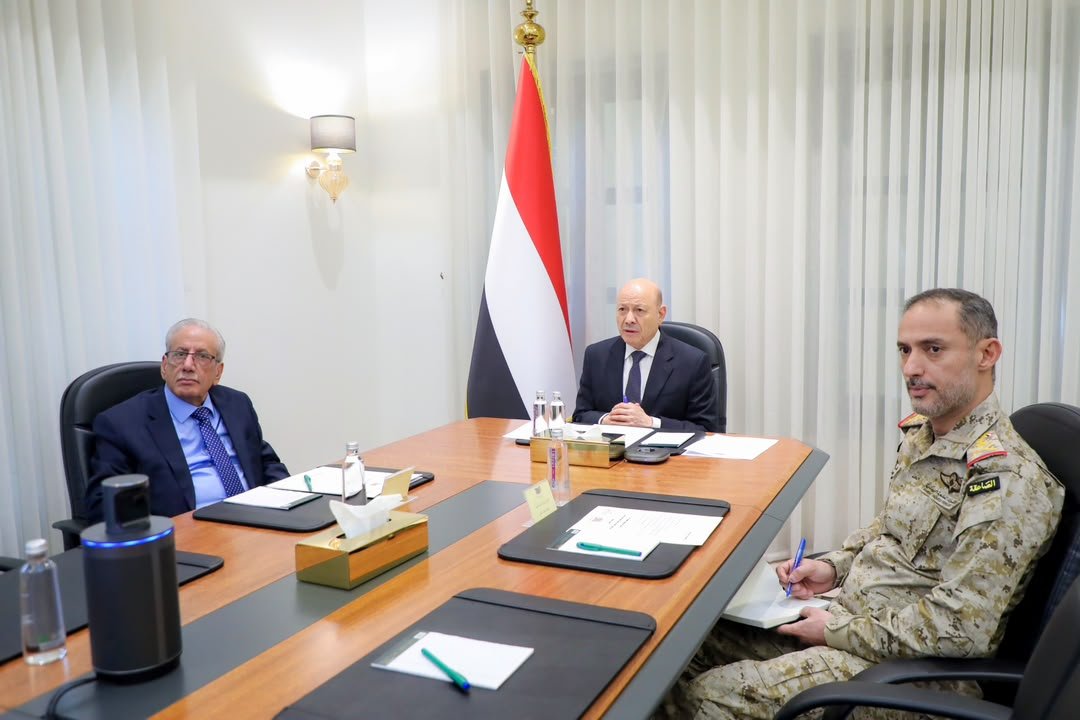
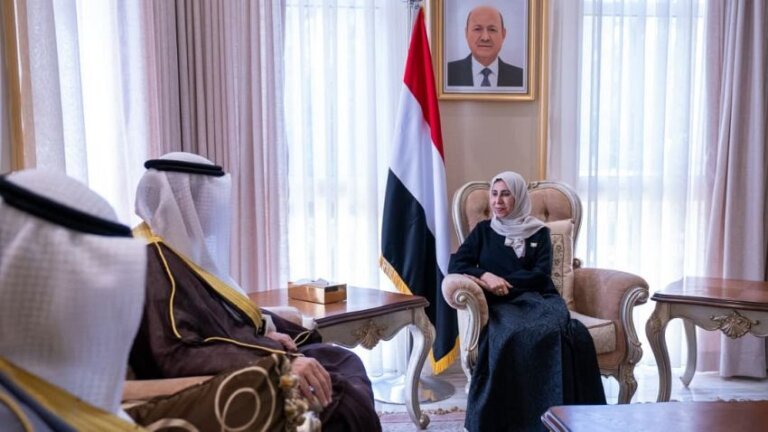
RIYADH, Saudi Arabia — Yemen’s presidential council chairman met ministers, governors and commanders on Monday on carrying out a general mobilisation and an amnesty scheme, the state news agency Saba reported.
Rashad al-Alimi, chairman of the Presidential Leadership Council, chaired the meeting.
Prime Minister Shaya al-Zindani attended, along with council member Sultan al-Aradah, several governors, ministers, and military and security commanders, Saba said.
The meeting was given over to practical measures for carrying out the two decisions, according to the agency.
The amnesty, which the government calls safe return, applies to Yemenis who stop fighting alongside the Houthis and come over to the government.
Those who do so will not be punished, under constitutional and legal guarantees the government has announced, Saba reported.
Al-Alimi repeated a call for people in Houthi-held areas to stop fighting or working for the group.
The guarantees extend to anyone who leaves, stops fighting, or ceases work on the group’s behalf, he said, according to the agency.
The guarantees include settling the status of members of the armed forces and security services who come over, and preserving their legal rights, al-Alimi said.
On the mobilisation, he said it was not a matter of gathering fighters alone.
He described it as a mobilisation of human, material and morale resources, and as a move to raise the capacity of state institutions and of the armed and security forces.
The account rests on Saba, the state news agency of the internationally recognised government. Yemen Herald could not independently confirm it, and no other record of the meeting has been published.
Al-Alimi also praised the armed forces, citing a military claim of 756 operations over 72 hours and 2,316 Houthi fighters killed or wounded.
Those figures come from the armed forces alone. No independent source has published them, and Yemen Herald could not verify them.
Al Jazeera reported on 27 September that it could not verify battlefield claims made by either side.
The Houthis dispute government accounts of front-line losses and issue their own.
Yemen’s parliament approved a general mobilisation this month at al-Alimi’s request.
The Presidential Leadership Council was formed in April 2022, when President Abed Rabbo Mansour Hadi transferred his powers to it.
The council brings together eight members drawn from military and political factions in the anti-Houthi camp.
Al-Zindani became prime minister in January 2026, after Salem Saleh bin Braik resigned. Al-Zindani had been foreign minister.
Afrah al-Zouba now holds the foreign ministry.
The government has operated from Aden and Riyadh since the Houthis took Sanaa in 2014.
A Saudi-led coalition intervened in March 2015.
A United Nations-brokered truce took effect in April 2022 and lapsed that October.
Fighting between government forces and the Houthis resumed in July 2026 and has since widened across several fronts.
Marib holds a large displaced population and sits on Yemen’s main onshore oil and gas infrastructure.
Al-Aradah governed the governorate through the years when it absorbed people fleeing the north.
UNICEF verified that at least 15 children had been killed, 14 injured and three reported missing in Yemen since early September.
Akhil Iyer, the agency’s representative in Yemen, said 146,000 people had been displaced in the three weeks to late September.
Djibouti state media said more than 3,000 people had crossed to that country.
The United Nations humanitarian response plan for 2026 puts more than 22 million people in Yemen in need of assistance.
It records 18.3 million people as acutely food insecure, and more than 2.2 million children under five as acutely malnourished, 516,157 of them severely.
The plan counts 5.2 million internally displaced people and seeks 2.16 billion dollars to reach 12 million of those in need.
Security Council Resolution 2216, adopted on 14 April 2015, demands that the Houthis withdraw from areas seized during the conflict and give up arms taken from state institutions. It passed by 14 votes to none, with Russia abstaining.
Houthi attacks on commercial vessels in the Red Sea began in late 2023. Many shipping operators rerouted around the Cape of Good Hope.
The European Union’s naval mission in the Red Sea, Operation Aspides, began escorting merchant ships in February 2024.
Kaja Kallas, the European Union’s foreign policy chief, asked member states this month to commit more warships to the area.
The Masam demining project said it cleared 5,164 mines and explosive remnants in Yemen over 25 days.
Saba did not report any dissent at the meeting, or list decisions taken at it.
Amnesty offers have featured in the conflict before, from both sides, with limited public accounting of how many people accepted them.
Hodeidah, on the Red Sea coast, remains under Houthi control.
Taiz is Yemen’s third-largest city and has been divided by front lines for most of the war.
Bab al-Mandab, at Yemen’s south-western tip, is one of the main chokepoints in global shipping.
Marib is the government’s main stronghold in northern Yemen.
Saada, where the Houthi movement began, lies on the border with Saudi Arabia.
Saba did not say how many people had taken up the safe return offer.
It gave no timetable for the mobilisation measures discussed.
Aden serves as the interim capital of the internationally recognised government.
About the Author