EU foreign policy chief Kaja Kallas asks member states for more warships in the Red Sea
 Yemen Herald News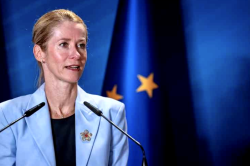
BRUSSELS, Belgium — The European Union’s foreign policy chief said the bloc lacks enough warships in the Red Sea to escort the commercial vessels queuing for protection.
Kaja Kallas, the EU High Representative for foreign affairs and security policy, made the remark on Monday.
“We need more vessels because literally there are commercial ships that are waiting in the queue to receive the escort that we do not have enough frigates that can do that,” she said, in remarks reported by the US Naval Institute.
She was speaking about Operation Aspides, the EU naval mission that escorts merchant traffic through the Red Sea and the Gulf of Aden.
Kallas had made the same case a week earlier.
On 21 September she said the mission had been planned around a fleet it never received.
“When Aspides was put in place, then the indication was that it needed at least 10 ships,” she said. “The situation is even more grave right now … I would assume that it is more than 10, but we do not have that much right now.”
Two countries have hinted they might provide additional ships, she said. She did not name them.
The request reached ministers in writing first.
Kallas sent a letter dated 19 September to the foreign and defence ministers of the 27 member states, ahead of Council meetings in September and October, the outlet Eunews reported.
The letter asked that the bloc be equipped with more numerous and better-equipped naval and air assets, according to that account.
Operation Aspides was launched in February 2024.
Its mandate is defensive. It escorts merchant vessels and does not strike targets on land.
The Council of the European Union extended the operation on 23 February 2026, carrying the mandate to 28 February 2027.
The Council set a financial reference amount of nearly 15 million euros for the period from 1 March 2026 to 28 February 2027.
The operation safeguards freedom of navigation in the Red Sea and surrounding waters, the Council said in that decision, providing defensive maritime security in accordance with international law.
The area of operation covers the Bab al-Mandab Strait, the Red Sea, the Gulf of Aden, the Arabian Sea, the Gulf of Oman, the Strait of Hormuz and the Gulf, according to the Council.
The Council named Rear Adm. Vasileios Gryparis as operation commander in that February decision. The operational headquarters is in Larissa, Greece.
Italy and Greece are the main contributors of ships, the US Naval Institute reported.
The mission deploys primarily three ships, drawn from Italy and Greece, with occasional support from other member states, the maritime news outlet gCaptain reported on 22 September.
That is against the figure of at least 10 that Kallas said the operation was designed to need.
“The operation needs more naval assets and more air assets to address the increased level of threats in the region,” she said in remarks carried by gCaptain.
The Italian frigate ITS Carlo Bergamini serves as flagship. The Italian minehunters ITS Crotone and ITS Rimini are also assigned to the mission.
Bab al-Mandab is the strait between Yemen and the Horn of Africa. Traffic bound for the Suez Canal passes through it.
The Houthi movement, which holds Sanaa and much of northern Yemen, began attacking merchant shipping in the corridor in late 2023. The group has said the campaign is tied to the war in Gaza.
Aspides was created in response to those attacks.
The military position in the strait has shifted this month.
Houthi forces captured the Red Sea port of Mokha and the island of Mayyun, placing units about 20 kilometres from the African shore and giving them command of the waterway, Al Jazeera reported on 13 September.
Hazem al-Assad, a member of the Houthi politburo, said in that report that “freedom of navigation and international trade in the Red Sea and Bab al-Mandeb are safe.”
Alexandru Cristian Hudisteanu, a maritime security expert and former naval officer, said in the same report that the narrower width of the passage made “targeting simpler for them than before.”
The commercial cost is already recorded. Shipping volume and tonnage through the Red Sea fell by between 50 and 55 percent from 2023 to 2025, according to IMF PortWatch figures cited by Al Jazeera.
Rerouting around the Cape of Good Hope adds more than 20 days to a transit, the same report said.
Egypt lost about 7 billion dollars between 2023 and 2024, roughly 60 percent of Suez Canal revenues, according to those figures.
The corridor has not closed. It has thinned.
Arsenio Longo, founder of the maritime intelligence firm Huax, counted about 25 commodity-vessel transits through Bab al-Mandab on 8 September.
Those included Aframax and Suezmax tankers, which carry about 700,000 and 1 million barrels respectively, and one very large crude carrier able to move about 2 million barrels, Longo said.
He cautioned against reading the count as a recovery. “The presence of ships in Bab al-Mandab therefore, does not mean the corridor is functioning normally again,” he said.
Neil Quilliam, a Middle East specialist at Chatham House, said the route had become “commercially unattractive and operationally hazardous” for mainstream operators.
European navies are also adjusting their deployments near the Strait of Hormuz, the US Naval Institute reported.
Kallas has held the post of High Representative since December 2024.
She served as prime minister of Estonia before taking the Brussels role.
About the Author