UN envoy Hans Grundberg concludes Cairo talks on Yemen escalation and Red Sea
 Yemen Herald News
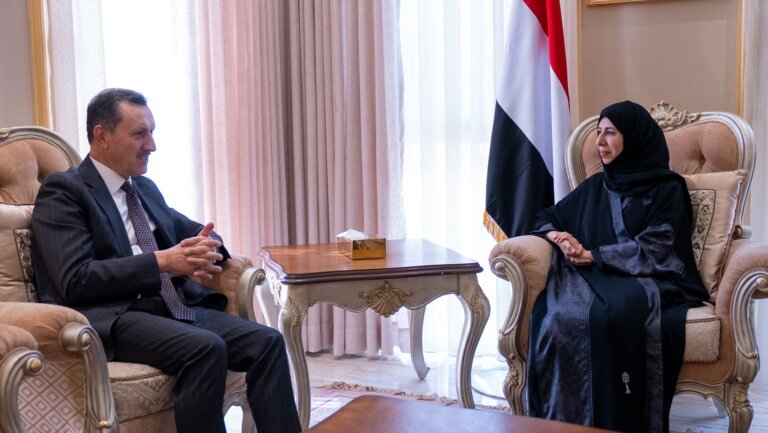
CAIRO, Egypt — UN Special Envoy Hans Grundberg concluded talks in Cairo on Wednesday with Egypt’s foreign minister and the Arab League’s secretary-general, his office said.
He met Badr Abdelatty, Egypt’s minister of foreign affairs, according to a readout issued by the Office of the UN Special Envoy for Yemen.
He also met Nabil Fahmy, secretary-general of the League of Arab States.
The talks covered the recent escalation in Yemen and its regional repercussions, including in the Red Sea, the readout said. It said they also covered UN efforts to end the conflict sustainably.
Grundberg expressed appreciation for the support Egypt and the Arab League have given to UN-led mediation, his office said.
The readout gave no further detail. It did not say what either counterpart told him, and it set out no next step.
The account of the visit rests on that statement. News agencies that carried the visit cited the same readout, and Yemen Herald found no account of the meetings independent of it. Neither the Egyptian foreign ministry nor the Arab League has published its own record of the talks.
Abdelatty took office as Egypt’s foreign minister in July 2024. Arab foreign ministers named Fahmy to head the Arab League in March 2026, succeeding Ahmed Aboul Gheit.
Grundberg last briefed the UN Security Council on 10 September. He told the council Yemen faced the greatest risk of a return to large-scale conflict since the truce of 2022.
The truce Grundberg referred to took effect in April 2022 under UN mediation. It was extended twice and formally lapsed that October, though several of its provisions held afterwards.
Fighting spread across several fronts in the weeks that followed.
More than 11,400 households had been newly displaced since 3 September, Grundberg said in that briefing. He placed most of them in Taiz and southern Hudaydah.
He said shelling had hit displacement sites in Marib, destroying shelters and killing children.
Ansar Allah, the movement also known as the Houthis, captured the port city of Mokha, Grundberg told the council. He put it about 75 kilometres from the Bab al-Mandab strait.
That gave the movement a direct presence on the approaches to the strait, he said, a corridor carrying a large share of world trade and energy shipments.
In the same briefing he set out three priorities. The first was keeping channels of engagement open even during hostilities, through the Military Coordination Committee.
The second was upholding international humanitarian law. The third was preserving what he called the pathway to a political settlement.
He said the demands Yemenis have raised remain open to negotiation. He listed reopening roads and airports, paying salaries, releasing detainees and securing equal citizenship.
More than 130,000 people have fled their homes in Yemen since early September, the United Nations said. It said more than 5.2 million were already displaced before the escalation.
Taiz accounts for more than 60 percent of the recent displacement, according to the UN. Al Jawf, Marib and Hudaydah have also seen people move.
Most of those displaced are women and children, the UN said. Many have moved more than once.
More than 3,000 Yemenis have reached Djibouti, the UN refugee agency said. It said it expects more than 10,000 further arrivals by the middle of October.
Its Djibouti operation is 15 percent funded, UNHCR said. In Yemen it received 34 million dollars of the 194 million it sought for 2026, a figure it gave before the current escalation.
More than 22 million people in Yemen need humanitarian assistance, the UN said. That is more than half the population.
Yemen also hosts about 65,000 refugees and asylum seekers, most of them from Somalia and Ethiopia, according to the UN.
Yemen’s minister of public health and population, Qasim Buhaibeh, said in late September that health facilities were probably operating below half their capacity. He told Al Jazeera the World Health Organization had previously put the figure at 60 percent.
Buhaibeh said 19.3 million Yemenis needed health assistance, and that 17 percent of the funding sought for that had been secured.
He listed emergency care, maternal and child health, vaccination and nutrition among the services under strain. He also named dialysis and cancer treatment.
The International Organization for Migration recorded 134,550 people displaced between June and 22 September, concentrated in Taiz, Lahj and Aden.
The World Health Organization said 838 people were killed and 3,643 wounded in Yemen between 6 August and 26 September. It put recorded casualties at 4,481 over that period, drawing on returns collected by Yemen’s Health Emergency Operations Center.
Mokha lies on Yemen’s Red Sea coast, south of Hudaydah.
Egypt has a standing interest in the waterway. Traffic through the Suez Canal, which depends on shipping passing Bab al-Mandab, is a source of state revenue.
The Arab League has backed the internationally recognised government through the conflict. Fahmy met Yemen’s foreign minister in New York in the week before the Cairo talks.
Grundberg has held similar rounds of consultations in Riyadh and Muscat during his tenure. He took up the post in September 2021.
Grundberg is the fourth person to hold the post since the UN appointed a special envoy for Yemen in 2012.
About the Author