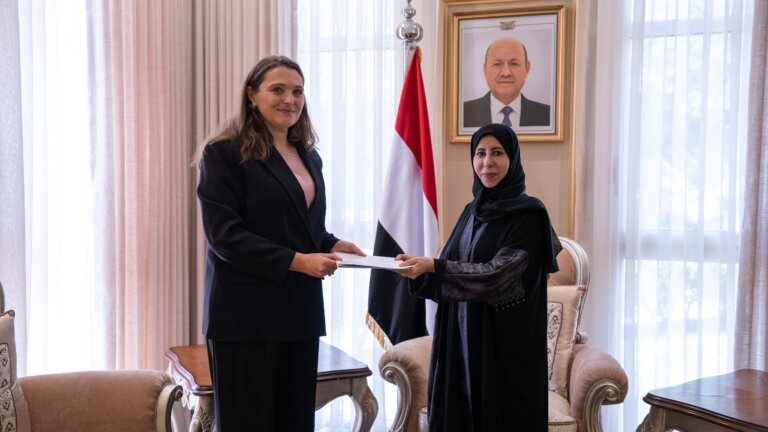
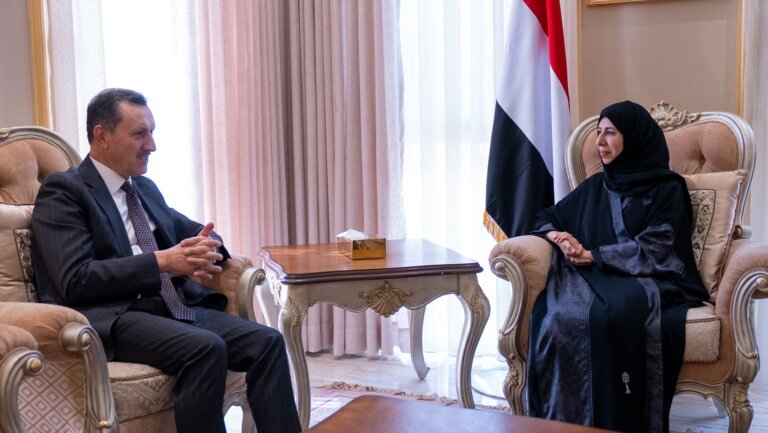
Waleed al-Abara and WHO discuss health services for displaced Yemenis in Aden
 Yemen Herald News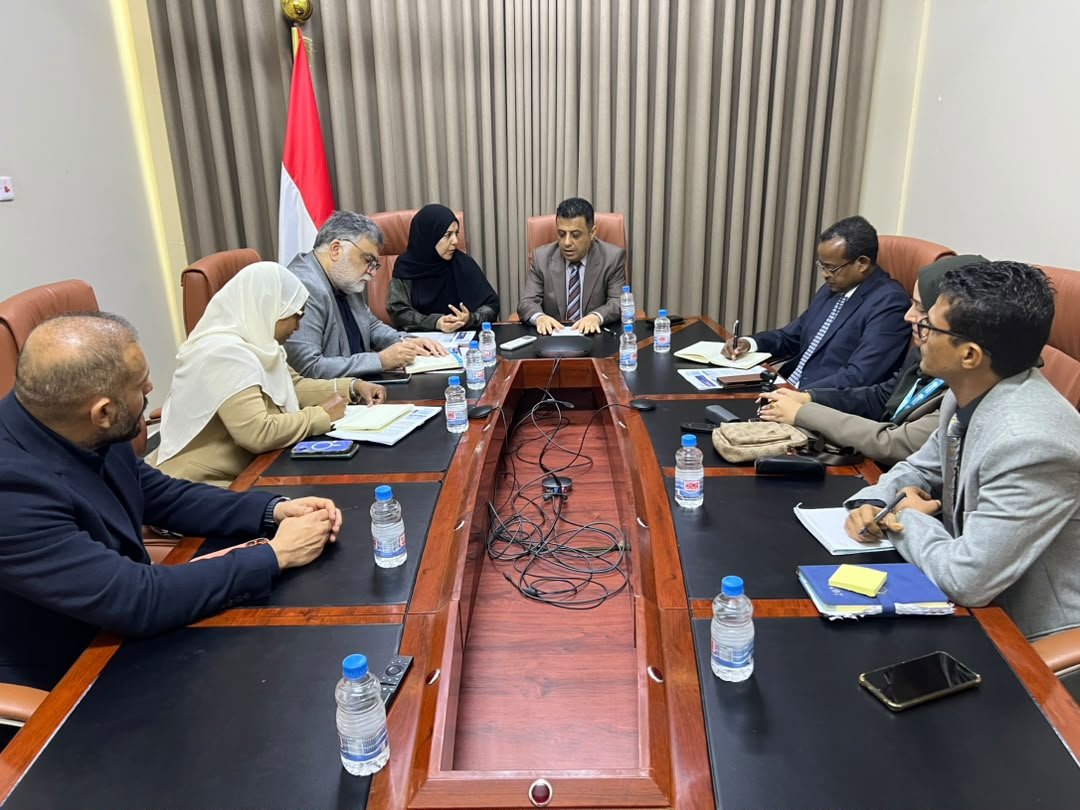
ADEN, Yemen — Yemen’s state minister for displacement discussed emergency health services for displaced people with the World Health Organization’s representative in the country on Wednesday, the state news agency Saba said.
Waleed al-Abara, minister of state for displacement and irregular migration affairs, met Syed Jafar, the WHO representative in Yemen, in Aden.
Al-Abara set out what he called urgent health needs at displacement sites, according to Saba. He named medical care, vaccination, nutrition support and services for women.
He asked for faster responses and for better exchange of data between government bodies and aid organisations, the agency said.
Jafar said WHO was identifying displacement sites in Aden, Taiz, Lahj and Abyan in order to deliver health services there, according to the same report.
He said the organisation planned to distribute polio and other vaccines. He also said it would work on malnutrition among children and mothers.
Saba gave no figures for the sites, the numbers covered or a timetable.
The account of the meeting rests on Saba, which is run by the internationally recognised government. Yemen Herald found no independent confirmation of it, and neither the ministry nor WHO has published its own readout.
The meeting follows a sharp rise in displacement.
More than 130,000 people have fled their homes in Yemen since early September, the United Nations said. More than 5.2 million were already displaced before that.
The UN gave a higher figure later in September, putting the number displaced by the recent fighting at more than 180,000.
Taiz accounts for more than 60 percent of the recent movement, according to the UN. Al Jawf, Marib and Hudaydah have also seen people leave.
Most of the displaced are women and children, the UN said. Many have moved more than once.
The International Organization for Migration recorded 134,550 people displaced between June and 22 September, concentrated in Taiz, Lahj and Aden.
Yemen’s minister of public health and population, Qasim Buhaibeh, said in late September that health facilities were probably operating below half their capacity. He told Al Jazeera that WHO had previously put the figure at 60 percent.
Buhaibeh said 19.3 million Yemenis needed health assistance. He said 17 percent of the funding sought for that had been secured.
He listed emergency care, maternal and child health, vaccination and nutrition among the services under strain. He also named dialysis and cancer treatment.
Yemen has recorded concurrent outbreaks of cholera, measles and polio, according to that account. More than 27,000 measles cases were confirmed in 2025.
About half of Yemeni children under five are chronically malnourished, Buhaibeh said.
WHO said cholera, measles and dengue were all circulating. It recorded 7,800 suspected cholera cases and 22 deaths in Yemen in 2026, more than 22,000 measles cases, and 37 deaths linked to dengue.
Nine health facilities near Taiz, Lahj and Hudaydah have been damaged or attacked, according to WHO. Emergency obstetric care has been suspended at hospitals in Marib and Ras al-Arah.
Several lifesaving supply lines at WHO’s warehouse in Aden are at zero stock, the organisation said.
WHO said it had deployed more than 20 mobile medical teams to priority areas. It sent nearly 60 tonnes of medical supplies, valued at 656,000 dollars, to 40 facilities across 10 governorates.
Of 2,900 children screened by the UN aid coordination office, more than a quarter were acutely malnourished and about 200 were severely so.
More than 3,600 Yemenis have crossed to Djibouti since 10 September, according to the UN. Nearly half of them are children.
The UN humanitarian plan published in March 2026 put more than 22 million people in need of assistance. It listed 18.3 million as acutely food insecure.
The plan recorded more than 2.2 million children under five as acutely malnourished, of whom 516,157 were severely so.
It sought 2.16 billion dollars to reach 12 million people.
Funding has fallen short. The UN refugee agency said it received 34 million dollars of the 194 million it sought for Yemen in 2026, a figure given before the current escalation.
More than 3,000 Yemenis have crossed to Djibouti, UNHCR said. It expects more than 10,000 further arrivals by the middle of October. Its Djibouti operation is 15 percent funded.
Yemen also hosts about 65,000 refugees and asylum seekers, most of them from Somalia and Ethiopia, according to the UN.
WHO said 838 people were killed and 3,643 wounded in Yemen between 6 August and 26 September, a total of 4,481. The count draws on returns collected by Yemen’s Health Emergency Operations Center from hospitals and health facilities.
UNICEF said 243 schools in Yemen had closed as displacement approached 130,000.
Al-Abara met the UN Office for the Coordination of Humanitarian Affairs earlier in the week to discuss moving families out of seven shelter sites.
He had also discussed policy frameworks with IOM earlier in September.
Aden is the seat of the internationally recognised government. The health ministry and most aid coordination for government-held areas run from the city.
WHO appealed earlier in 2026 for funding to sustain health services in Yemen, saying shortfalls would force it to cut support to hospitals and primary care centres.
The agency’s periodic casualty bulletin is compiled from facility returns and does not cover deaths and injuries that never reach a hospital.
About the Author