All Six Crew Killed in US KC-135 Tanker Crash in Western Iraq
 Yemen Herald News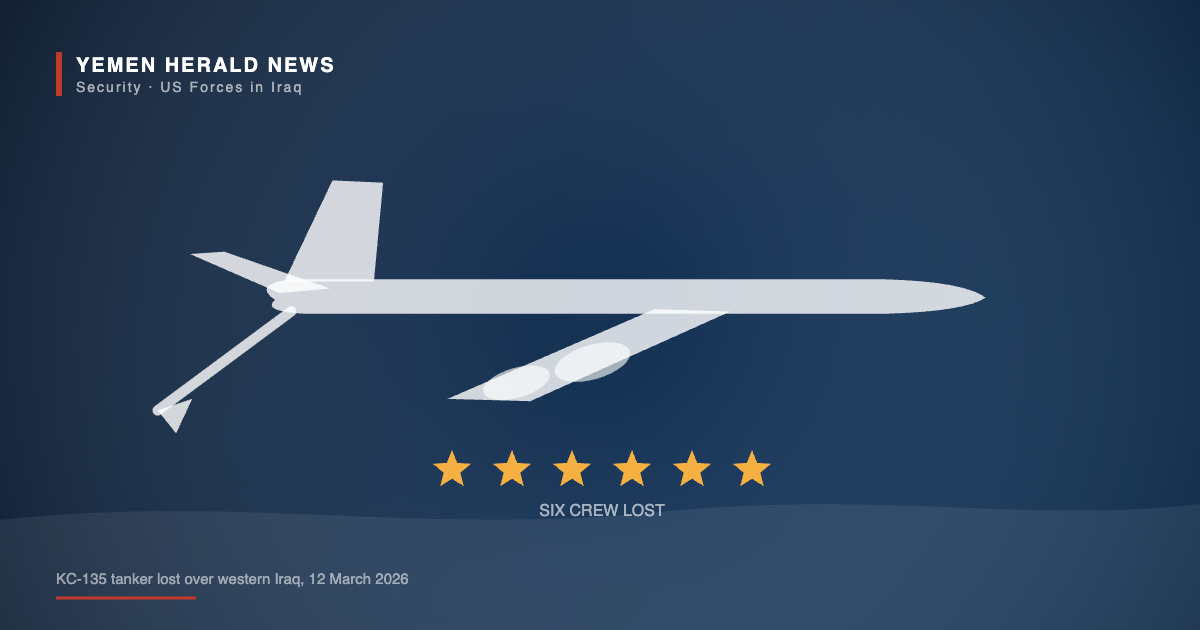
All six crew members aboard a United States Air Force KC-135 aerial refuelling aircraft that came down in western Iraq on 12 March 2026 were killed, US Central Command confirmed, revising an earlier account that had reported four deaths with two crew still unaccounted for.
The initial statement issued after the crash said four of those on board had died and that search teams were working to locate the remaining crew. That figure was superseded when Central Command announced that all six were confirmed deceased. Some early reporting had also referred to at least five crew members on board; the final count was six, and readers who saw the first accounts should treat those numbers as provisional rather than accurate.
The Pentagon subsequently named the six airmen as Major John A. Klinner, 33, of Auburn, Alabama; Captain Ariana G. Savino, 31, of Covington, Washington; Captain Seth R. Koval, 38, of Mooresville, Indiana; Captain Curtis J. Angst, 30, of Wilmington, Ohio; Technical Sergeant Ashley B. Pruitt, 34, of Bardstown, Kentucky; and Technical Sergeant Tyler H. Simmons, 28, of Columbus, Ohio.
Central Command said the aircraft was lost while flying over friendly airspace during Operation Epic Fury, the name given to US operations against Iran during the conflict. A second aircraft was involved in the incident and landed safely. General Dan Caine, chairman of the Joint Chiefs of Staff, said the loss was not the result of hostile or friendly fire. The circumstances were placed under investigation, and the military did not speculate publicly on a cause while that work was under way.
The KC-135 Stratotanker is one of the oldest airframes still in frontline American service. Derived from the same design lineage as the Boeing 707, the type entered service in the late 1950s and has been repeatedly re-engined and updated rather than replaced. Its role is to extend the range and endurance of fighters, bombers and surveillance aircraft by transferring fuel in flight, which makes it a routine but indispensable presence over any sustained air campaign.
That role also explains why tanker sorties are flown continuously and often at night, in crowded airspace, with aircraft manoeuvring in close formation to make contact with a refuelling boom. Air-to-air refuelling is among the more technically demanding routine tasks in military aviation, and the involvement of a second aircraft in this incident placed the accident within that context, although no official finding on sequence or cause was released.
The loss came during a period of intense American air activity across the region. Reporting at the time noted that the KC-135 was the fourth manned US aircraft lost during that month of operations, a rate of attrition that drew attention in Washington precisely because the losses were not being attributed to enemy action. Sustained high-tempo flying places strain on airframes, maintenance cycles and aircrew rest schedules, and accident rates have historically risen during extended campaigns.
Western Iraq has served as a corridor for US aircraft operating between bases in the region, and American forces have maintained a presence in the country through the coalition formed against the Islamic State group. The area over which the aircraft was flying was described by Central Command as friendly airspace, a formulation intended to distinguish the incident from the contested airspace further east where the campaign against Iran was being prosecuted.
For the US Air Force, the accident represented one of the costlier single losses of the campaign in terms of personnel. Tanker crews are small relative to the size of the aircraft, typically comprising pilots, a boom operator and additional mission crew depending on the sortie, which meant that the loss of a single airframe accounted for six deaths.
Losses that occur away from enemy fire are recorded differently from combat deaths but are treated with the same formal honours. Remains are returned through the mortuary facility at Dover Air Force Base in Delaware, and the units to which the airmen belonged are supported through established casualty assistance procedures. The Air Force did not immediately disclose the home wing of the aircraft in its first statements confirming the deaths.
Investigations of this kind are conducted by an accident investigation board, which examines maintenance records, flight data, crew scheduling and any recovered wreckage before producing findings. That process customarily takes months, and interim public statements are generally limited to confirmed facts. Central Command did not set out a timetable for its conclusions when it confirmed the deaths.
The Iraqi government did not report civilian casualties on the ground in connection with the crash. Recovery of the crew and of the wreckage in a remote area of the western desert involved coordinated search operations, and Central Command acknowledged the assistance of partner forces in the effort without detailing which units took part.
The episode illustrates a recurring feature of how casualty information emerges from active operations. Early figures are released under pressure and on incomplete information, and are frequently revised. In this case the correction moved in the direction of higher losses, and the confirmed record is that six US airmen died in the crash of a KC-135 in western Iraq on 12 March 2026.
About the Author