Iran-Aligned Group Claims Downing of US Tanker That Crashed in Western Iraq
 Yemen Herald News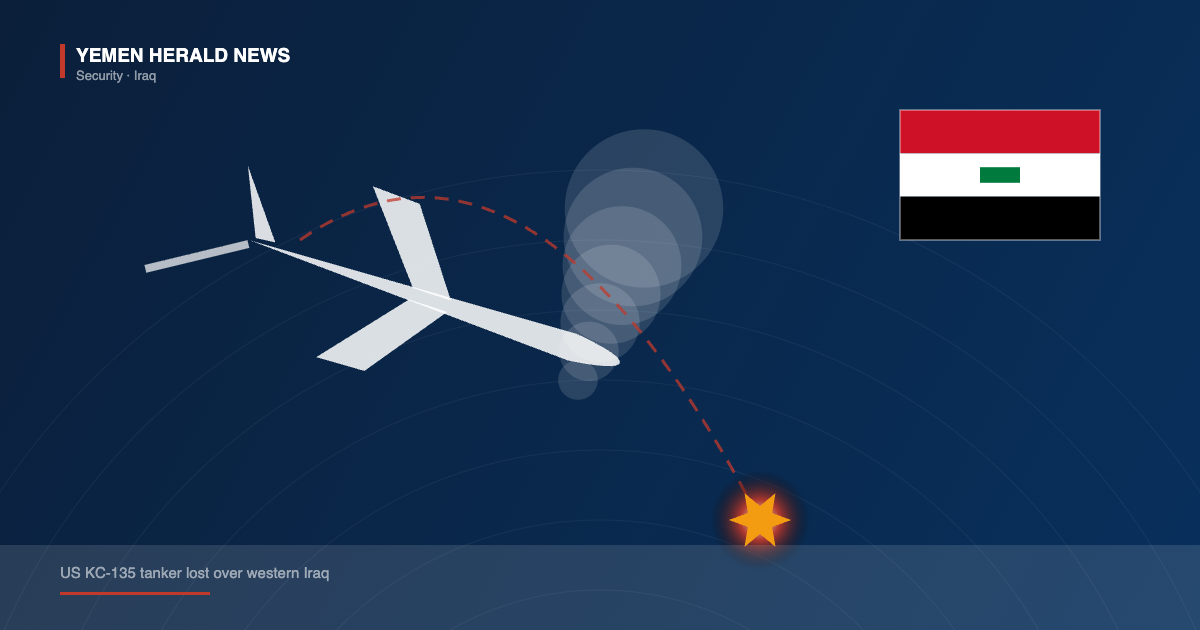
An Iran-aligned armed group claimed responsibility for the loss of a United States Air Force refuelling aircraft that crashed in western Iraq in March 2026, a claim the American military rejected. The aircraft was a KC-135 Stratotanker, and US Central Command confirmed that it had come down while supporting operations against Iran.
The Islamic Resistance in Iraq, an umbrella label used by Iran-backed militias in the country, posted a statement on its Telegram channel asserting that it had brought the aircraft down. The same statement claimed the group had also targeted a second KC-135 and forced it to make an emergency landing. Reuters reported the claim at the time.
US Central Command gave a different account. It said the circumstances of the incident were under investigation but that the loss of the aircraft was not the result of hostile fire or of friendly fire. Subsequent reporting described an apparent mid-air accident involving a second KC-135 operating in the same formation; that aircraft landed safely in Israel.
All six crew members aboard the tanker were killed. The Pentagon identified them on 15 March, and reporting at the time said they ranged in age from 28 to 38 and were assigned to two separate air refuelling wings. An earlier account attributed to a US official had put the number of people on board at at least five, a figure the official identifications later corrected.
The KC-135 has been in American service for more than sixty years and remains the backbone of the US Air Force’s aerial refuelling fleet. A standard crew consists of a pilot, a co-pilot and a boom operator, who lies at the rear of the aircraft and guides the refuelling boom into the receptacle of the receiving aircraft. Larger crews are carried on some missions.
Tankers rarely feature in accounts of air campaigns, but nothing else in a modern strike package can operate without them. Fighters and bombers flying long distances from bases in the Gulf or the Mediterranean depend on refuelling aircraft holding station in orbits along the route, and the loss of a tanker removes capacity that cannot be replaced quickly, since the fleet is small, ageing and heavily committed across several theatres at once.
Aerial refuelling is among the most demanding routine tasks in military aviation. Two large aircraft fly in close formation, often at night and frequently in radio silence, with only metres separating the boom from the receiving airframe. The margin for error is small, and the loss of an aircraft during such an operation is not by itself evidence of enemy action.
The crash prompted a debate inside the Air Force about the communications equipment carried by its tanker fleet. Defense One reported that senior officers cited the incident in arguing for upgrades to airborne communications, describing the limitations of the current systems as a persistent worry for crews operating in contested airspace.
The aircraft was supporting a campaign that had begun weeks earlier. American and Israeli forces struck targets inside Iran from late February 2026, and Iran responded with waves of drones and missiles directed at Israel, at American bases and at the Gulf Cooperation Council states hosting them.
Iraq occupied an awkward position in that campaign. American aircraft transited its airspace and American personnel remained on its territory, while Iran-aligned militias operating inside the country attacked or claimed attacks on those same forces. The Iraqi government has repeatedly said it does not want the country used as a theatre for the confrontation between Washington and Tehran.
Claims of responsibility from such groups are routinely difficult to verify. Militias have an incentive to attach themselves to any American loss, and the United States has an incentive to attribute losses to accident rather than to enemy action. In this case the American assessment and the militia claim were flatly inconsistent, and no independent evidence emerged publicly to resolve the difference.
The incident was one of several American aircraft losses reported during the escalation, and the deadliest for the Air Force in the region in years. Six deaths in a single non-combat loss exceeded the toll of most individual engagements in the campaign, a pattern familiar from earlier conflicts in which accidents accounted for a substantial share of military fatalities.
For Iraq the crash carried domestic political weight. Successive governments in Baghdad have sought to manage the presence of American forces without provoking the militias that operate outside formal state control, and each claimed attack on American assets renews pressure on that balance from both directions.
Reporting on the crash appeared across major American outlets including CNN, the Washington Post, CNBC and Fox News, and was carried internationally. Coverage consistently paired the American assessment that hostile fire was not involved with the militia claim that it was, leaving the discrepancy visible rather than resolving it.
The Air Force did not announce a suspension of refuelling operations following the loss, and sorties supporting the campaign continued. Investigations into aircraft accidents of this kind typically take months to complete, and the findings are published only after safety and accident boards have reported.
For Yemen, the episode was a reminder of how far the confrontation had spread beyond its original participants. The Red Sea, the Gulf and Iraqi airspace were by then all part of a single contested arc, and Yemeni ports and shipping lanes sat at its southern end, exposed to the same escalation in insurance costs and military traffic that affected the whole region.
About the Author