UN envoy Hans Grundberg says he is alarmed by intensified fighting in Taiz
 Yemen Herald News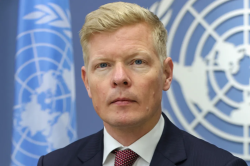
TAIZ, Yemen — UN Special Envoy Hans Grundberg said on Thursday he was alarmed by intensified fighting in Taiz governorate, where his office has received reports of civilian casualties and blocked roads.
Grundberg issued the statement on Oct. 1.
“I am alarmed by developments in Taiz governorate, where fighting has significantly intensified,” he said.
He said the reports reaching his office on casualties, damage to infrastructure and road closures were deeply troubling.
The closures are preventing civilians from leaving areas affected by the fighting, according to the statement.
“Civilians and civilian infrastructure must be protected,” Grundberg said.
He said every effort must be made to prevent further harm and to ensure safe and unhindered access to people in need.
Grundberg called on the Houthis to halt their offensive.
He said he remained in contact with the Yemeni government and the Houthis over efforts to contain the fighting.
The envoy’s office did not give a figure for civilian deaths.
Taiz is Yemen’s third-largest city.
It hosts the majority of Yemenis displaced by recent fighting elsewhere in the country, according to the statement.
Figures cited in the statement show nearly 147,000 people displaced across Yemen between Sept. 1 and Sept. 18.
Taiz received more than 80,000 of them.
The International Organization for Migration has since put displacement at more than 149,000 people.
Most of those people come from Taiz and Lahj governorates, according to the organisation.
The organisation said on Sept. 11 that 46,000 people had been displaced from the west coast and Taiz governorates, and that the number was rising by the hour.
“Families are being forced to flee for the second or third time since the start of this conflict, with almost nothing left,” IOM Director General Amy Pope said.
The organisation said its emergency stocks were already depleted after recent flood relief work.
It listed shelter, food, water, household items, health care and protection as urgent needs.
It called for safe and sustained humanitarian access and for the restoration of communication and transport routes.
The Office for the Coordination of Humanitarian Affairs recorded 14 civilians killed or wounded, including two children, in the first days of September.
The World Health Organization recorded 67 deaths and 288 injuries across seven governorates between Aug. 6 and Aug. 24.
It said 60 percent of health facilities in Yemen were fully functional.
Al Jazeera reported on Sept. 16 that camps around Taiz were overflowing with people who had fled the Houthi offensive.
Houthi forces have besieged Taiz city for much of the war, restricting the roads into it.
Government warplanes carried out dozens of airstrikes on Houthi positions on the outskirts of Taiz city, The National reported on Friday.
Col. Majed al-Nazili, a spokesman for the Yemeni Armed Forces, said the strikes killed dozens of Houthi fighters and reinforcements.
Government forces separately claimed 30 Houthi fighters killed and 50 wounded, according to reporting by Xinhua.
A military official quoted in that report described heavy casualties on both sides without giving numbers.
The Yemeni army said separately that more than 100 Houthi fighters had been killed in clashes across Taiz in 24 hours.
Those combatant tolls rest on government military sources. Yemen Herald found no independent confirmation of them, and the Houthis dispute government accounts of the fighting.
Houthi military spokesman Yahya Sarea said the Saudi-led coalition had carried out 47 attacks in 24 hours.
The coalition said it intercepted two ballistic missiles and four drones over cities in southern Saudi Arabia on Thursday.
Neither of those accounts has been independently confirmed.
Houthi forces took the Red Sea port of Mokha last month.
Mokha sits on Yemen’s Red Sea coast, north of the Bab al-Mandab Strait.
Taiz links Houthi-held areas in the north with government-held territory in the south and with the Red Sea coast.
Control of the city bears on the movement of weapons and supplies between fronts and the port of Aden.
Fighting has also been reported in Saada, al-Jawf and Lahj governorates, and around Mayyun Island at the mouth of the Bab al-Mandab Strait.
The World Food Programme has said 74 percent of Yemeni households cannot meet their basic food needs.
Matthew Hollingworth of the programme said the effect of the latest flare-up threatened to be “absolutely devastating”.
The Office for the Coordination of Humanitarian Affairs said in its March plan that more than 22 million people in Yemen needed assistance.
It put the number of acutely food insecure people at 18.3 million.
It said more than 2.2 million children under five were acutely malnourished, including 516,157 with severe acute malnutrition.
The office recorded 5.2 million internally displaced people and sought 2.16 billion dollars to reach 12 million of them.
Britain announced 10 million pounds in new humanitarian funding for Yemen on Sept. 25, citing the escalation.
The Foreign, Commonwealth and Development Office said more than 130,000 Yemenis were estimated to have been displaced by then.
Yemen’s war began in 2014, when Houthi forces took Sanaa.
A truce agreed in 2022 has since broken down.
Grundberg held talks in Cairo and in Muscat in the days before the statement, including a meeting with the Houthis’ chief negotiator.
Taiz lies about 100 kilometres from Mokha.
About the Author