Airstrikes hit Sanaa hours after Saudi-led coalition reports missile and drone interceptions
 Yemen Herald News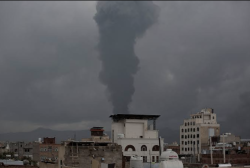
SANAA, Yemen — Airstrikes shook Yemen’s capital late Thursday, residents said, hours after the Saudi-led coalition reported intercepting two ballistic missiles and four drones over southwestern Saudi Arabia.
Witnesses told the German news agency DPA that heavy blasts were heard in several parts of Sanaa and that aircraft flew over the city for a sustained period.
Smoke rose near the Presidential Palace and Mount al-Nahdain, a height overlooking the southern edge of the capital, the same witnesses said.
Residents who spoke to the Chinese news agency Xinhua described strikes on Sanaa and on residential neighbourhoods of the city.
Xinhua reported that strikes were also carried out in the northern provinces of Saada and Amran and in Taiz province, in the southwest.
Al-Masirah, the television channel run by the Houthi movement, called the strikes “Saudi aggression.” It gave no immediate casualty figures, according to Xinhua.
Saudi Arabia had not commented on the strikes on Sanaa, Xinhua reported. Yemen Herald could not establish what the aircraft targeted.
The coalition said earlier on Thursday that it had intercepted and destroyed two ballistic missiles and four drones launched by the Houthis toward Khamis Mushait and Jazan.
The four drones were brought down over Khamis Mushait, according to the coalition’s account. The two missiles were intercepted over Khamis Mushait and Jazan.
Maj. Gen. Turki al-Maliki, the official spokesman for the Coalition to Restore Legitimacy in Yemen, announced the interceptions in a statement carried on the social platform X.
He said the alliance was acting against what he called “the terrorist Houthi militia in Yemen.” The movement rejects that description of itself.
Saudi Arabia’s Civil Defence reported limited material damage to several buildings and vehicles in Khamis Mushait caused by falling debris. It reported no casualties.
The exchange followed an attack on Saudi Arabia’s Medina province on Tuesday. The coalition said a drone struck at 5:11 a.m. and disabled a power transformer at the Taibah electricity distribution station.
Al-Maliki attributed that attack to the Houthis. The movement denied targeting holy sites in Medina.
Yemen Herald found no independent confirmation of either side’s account of the Medina attack.
Al-Maliki said investigators had concluded the Houthis were responsible for the Medina attack. “The investigation and evidence gathered by the competent authorities have confirmed the involvement of the Terrorist Houthi Militia in planning and executing this cowardly terrorist act,” he said.
A senior Houthi official rejected the accusation that the movement had targeted Islamic holy sites, according to Houthi media cited by the news site Al-Monitor.
The air activity came as fighting continued in Taiz, where government forces and Houthi units have been engaged on several fronts this week.
Government forces said 30 Houthi fighters were killed and 50 others wounded in those battles, according to Xinhua.
Those figures come from one party to the fighting. No independent source has confirmed them, and the Houthis have not published their own count.
Arab News reported on Thursday that the Houthi assault spanned 56 flashpoints across the governorate, citing residents and government officials.
The newspaper named Jabal Habashi and Maqbanah, west of Taiz city, and al-Misrakh district among the areas where fighting was reported.
Ahmed Nagi, an analyst at the International Crisis Group, told the newspaper the Houthis were attacking on several fronts and seeking to cut the road linking Taiz to Aden.
Residents said fighters had reached the Hayjat al-Abd road, the main southern route toward Aden, the newspaper reported.
Taiz city has been held by government forces and surrounded on several sides by Houthi positions for most of the war.
Al-Monitor reported on Thursday that the coalition had struck 11 targets in Saada and had carried out what it described as a high-value targeting operation in Sanaa.
The same report put the number of airstrikes on Houthi positions in Taiz at 27. Yemen Herald could not reconcile that figure with other accounts of the air operations.
Hans Grundberg, the United Nations special envoy for Yemen, said on Thursday that he was alarmed by developments in Taiz governorate, where fighting had significantly intensified.
Military operations by Ansar Allah, as the Houthi movement formally calls itself, pose grave risks to the civilian population, he said.
The envoy cited reports of casualties, damage to infrastructure and road closures affecting people’s ability to leave the area.
Taiz is hosting the majority of Yemenis newly displaced by recent fighting elsewhere, according to his statement.
“I repeat my call on Ansar Allah to halt its military offensive,” Grundberg said. Civilians and civilian infrastructure must be protected, he added.
The Houthis took Sanaa in September 2014. The coalition intervened in March 2015 on the side of the internationally recognised government.
Khamis Mushait, in Saudi Arabia’s Asir region, is the site of King Khalid Air Base. Jazan lies on the Red Sea coast, across the border from Yemen’s northern provinces.
The United Nations humanitarian plan for Yemen, published in March, counts more than 22 million people in need of assistance.
It records 18.3 million people as acutely food insecure and 5.2 million as internally displaced within the country.
More than 2.2 million children under five are acutely malnourished, the plan says, including 516,157 severe cases.
The plan seeks 2.16 billion dollars to reach 12 million people this year.
Medina is Islam’s second holiest city. The Prophet’s Mosque there draws millions of visitors each year.
About the Author