Qatar’s emir renews support for Yemen’s unity in reply to al-Alimi
 Yemen Herald News
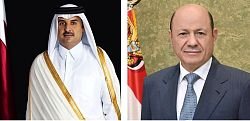
RIYADH, Saudi Arabia — Yemen’s Presidential Leadership Council chairman Rashad al-Alimi received a written reply from Qatar’s emir on Tuesday, the state news agency Saba said.
The message from Sheikh Tamim bin Hamad Al Thani answered an earlier letter from al-Alimi on relations between the two countries and on developments in Yemen, according to Saba.
Saba said the emir renewed Qatar’s commitment to standing by Yemen and to supporting efforts to achieve peace and stability, and to preserving the country’s unity, sovereignty and territorial integrity.
The agency said the emir also expressed appreciation for the ties between the two countries and affirmed Qatar’s intention to develop them across several fields.
Saba did not say when al-Alimi sent his original message, or what he asked for in it.
The account of the exchange rests on Saba, the news agency of the internationally recognised government, reporting the council’s own correspondence. Yemen Herald found no independent account of the message or its contents.
The exchange was reported while government forces pressed an offensive in the south-west.
Yemen’s government announced an operation it calls Dawn of Yemen on Sunday, Al Jazeera reported. Government units and allied Popular Resistance and Giants Brigades forces have claimed positions in Taiz governorate, among them the port of Mokha and the district of Dhubab, near the Bab al-Mandab strait.
Government forces also claimed the al-Manzara, al-Ashari and Dhiban mountains in Haifan, south of Taiz, Al Jazeera reported.
A Houthi military spokesman said the group held its battlefield gains and described the government’s account as fabricated, Al Jazeera reported. Al Jazeera said it had not independently verified the extent of the claimed advances.
Saudi-led coalition spokesman Major General Turki al-Maliki said coalition forces struck Houthi weapons depots and stores for explosive boats and naval mines in Hodeidah governorate.
The Houthis said they fired ballistic and cruise missiles and drones at facilities in Saudi Arabia, among them King Khalid International Airport in Riyadh and a refinery at Rabigh. Saudi Arabia’s General Authority of Civil Aviation said separately that airports at Jazan and Najran, in the kingdom’s south, were targeted on Monday evening. Neither account has been independently verified.
The World Health Organization has recorded at least 959 people killed and more than 4,200 wounded since the fighting resumed, Al Jazeera reported. The International Organization for Migration put the number displaced at more than 184,000.
Qatar is not a member of the Saudi-led coalition that intervened in Yemen in 2015. It was removed from the coalition in June 2017, during the rift between Doha and several Gulf states, and that dispute was settled by the al-Ula declaration in January 2021.
Qatar took part in the coalition’s early operations in Yemen in 2015, before its removal two years later.
Doha has kept its own channel to Yemen’s leadership since then. Sheikh Tamim met al-Alimi in Doha in July, the Qatari newspaper The Peninsula reported at the time, and the emir sent al-Alimi a message of condolence in May.
Qatar has said it supports political consensus among Yemen’s factions, Asharq Al-Awsat reported.
Qatar has also funded humanitarian work in Yemen through the Qatar Fund for Development. The fund gave $15 million to UNICEF in June 2023 for 13 water and sanitation projects across 11 Yemeni cities, UNICEF said at the time, work it said was intended to reach more than 4 million people.
Those projects covered Hodeidah, Dhamar, Al Bayda, Hajjah, Taiz, Lahj, Al Jawf, Saada, Aden, Hadramout and Abyan, according to UNICEF.
Al-Alimi has chaired the Presidential Leadership Council since April 2022, when former president Abd Rabbu Mansour Hadi transferred his powers to it and dismissed his vice-president. The council is seated in Aden, and its members spend long periods in Riyadh.
The Presidential Leadership Council has eight members and was created to bring the factions opposed to the Houthis under one body. Al-Alimi, a former interior minister, advised Hadi before taking the chairmanship.
The council was formed days after a two-month truce brokered by the United Nations took effect. The truce was renewed twice, lapsed in October 2022, and no nationwide ceasefire has been agreed since.
The United Nations special envoy for Yemen, Hans Grundberg, said in March that Yemen could not again become an arena for regional escalation, and called for maximum restraint. He said then that a fragile opportunity for a political settlement remained.
The humanitarian position has not eased. The UN Office for the Coordination of Humanitarian Affairs said in its March 2026 response plan that more than 22 million Yemenis need assistance and that 18.3 million are acutely food insecure.
OCHA put the number of internally displaced at 5.2 million and said more than 2.2 million children under five are acutely malnourished, 516,157 of them severely.
The plan sought $2.16 billion to reach 12 million people.
Saba operates separate newsrooms in Aden and in Houthi-controlled Sanaa, and the two publish competing accounts of the war.
Shipping through the Red Sea has been disrupted since the Houthis began attacking vessels in late 2023. Bab al-Mandab, where government forces say they have advanced, carries traffic between the Red Sea and the Gulf of Aden.
About the Author