Air Canada Express Jet Hits Airport Fire Truck at LaGuardia, Killing Both Pilots
 Yemen Herald News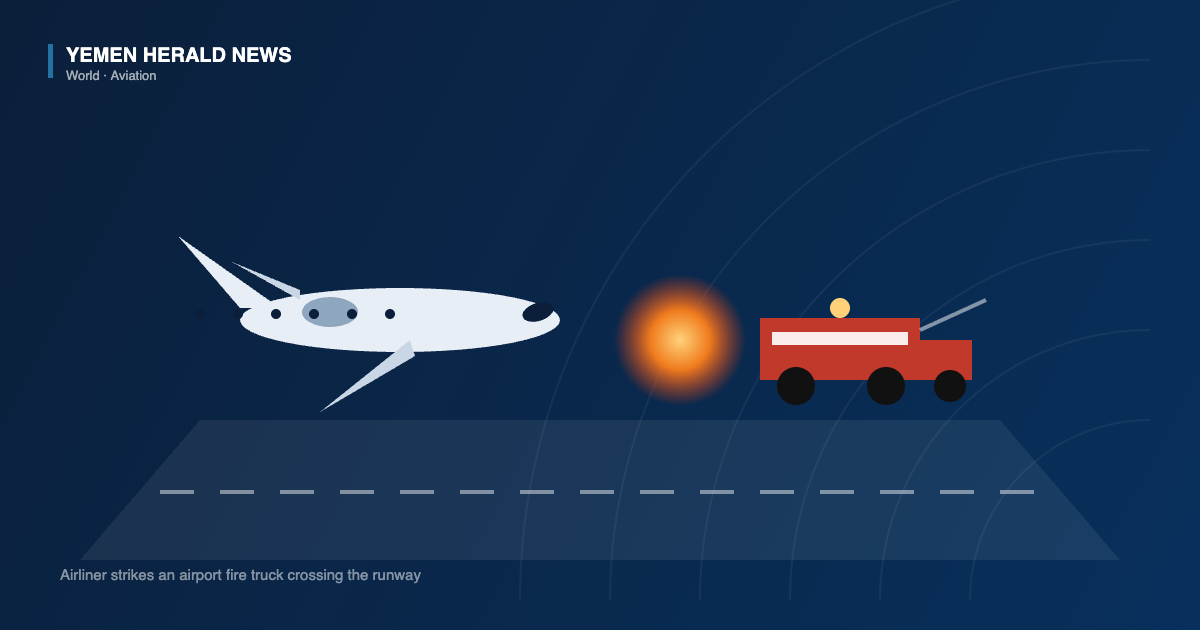
An Air Canada Express regional jet struck an airport fire truck while landing at New York’s LaGuardia Airport late on 22 March 2026, killing both pilots, injuring dozens of other people on board and closing the airport for much of the following day. The aircraft, a Bombardier CRJ-900 operated by Jazz Aviation on behalf of Air Canada Express as flight AC8646 from Montreal, was on final approach to Runway 4 with 76 people aboard when the collision occurred just before midnight.
The truck was crossing the runway on its way to a separate, unrelated emergency when the jet touched down. The two vehicles met on the landing roll. The National Transportation Safety Board later reported that preliminary flight data showed the aircraft travelling at between 93 and 105 miles per hour at the moment of impact — a figure far higher than early accounts circulating on the night suggested, and one that helps explain the severity of the outcome.
The captain and first officer were both killed. Thirty-nine people in total were reported injured, among them two Port Authority officers. The New York City Fire Department and Port Authority emergency crews responded within minutes, and passengers were evacuated from the damaged aircraft on the runway. The Federal Aviation Administration imposed a ground stop on all departures bound for LaGuardia while the runway was secured, and arrivals were diverted to other airports in the region. The airport remained shut overnight and through the following morning, reopening at 2pm on the Monday.
Early reporting on the night was fragmentary and in several respects wrong. Initial accounts described the struck object simply as a Port Authority vehicle and put the aircraft’s speed at around 24 miles per hour, an estimate that suggested a low-energy taxiway bump rather than a collision during the landing roll. Unverified social media footage circulated showing damage to the aircraft’s nose. The NTSB’s preliminary findings corrected the speed figure by a factor of four and identified the vehicle as an airport firefighting truck.
The safety board’s preliminary work pointed to a combination of factors rather than a single failure. Air traffic controllers were managing arriving aircraft and a ground emergency at the same time, producing a high-workload environment. Investigators noted communication problems including blocked radio transmissions and delayed recognition of instructions. They also flagged the limitations of surface detection systems, which depend on ground vehicles being properly equipped to appear on controllers’ displays; a vehicle without functioning equipment can be effectively invisible to the automated warnings intended to prevent exactly this kind of conflict.
That last point connects the accident to a longer-running concern in American aviation. Runway incursions — the presence of an aircraft, vehicle or person in a protected area of a runway — have been a recurring focus of NTSB and FAA attention for years, and a series of near-misses at major United States airports had already prompted reviews of ground movement procedures, controller staffing and surface surveillance technology before this crash.
LaGuardia is a particularly demanding environment for ground operations. It occupies a small site in Queens hemmed in by Flushing Bay and by the surrounding city, with two intersecting runways of limited length and a dense schedule of regional and short-haul flights. There is little margin for absorbing disruption, and vehicle movements across active runways are a routine part of operating there.
For Air Canada, the accident was the most serious involving one of its branded flights in many years. The airline issued statements confirming the aircraft, the flight number and the number of people on board, and said it was cooperating with investigators. Jazz Aviation, the Halifax-based regional carrier that operates a substantial portion of the Air Canada Express network under contract, was directly responsible for the flight crew and the aircraft. Because the accident occurred on United States territory, the NTSB leads the investigation, with Canadian and manufacturer participation provided for under international arrangements.
The CRJ-900 itself is a widely used 76-to-90-seat regional jet, originally built by Bombardier and now supported by Mitsubishi Heavy Industries after the CRJ programme changed hands in 2020. Hundreds remain in service across North America on precisely the sort of short domestic and transborder routes that AC8646 was flying.
The disruption at LaGuardia rippled outward for the rest of the week. With one of the two runways closed as an active accident site and the airport handling reduced capacity after it reopened, airlines cancelled or consolidated dozens of regional flights, and passengers were rebooked through Newark and John F. Kennedy. Delays at LaGuardia propagate quickly through the wider North American network, because so many of its flights are short rotations flown several times a day by the same aircraft and crews.
A preliminary report of the kind issued in the weeks after the crash sets out what investigators have established so far; it does not assign cause or blame. A final report, with findings on probable cause and safety recommendations, typically follows a year or more later. Any conclusions about responsibility — whether they concern the truck’s movement, the clearance issued, the equipment fitted to the vehicle or the design of the warning systems — will rest on that document rather than on the preliminary material available now.
About the Author