Yemen’s social affairs minister asks U.S. to help fund child protection plan
 Yemen Herald News
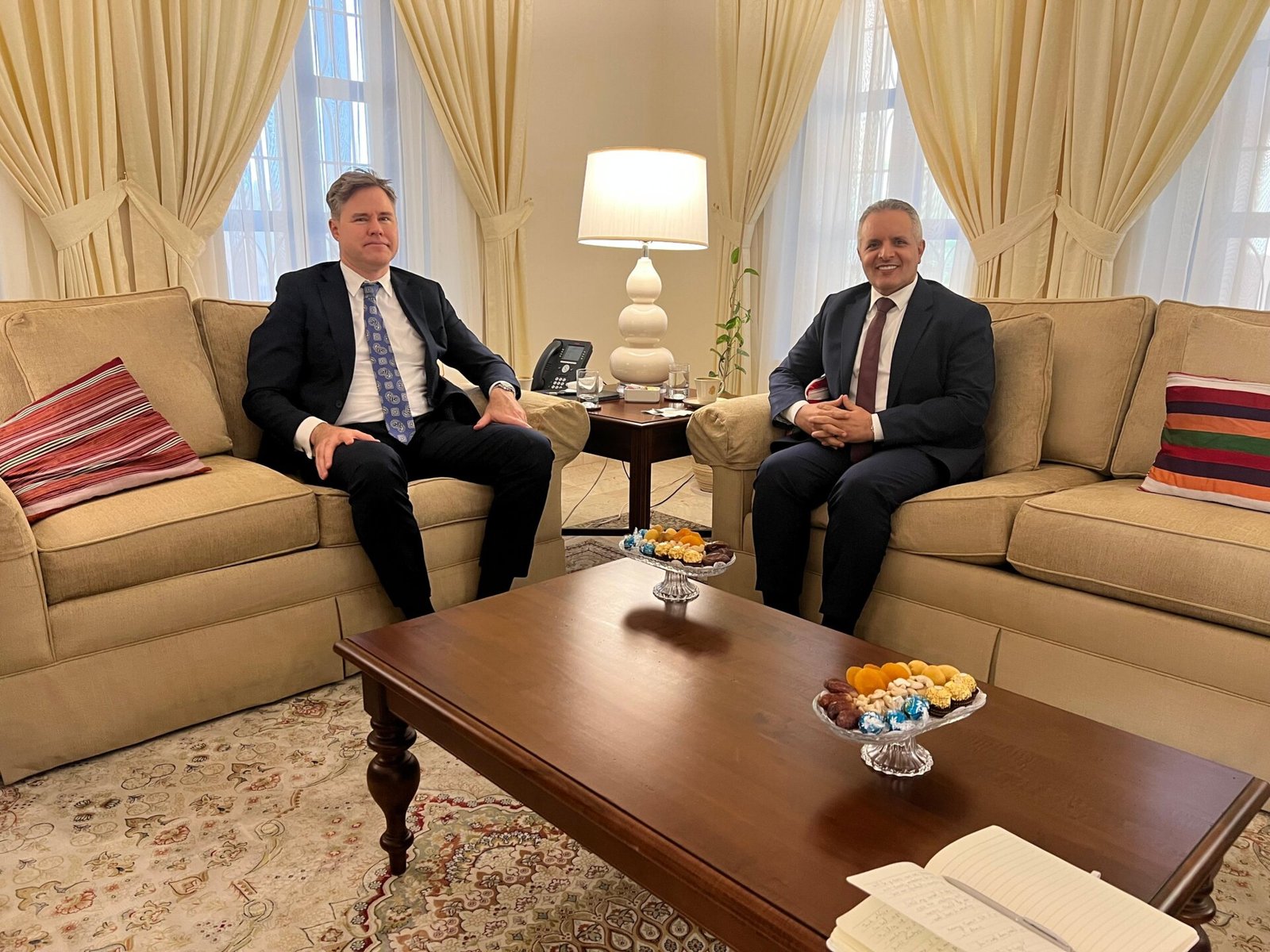
RIYADH, Saudi Arabia — Yemen’s social affairs minister asked the United States on Wednesday to help fund a four-year national child protection plan, the state news agency Saba said.
Minister of Social Affairs and Labour Mukhtar al-Yafeai met the U.S. charge d’affaires for Yemen, Neil Hop, in Riyadh, according to Saba.
The two discussed the humanitarian situation and cooperation on social protection, the agency said. Their talks centred on carrying out the National Child Protection Plan 2026-2029.
This account rests on Saba, the news agency of Yemen’s internationally recognised government. No independent confirmation of the meeting has been published, and Yemen Herald could not verify it with a second source.
Saba said the talks also covered displacement and rising humanitarian needs caused by the recent escalation, and measures to protect children caught in it.
Both sides condemned the recruitment of children into the fighting, the agency said. Saba attributed that recruitment to what it called Houthi terrorist militias, a characterisation the Houthis reject.
Al-Yafeai said partnership with Washington mattered for humanitarian response and social protection programmes, and for raising the money the plan needs, according to the agency. He thanked the United States for its support for the Yemeni government, Saba said.
Hop affirmed “Washington’s continued interest in the humanitarian situation in Yemen” and a willingness to support response efforts, the agency reported.
He said his mission would keep coordinating with the government and with partners on child protection and on the needs of displaced people and the groups worst affected, according to Saba.
Saba described Hop as acting U.S. ambassador. The U.S. Mission to Yemen gives his title as charge d’affaires and spells his surname Hop.
The mission said he arrived on Aug. 5. It described him as a career member of the Senior Foreign Service with the rank of counselor, with more than 24 years in diplomatic and national security posts.
He has directed the State Department’s office for Israel and Palestinian affairs and its Pakistan office, the mission said. He served as political counselor in Riyadh and as economic and political chief in Doha.
He has also served as a senior adviser for technology diplomacy, as regional platform leader in Afghanistan, and in section leadership roles in Jerusalem and Baghdad, the mission said. It described him as a distinguished graduate of the National War College.
He speaks Arabic and Spanish and served 28 years as a U.S. Army Reserve officer, according to the mission.
The plan he discussed with al-Yafeai was launched by the Ministry of Social Affairs and Labour at a ceremony in Aden on Nov. 17, 2025.
It seeks about $351 million over four years and covers 12 of Yemen’s governorates. The ministry gave it the motto “Childhood without protection, a future without security.”
That sum would pay for protection services for about 504,000 children, roughly a fifth of those the ministry says need them.
The plan sets seven objectives. They include strengthening the legal framework for child protection, widening services for children and families, and building alternatives to institutional care.
It also calls for training about 27,000 national personnel. UNICEF helped prepare it with the government, academics from the universities of Aden, Hadramout and Taiz, international experts and civil society groups.
The United Nations has documented child recruitment by both sides of the war.
The U.N. secretary-general’s annual report on children and armed conflict, issued on June 17, verified 742 grave violations against 652 children in Yemen during 2025. Of those children, 550 were boys and 102 were girls. The report carries the document symbol A/80/723-S/2026/357.
The report verified the recruitment and use of 262 children. It attributed 135 cases to the Yemen Armed Forces and affiliated forces and groups, and 127 to the Houthis. The cases attributed to government forces and allied groups outnumbered those attributed to the Houthis.
It also verified the killing of 150 children and the maiming of 281. It recorded 10 attacks on schools and hospitals, two on schools and eight on hospitals.
Displacement has climbed since the fighting resumed. The International Organization for Migration said on Oct. 5 that more than 184,000 people had been displaced between Aug. 1 and Oct. 4.
The agency recorded 21,798 people, or 3,633 households, displaced between Sept. 27 and Oct. 3, a 26% rise on the previous week. A further 6,474 people were displaced on Oct. 4 alone, it said.
IOM carried out a rapid protection assessment at displacement sites in Marib governorate. It warned that households were turning to coping strategies that include child labour. The agency released the findings from Geneva and Aden.
The caseload was already large before the summer. The U.N. humanitarian office’s needs and response plan for 2026, published in March, counted more than 22 million people in need of assistance.
It put 18.3 million people in acute food insecurity and more than 2.2 million children under five in acute malnutrition, 516,157 of them severely.
The plan recorded 5.2 million internally displaced people. It sought $2.16 billion to reach 12 million of those in need.
Saba did not say whether Washington made any funding commitment at the meeting. The agency filed its report from Riyadh.
About the Author