Al-Alimi says Operation Yemen Dawn will continue until Sanaa is restored
 Yemen Herald News
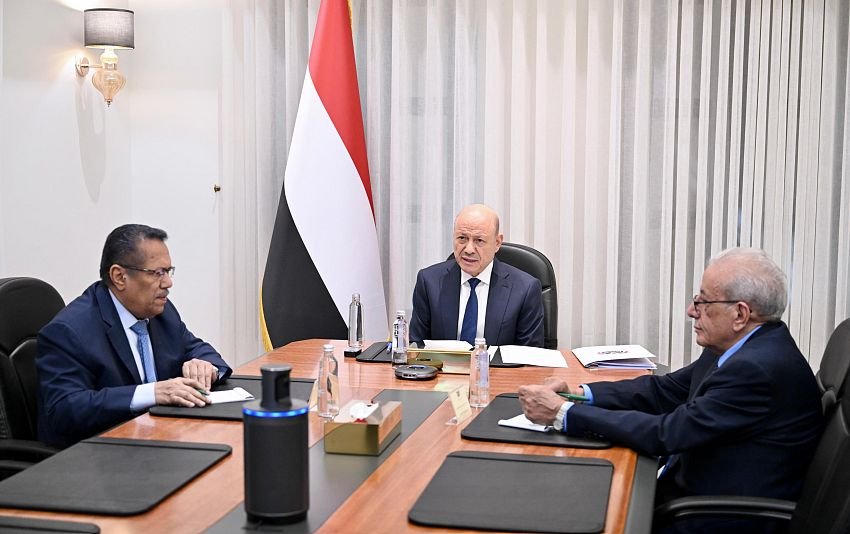
ADEN, Yemen — Presidential Leadership Council Chairman Rashad al-Alimi said Wednesday that Operation Yemen Dawn will continue until government forces restore Sanaa and extend state authority nationwide.
He spoke at a meeting with leaders of the National Coalition of Political Parties and Components, a grouping headed by Ahmed Obaid bin Daghr, who served as prime minister from 2016 to 2018.
The account of the meeting rests on the state news agency Saba, which is run by the internationally recognised government. No independent confirmation of what was said has been published.
Yahya al-Shaibi, director of the presidency office, attended, Saba reported. So did Abdullah Abu Huriah, minister of state for parliamentary affairs, who chairs the committee that handles political parties.
Al-Alimi described the offensive as a new phase aimed at restoring state institutions and completing the recovery of territory outside government control, according to the agency.
The government announced the start of the operation on Oct. 4.
Al-Alimi said progress on one front might be accompanied by setbacks on another, Saba reported. He said the objectives had not changed.
He asked the parties to convert political backing into organised work. That meant opening or reactivating branches across the governorates, he said.
He also asked them to stay in contact with members and supporters living in areas the Houthis administer.
The chairman praised the armed forces, security units and the irregular formations the government calls popular resistance. He referred to those killed and wounded, and to their families.
Al-Alimi returned to a safe-return and amnesty offer the council has promoted. It applies to fighters who leave the Houthi movement, Saba reported, and excludes anyone involved in a specified list of crimes.
He said the offer could separate the movement’s leaders from the communities whose young men are sent to the front.
He thanked Saudi Arabia for its backing, naming King Salman bin Abdulaziz and Crown Prince Mohammed bin Salman. Saudi Arabia has led the military coalition supporting the government since 2015.
Al-Alimi welcomed a Saudi cabinet statement that reaffirmed support for restoring state institutions, the agency said. The cabinet said the Houthis had chosen escalation over peace and that their actions threatened shipping in the southern Red Sea and the Bab al-Mandab Strait.
He praised directives attributed to King Salman on the status of Yemenis in Saudi Arabia who hold no legal residency.
The Houthi movement rejects the council’s authority. It describes the offensive as foreign-directed aggression and disputes the government’s account of the fighting. It did not comment on Wednesday’s meeting.
The council was formed in April 2022, when President Abed Rabbo Mansour Hadi transferred his powers to an eight-member body. Al-Alimi has chaired it since.
Fighting has widened since early August. The government said on Oct. 5 that its forces had taken Bab al-Mandab and the Red Sea port of Mocha. The Houthis disputed that account.
Houthi fighters cut the road between Taiz and Aden on Oct. 4 after seizing al-Safiya, according to security sources cited at the time.
The International Organization for Migration said 184,000 people were displaced inside Yemen between Aug. 1 and Oct. 4. Most moved after Sept. 1, the agency said.
Its Displacement Tracking Matrix recorded 21,798 people displaced in the week to Oct. 3. That was a 26 percent increase on the previous week.
The United Nations humanitarian plan published in March estimated that more than 22 million Yemenis needed assistance this year, and that 18.3 million were acutely food insecure. It sought 2.16 billion dollars to reach 12 million people.
The Saudi-led coalition said about 100 aircraft took part in the opening phase of the offensive, The National reported.
Government forces opened a push to retake al-Waziyah, west of Taiz, on Oct. 7, Al Jazeera reported.
The World Health Organization has recorded 5,166 casualties in Yemen since fighting resumed in August.
Yemen’s delegation told the UN Human Rights Council on Oct. 5 that the escalation had killed more than 250 civilians. The Houthis reject government casualty accounts.
Houthi forces have fired on Saudi territory during the offensive. Jordan condemned attacks on Jazan and Najran, and the Saudi-led coalition said a Houthi drone struck a power station near Medina.
Two Houthi missiles targeted Aden airport on Oct. 7, the transport ministry said, forcing an inbound flight to divert.
Donors have directed money toward Yemen over the past week. The UN Central Emergency Response Fund released 18 million dollars, France pledged a further 3 million euros and Japan announced an 8 million dollar emergency grant.
Al-Alimi visited commanders on the Taiz front on Oct. 1, three days before the offensive began.
The Southern Transitional Council, which holds seats on the leadership council, has called a mass rally in Aden for Oct. 14.
Qatar’s emir renewed support for Yemen’s unity in a message to al-Alimi, Saba reported on Oct. 6.
The same UN plan counted 5.2 million people displaced inside Yemen before the current escalation, and more than 2.2 million children under five acutely malnourished, of whom 516,157 were severely affected.
The World Food Programme warned on Oct. 4 that food security in Yemen could collapse, saying three in four households were going without adequate food.
Saba said the coalition of parties pledged to back the state through the current phase.
Saba did not say where Wednesday’s meeting was held.
About the Author