ANKARA, Turkey — Turkish Foreign Minister Hakan Fidan said on Thursday that
 Yemen Herald News
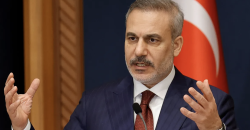
ANKARA, Turkey — Turkish Foreign Minister Hakan Fidan said on Thursday that Turkey will not send troops to attack the Houthis in Yemen, describing its defence pact with Saudi Arabia as defensive.
Fidan spoke at a news conference in Ankara, as Saudi Arabia sought military support from allies after a week of Houthi strikes on its airports.
“This is not an offensive agreement,” Fidan said of the accord, according to Middle East Eye.
He said Turkey will not send troops to another country’s territory to launch an attack there.
Any Turkish deployment to Saudi Arabia would be “only defensive in nature,” Fidan said.
The accord is the Makkah Joint Defence Agreement, signed in August by Saudi Arabia, Turkey and Pakistan. Its text has not been made public.
Fidan said the work needed to put the agreement before the Turkish parliament had been completed.
“The necessary work to submit the Mecca agreement to the Turkish parliament has been concluded,” he said. Ankara had decided to forward it to parliament as soon as possible, he added.
Military delegations would assess Saudi Arabia’s operational defence needs and determine what Turkey and Pakistan could contribute, Fidan said.
The three countries agreed this week to deploy forces and military equipment jointly in support of Riyadh.
Pakistani Deputy Prime Minister Ishaq Dar, Saudi Defence Minister Khalid bin Salman and Fidan were photographed together in Riyadh on Monday.
Middle East Eye reported earlier in the week, citing unnamed officials, that Turkey could send additional personnel, pilots and aircraft in the coming weeks, subject to parliamentary approval.
The same officials said air defence and electronic warfare equipment could also be provided.
A senior Turkish official told the outlet that Ankara does not plan to send a large group of soldiers and has no plans to intervene directly in Yemen.
Turkish officials said the country has kept technical teams, air defence systems and electronic warfare equipment in Saudi Arabia since last year.
They said a military training agreement dating from 2010 allows limited Turkish forces into the kingdom for technical purposes.
A small number of special forces could deploy once parliament grants authorisation, which officials expect later this month.
Pakistan has gone further. Its foreign ministry said on Friday it has a “substantial number of forces as well as resources” in Riyadh.
The deployments follow attacks on two Saudi airports that Saudi Arabia’s General Authority of Civil Aviation said killed three people and injured 36.
A Sudanese resident was killed at King Khalid International Airport in Riyadh, the authority said.
Two women, one Moroccan and one Algerian, were killed at Abha International Airport.
Eight people were injured in Riyadh, among them five Saudi citizens, two Egyptian residents and a Pakistani national, the authority said.
Twenty-eight were injured at Abha, including Saudi citizens and residents from Bangladesh and the Philippines.
Earlier in the week, attacks on Jazan and Najran airports near the Yemeni border injured three people and caused material damage, Saudi authorities said.
Saudia said one of its pilots, Captain Hamoud Ali Alkalthami, was killed and one of its aircraft damaged in a later strike on the Riyadh airport.
The Houthis said a ballistic missile hit its intended target at King Khalid International Airport on Thursday. Saudi Arabia has not confirmed that strike.
The Saudi-led coalition said on Thursday it intercepted two ballistic missiles heading toward Riyadh and one toward Khamis Mushait.
It said on Friday it had destroyed three rocket launch platforms used by the Houthis.
Coalition spokesman Col. Turki al-Maliki said attacks on civilians will be met with resolve.
Saudi civil aviation authorities said airport operations resumed on Friday and air traffic returned to normal.
Houthi spokesman Yahya Saree warned airlines against flying in Saudi airspace, saying aircraft over the kingdom, except over Mecca and Medina, would be treated as targets.
The exchanges follow a counteroffensive launched in early October by Yemen’s internationally recognised government.
Government forces said they reached Mokha on Monday and pushed the Houthis back from the Bab al-Mandab strait. The Houthis dispute that account.
The Houthis had seized territory along the strait in September.
The coalition said it carried out 97 targeting operations against Houthi reinforcements on the Tor al-Baha front and the Taiz axis.
It said separately that it had destroyed 82 Houthi military sites in Saada, Hodeidah, Jawf and Marib.
Missile and drone strikes hit Aden International Airport on Wednesday, Yemen’s transport ministry said. A missile landed near the runway as a flight from Cairo was due. The Houthis said the target was a military camp nearby.
Syria denied this week that it had been asked to send forces. A media adviser to the Syrian president called reports of such a request a lie.
The United States has declined to carry out direct strikes on the Houthis and is providing intelligence support, Time reported.
The International Organization for Migration said more than 200,000 people have been displaced since fighting resumed in June.
Saudi Arabia accused the Houthis last month of attempting an attack on Mecca, calling it a red line. The Houthis and Iran denied it.
The coalition accuses Iran of arming and funding the Houthis. Iran and the Houthis deny it.
About the Author