Syria denies it is weighing troop deployment to Yemen
 Yemen Herald News
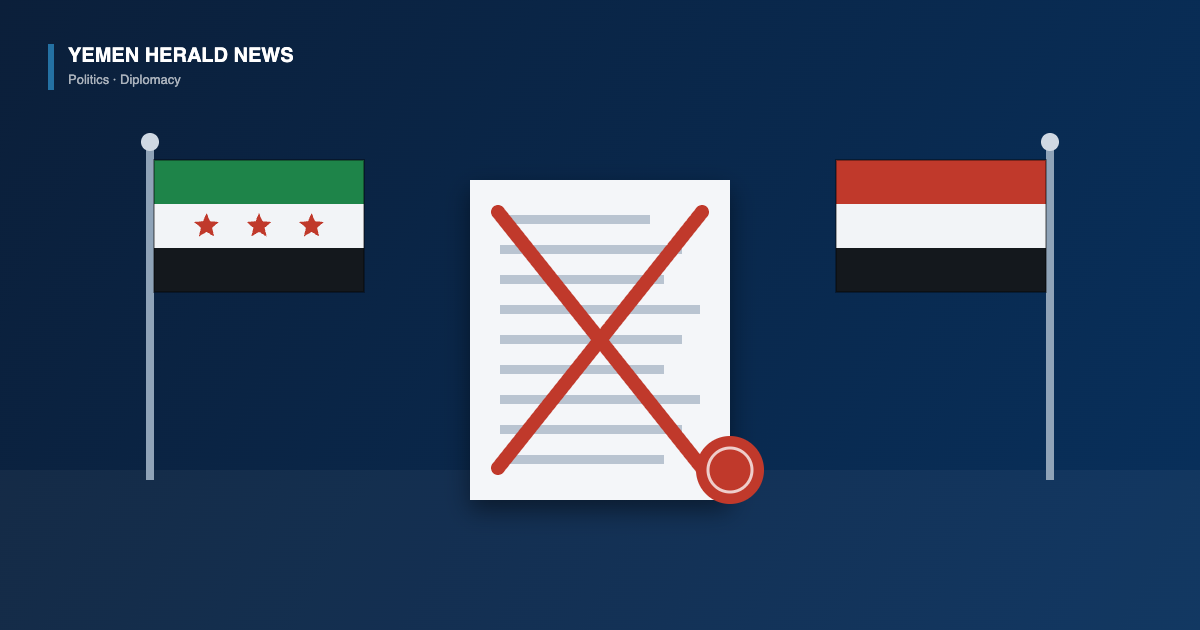
DAMASCUS, Syria — Syria has denied reports that it is considering sending troops to Yemen to fight the Houthis, saying its priority is rebuilding the country.
Ahmed Muwaffaq Zeidan, the presidential media adviser, said the reports circulating about a deployment were false and without foundation.
He said Syria stood with Saudi Arabia on matters of its security.
The Syrian Ministry of Information issued a separate statement. It said the priority at this stage is rebuilding the country and strengthening its institutions.
The ministry said Damascus was working with partners on reconstruction and on improving the lives of Syrians.
It said Syrian policy rested on stability, peace and cooperation, and not on opening new fronts.
The denials were issued on 7 October.
They followed reports by Axios and Reuters that Damascus was weighing a Saudi request to send forces to Yemen.
Those reports said the request involved thousands of troops. Yemen Herald could not independently confirm the terms of any such request.
Neither report has been confirmed on the record by Saudi Arabia.
The exchange comes as Saudi Arabia seeks support from partners for its campaign against the Houthis.
Saudi Arabia and the Yemeni government launched that offensive at the start of October.
It followed the seizure by Houthi forces of a stretch of territory along the Bab al-Mandab strait in September.
The Saudi-led coalition said about 100 aircraft took part in the opening phase.
It said its forces carried out 97 targeting operations against Houthi reinforcements on the Tor al-Baha front and the Taiz axis.
Yemeni government forces have claimed control of the Bab al-Mandab coastline and the port of Mokha. The Houthis have not confirmed losing ground there.
Other governments have set out their own limits in the past week.
Turkish Foreign Minister Hakan Fidan said Thursday that Türkiye would not send troops to another country to mount an attack.
He described the defence agreement signed in August by Türkiye, Saudi Arabia and Pakistan as defensive, and said Turkish officials were assessing support in air defence, electronic warfare and technical assistance.
That agreement is known as the Mecca Joint Defence Agreement. Under its terms an armed attack on one signatory is treated as an attack on all.
Turkish officials told Reuters that support in the near term would be largely bilateral, because parliament has not ratified the pact.
A Pakistani Foreign Ministry spokesman said Friday that Pakistan had a substantial number of forces in Riyadh.
He said Pakistani personnel would act in defence of Saudi territory and would not cross into Houthi-held areas.
The Houthis have struck targets inside Saudi Arabia during the offensive.
Saudi Arabia’s General Authority of Civil Aviation said attacks on the airports at Riyadh and Abha killed three people and wounded 36.
It said a further attack at Riyadh’s King Khalid International Airport on Thursday killed three Saudi citizens and damaged a Saudia aircraft on the ground.
The authority said the first strike hit airport facilities and the second hit the aircraft. It said several people of different nationalities were wounded, with injuries ranging from minor to severe.
Saudia named one of the dead as Captain Hamoud Ali al-Kalthami, a pilot.
The Houthi military spokesperson said the group fired a ballistic missile at the airport and that it hit its target.
The group has told airlines to stay out of Saudi airspace.
It said aircraft other than those flying over Mecca and Medina would be treated as targets, and warned that the conflict would be a long one.
At least three people were wounded in attacks on the airports at Jazan and Najran, near the Yemeni border.
At least 124 flights to and from Riyadh were cancelled by Friday afternoon, according to FlightAware.
Air India suspended operations through Saturday, the Indian Embassy said. Lufthansa Group suspended its Riyadh flights through 16 October, and Pakistan International Airlines halted service.
Riyadh airport reopened on Friday, and the aviation authority said air traffic had returned to normal.
The coalition said it intercepted two ballistic missiles heading toward Riyadh on Thursday, and destroyed three rocket launch platforms on Friday.
Coalition spokesman Colonel Turki al-Maliki said attacks on civilians and civilian facilities would be met with resolve.
The United Arab Emirates, the United Nations, the United Kingdom and several Arab states condemned the airport attacks. The UAE said the three killed in the earlier attacks were a Moroccan, an Algerian and a Sudanese national.
Syria has its own reconstruction burden after years of war.
Its government has sought international support for rebuilding, and has pointed to that work in explaining its position on Yemen.
Yemen’s war has driven one of the world’s largest relief operations.
The United Nations humanitarian plan for 2026 says more than 22 million people in Yemen need assistance.
It says 18.3 million people are acutely food insecure, and that more than 2.2 million children under five are acutely malnourished, 516,157 of them severely.
It records 5.2 million displaced people and seeks 2.16 billion dollars to reach 12 million of those in need.
The Houthis took the Yemeni capital, Sanaa, in 2014, and a Saudi-led coalition intervened the following year.
The Houthis are aligned with Iran, which has denied arming them.
The war was largely frozen for years before the current escalation.
Zeidan did not say whether Syria had received any request.
About the Author