Saudi-led coalition says it destroyed three Houthi missile launchers in Yemen
 Yemen Herald News
RIYADH, Saudi Arabia — The Saudi-led coalition said on Friday it destroyed three Houthi missile launchers in Yemen, a day after attacks on Riyadh’s main airport killed three Saudi citizens.
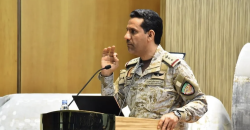
Maj. Gen. Turki al-Maliki, official spokesman for the Coalition to Support Legitimacy in Yemen, announced the strikes in a statement posted on X.
“We destroyed 3 rocket launch platforms used by the Houthi militia to threaten regional security,” he said.
Al-Maliki said Houthi attacks on civilians and civilian facilities “will be met with resolve.”
The coalition said the strikes were carried out on Thursday. It did not say where in Yemen the launchers stood.
The Saudi Press Agency published footage it said showed strikes on three truck-mounted launchers at separate locations. One sequence shows a strike on a member of a launch crew.
The account of the operation rests on the coalition’s own statement and the footage it released. Yemen Herald found no independent confirmation that the launchers were destroyed.
The Houthis have not commented on the claim.
The launcher strikes fall within a wider air campaign the coalition has described in near-daily statements.
The coalition said on Wednesday it had destroyed 82 Houthi military targets in Saada, Hodeidah, al-Jawf and Marib.
Those included 11 mountain-based ballistic missile storage sites in Saada, command and control centres, communications systems and weapons depots, it said.
Al-Maliki said on 5 October that 324 high-value targets had been destroyed. The coalition said it was supporting Yemeni government forces with 100 fighter jets.
Coalition naval forces struck Hodeidah governorate the same day, destroying weapons depots, boat explosive storage and naval mines, al-Maliki said.
Yahya Saree, the Houthi military spokesman, gave a different account. He said 60 airstrikes and a missile had hit Sanaa and five other governorates in 24 hours.
Saree said Saudi Arabia had carried out 1,576 strikes since the escalation began. Yemen Herald could not verify either figure.
The strikes followed two attacks on King Khalid International Airport in Riyadh on Thursday.
Saudi Arabia’s General Authority of Civil Aviation said three Saudi citizens were killed. One attack hit airport facilities. The other struck a Saudia aircraft.
Saudia named the dead pilot as Captain Hamoud Ali Alkalthami.
The authority said citizens and residents of several nationalities were wounded. It gave no figure for Thursday.
It said later that airport operations had resumed and that air traffic had returned to normal.
Saree said the group fired a ballistic missile at the airport on Thursday afternoon and that it hit its target.
He warned airlines the same day against flying in Saudi airspace, which he called a theatre for Houthi operations.
A separate run of attacks preceded them in the first week of October.
The civil aviation authority said on Tuesday that attacks on Jazan and Najran airports the previous evening injured three people and caused material damage.
It said on Wednesday that an attack on Abha International Airport killed two women, one Moroccan and one Algerian, and wounded 28.
An earlier attack on King Khalid airport killed a Sudanese national and injured eight people, among them Saudi, Egyptian and Pakistani residents, the authority said.
Those attacks left three dead and 36 wounded. The Houthis claimed them.
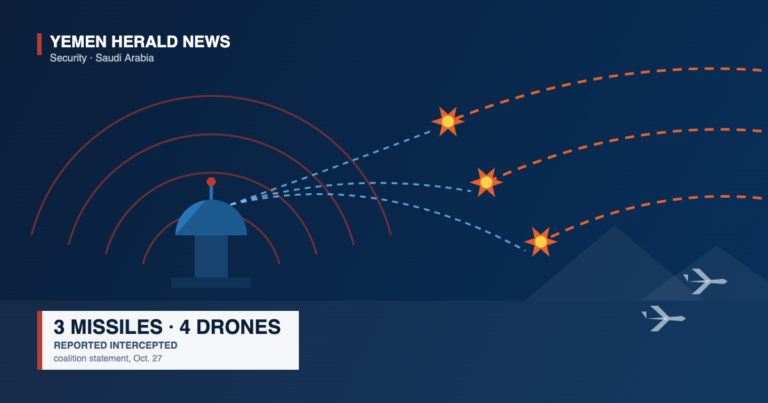
The coalition said on Thursday it destroyed two ballistic missiles heading toward Riyadh and a third heading toward Khamis Mushait, near the Yemeni border.
Saudi Arabia’s civil defence agency said debris from an intercepted missile damaged a kindergarten and a medical clinic complex in Riyadh. It did not say whether anyone was hurt.
Stephane Dujarric, spokesman for the UN secretary-general, said on Thursday that targeting civilians and civilian facilities is prohibited under international humanitarian law. He urged all parties to protect civilians.
Airlines cut service to the Saudi capital. Air India cancelled Riyadh flights until at least the weekend.
Lufthansa Group airlines suspended Riyadh flights through 16 October, Reuters reported.
The United States embassy urged its citizens to watch for cancellations and airspace closures.
Saudi Arabia and Yemen’s internationally recognised government asked the UN Security Council on Friday to act on the escalation.
Rashad al-Alimi, head of Yemen’s Presidential Leadership Council, announced the government offensive on 4 October. He said it aimed to restore state institutions and retake Sanaa.
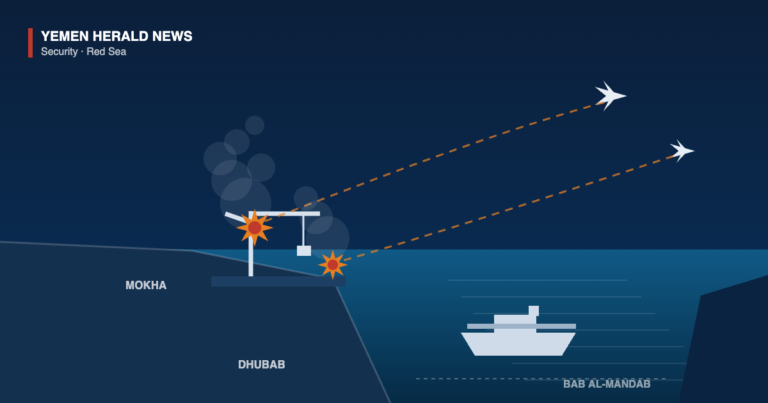
The Houthis had taken Mokha on 10 September. They seized Al Turbah, south of Taiz on the road to Aden, on 4 October.
Government forces said they reached Mokha on 5 October and pushed the Houthis back from the Bab al-Mandab Strait. The Houthis dispute that account.
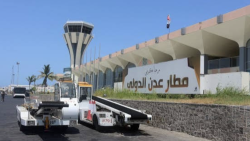
The Southern Giants Brigades said they took Dhubab airport, cutting the supply line between Mokha and Bab al-Mandab.
Yemeni authorities said a missile landed near the runway at Aden airport on Wednesday as a Cairo flight was due. The Houthis said their target was a military camp nearby.
The International Organization for Migration said on Wednesday that more than 200,000 people had been displaced since the fighting began in June.
Yemen’s 2026 humanitarian plan counts more than 22 million people in need and 18.3 million who are acutely food insecure, according to the United Nations.
The plan seeks 2.16 billion dollars to reach 12 million people.
Al-Maliki did not say whether the coalition would release further detail on the strikes.
About the Author