Saudi-led coalition says projectile struck Riyadh airport terminal and started a fire
 Yemen Herald News
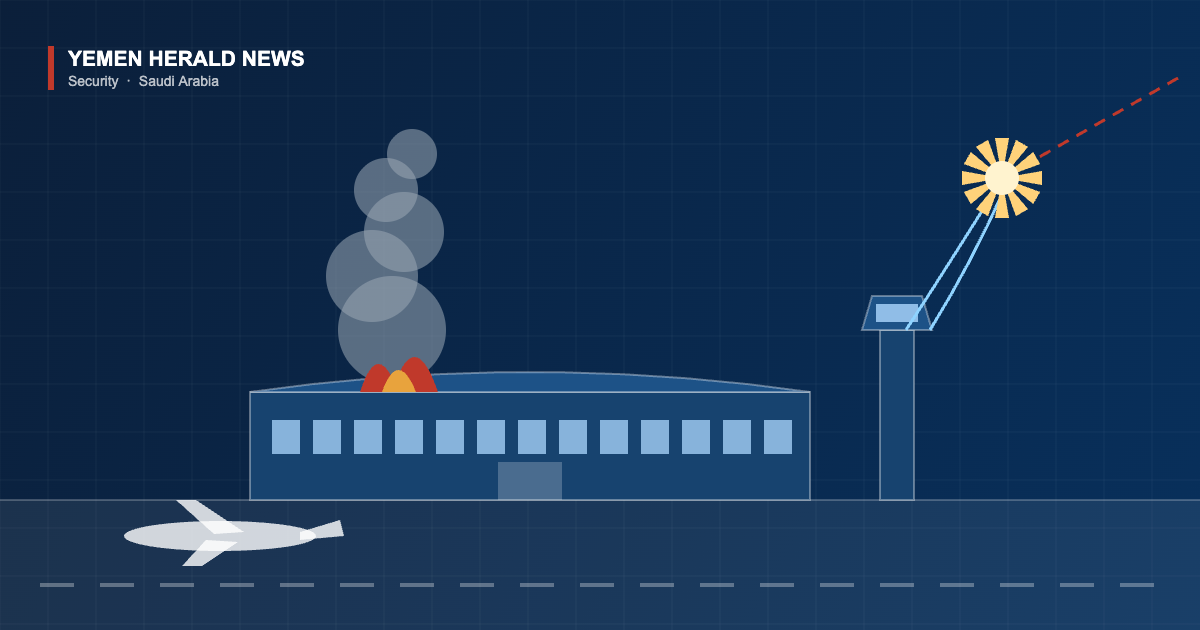
RIYADH, Saudi Arabia — A projectile struck a passenger terminal at King Khalid International Airport on Sunday and started a fire, the Saudi-led coalition in Yemen said.
The coalition said the projectile hit Terminal 4.
Coalition spokesman Turki al-Malki said air defences intercepted a cruise missile near the airport.
Saudi Arabia’s General Authority of Civil Aviation said the attack caused injuries. It gave no number.
The authority said damage assessment and safety checks of airport buildings were under way.
The airport stayed closed through Sunday. Flightradar24 said the suspension had been extended to midnight local time at the start of Monday.
Saudi aviation authorities did not say when flights would resume. One aviation source said operators were told at dawn that flights would remain suspended.
A second source said radar and communications equipment had been damaged and that the runways needed assessment.
The strike followed an attack on the same airport on Saturday that Saudi authorities said killed 12 people and injured 309.
The civil aviation authority said the dead were four Saudis and eight foreign nationals, among them an American. It said some of the injured were in critical condition.
India’s embassy in Riyadh said on Sunday that an Indian citizen wounded in Saturday’s attack had died.
Jordan said one of its citizens was killed and four were wounded.
U.S. Secretary of State Marco Rubio said an American citizen was among the dead. He called for the attacks to stop.
The head of the Houthi movement’s media office said on X that the group had shut Riyadh’s airport. The movement claimed a ballistic missile strike there on Thursday. It made no formal claim for Saturday’s attack.
The movement said it struck four Saudi targets in 24 hours, naming the airports at Riyadh and Dammam, a gas site operated by Aramco at Shugadam and the Tanajib refinery.
Saudi Arabia did not confirm the claims about the oil and gas sites.
Houthi military spokesman Yahya Saree warned airlines, airport workers and travellers against using Saudi airports and airspace, saying the facilities remained vulnerable.
The movement has told aviation companies to avoid Saudi airspace except over Mecca and Medina, and has said it regards aircraft there as targets.
The Houthis say their strikes answer Saudi attacks on the airports at Sanaa and Hodeidah, and that they intend to close Saudi airports to traffic.
King Fahd International Airport in Dammam was also attacked, and damage there was being assessed.
Houthi-run Al Masirah television reported a Saudi strike on Sanaa International Airport. Saudi Arabia did not comment immediately.
Carriers in the United Arab Emirates extended cancellations of flights to Riyadh into Tuesday.
United Nations Secretary-General Antonio Guterres said in a statement on Saturday that attacks on civilians and civilian infrastructure are a violation of international law, and that the attacks “must cease immediately”.
Hans Grundberg, the U.N. special envoy for Yemen, told the Security Council on Oct. 9 that the country had “slid back into full-scale war, with hostilities spreading across multiple frontlines”.
Grundberg said fighting had continued in the highlands west and south of Taiz city and had extended into Lahj. He repeated a call on Ansar Allah, the Houthi movement’s formal name, to stop its attacks on Saudi Arabia.
He said civilians, especially women and children, were again bearing the brunt of the violence, in a country the International Monetary Fund ranks as the world’s poorest.
“Gains on the battlefield cannot substitute for the negotiations that will be required to settle the conflict,” Grundberg said.
Saudi Arabia’s representative to the United Nations, Abdulaziz al-Wasil, told the Security Council that the targeting of civilians threatened international peace and security.
Al-Maliki said earlier that attacks on civilians “will be met with resolve”.
Asked on Saturday whether the United States would take part in Saudi strikes, President Donald Trump told reporters: “We may. We’re going to look at it.” He announced no decision.
Israeli Prime Minister Benjamin Netanyahu described Saturday’s attack as a “horrific terrorist attack”. Kaja Kallas, the European Union’s foreign policy chief, called it an “appalling act of terror”.
Saturday’s strike was the third on the airport in a week, the civil aviation authority said.
Three people were killed in an attack on the airport on Oct. 8, among them a pilot for the national carrier Saudia whom the airline named as Captain Hamoud Ali Alkalthami. Dozens were wounded.
The civil aviation authority said attacks on King Khalid and Abha airports on Oct. 7 killed three civilians and injured 36.
At least three people were wounded in attacks on the airports at Jazan and Najran, near the border with Yemen.
The Houthi movement has held Sanaa since 2014. A Saudi-led coalition intervened in Yemen in March 2015 on behalf of the internationally recognised government.
The two sides give conflicting accounts of the damage their attacks cause, and each disputes the other’s casualty figures.
The United Nations humanitarian response plan for Yemen, published in March 2026, put the number of people in need at more than 22 million and sought 2.16 billion dollars to reach 12 million of them.
Yemen Herald could not independently establish the origin of the projectile that hit Terminal 4 on Sunday. The civil aviation authority is the only source for Sunday’s report of injuries. It gave no number, and no independent confirmation has been published.
The Saudi embassy in Kuwait arranged buses for Saudi citizens whose flights were cancelled.
About the Author