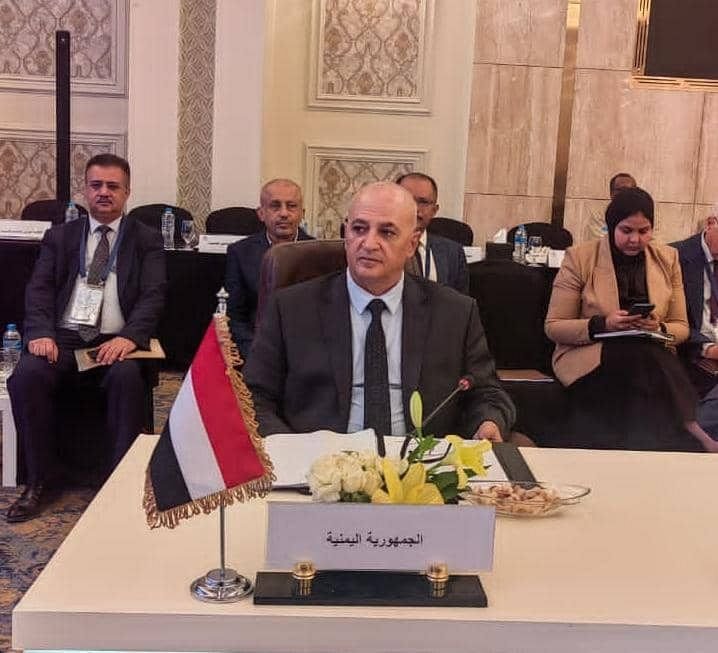
Yemen’s vice foreign minister briefs UN refugee chief Barham Salih in Geneva
 Yemen Herald News
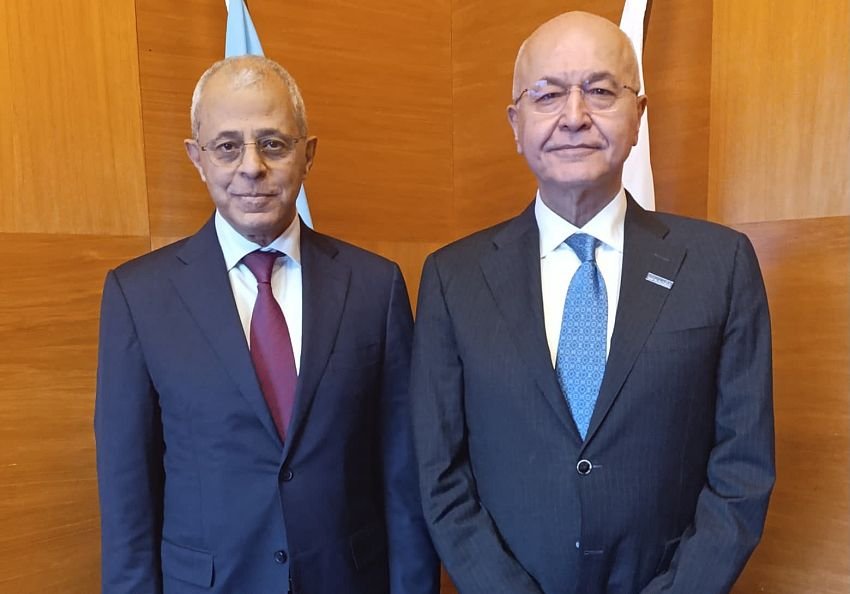
GENEVA, Switzerland — Yemen’s vice foreign minister briefed the UN refugee chief on his country’s displacement crisis on Monday, on the sidelines of the agency’s annual governing session.
Mustafa Noman met Barham Salih, the United Nations High Commissioner for Refugees, during the 77th session of the agency’s Executive Committee, Yemen’s state news agency Saba reported.
Saba said the two discussed cooperation between Yemen and the refugee agency, the humanitarian situation and the displacement caused by the fighting.
Noman blamed a recent military escalation by Houthi forces for deepening civilian suffering, according to the agency. He also raised the siege of Taiz, which he attributed to the group.
The Houthis did not comment on his remarks. The group disputes government accounts of the fighting in Taiz.
The account of the bilateral meeting rests on Saba, which is run by the internationally recognised government. No independent confirmation of the meeting has been published.
Salih said the refugee agency wanted to widen its field presence in Yemen and work with the government on humanitarian problems, Saba reported.
The Executive Committee opened its 77th session in Geneva on Monday. The committee is made up of member states, oversees the refugee agency’s programmes and approves its budget.
Salih took office in January, succeeding Filippo Grandi. The General Assembly elected the former Iraqi president to the post in December 2025.
He told the committee that aid organisations were being asked to do “the impossible” as funding falls.
UNHCR has received about 3 billion dollars for 2026, roughly 35 percent of the 8.5 billion dollars it says it needs.
The agency has proposed a 2027 budget of 7.1 billion dollars, 16 percent below this year’s, against forecast income of 2.68 billion dollars.
Salih pointed to the effects of the shortfall elsewhere. He said services for unaccompanied children were at risk in Chad, and that registration had stopped for tens of thousands of refugees in Ethiopia.
Global humanitarian funding fell to an estimated 33.3 billion dollars in 2025, from 47.5 billion dollars at its peak in 2022, according to the research network Alnap.
More than 117 million people are displaced worldwide, according to UNHCR. The agency is responding to 22 emergencies in 18 countries this year, Yemen among them.
Noman told the session that Yemen had hosted refugees for decades despite limited means, and that none of its refugee commitments had drawn international funding, Yemen TV reported.
He said burden-sharing was a mutual obligation, and that Yemen wanted partnership with the international community rather than a substitute for its own state.
He asked the committee to move from managing needs year by year toward recovery and rebuilding institutions, according to the same account.
Noman said the escalation had displaced tens of thousands of people. Salih told the session that recent escalations had displaced hundreds of thousands, and urged an end to the fighting.
The International Organization for Migration says more than 201,000 people have been displaced in Yemen since September, with Taiz the worst affected.
Hans Grundberg, the UN special envoy for Yemen, told the Security Council on 9 October that the country had returned to full-scale war.
Grundberg said that unless war became Yemen’s permanent reality, the time to consider political strategies was now. He asked the council to back mediation.
Jeff Bartos, the US ambassador to the UN for management and reform, told the council Washington was gravely concerned by the Houthi escalation. He called on Iran to end its support for the group.
President Rashad al-Alimi, chairman of the Presidential Leadership Council, announced an offensive on 4 October to restore state authority. The government calls the operation Dawn of Yemen.
Government forces are trying to retake the Bab al-Mandab strait, which has carried more traffic since attacks disrupted shipping through the Strait of Hormuz.
The Houthis declared a blockade on Saudi-linked shipping in July. In September they seized Mayyun Island and areas around Mocha and Dubhab.
Saudi-led coalition officials say air strikes have destroyed 136 military targets in areas the Houthis hold. Strikes have hit Sanaa International Airport, telecommunications sites and Mount Attan.
The armed forces spokesman, Colonel Majid al-Nuzaili, said government forces had carried out more than 2,750 strikes in 24 hours. The Houthis dispute government accounts of the campaign.
The Houthis have fired on airports in Saudi Arabia during the escalation. Several airlines suspended flights to Riyadh.
The UN says at least 46 civilians have been killed and more than 130 injured since August.
Fighting has intensified across Taiz governorate since September. Aid agencies reported camps there filling with people fleeing the front lines.
The UN humanitarian plan for 2026 lists more than 22 million Yemenis in need of aid and 18.3 million as acutely food insecure. It counts 5.2 million displaced people and seeks 2.16 billion dollars to reach 12 million of them.
Yemen’s war began in 2014, when the Houthis took Sanaa. A UN-brokered truce in 2022 reduced the fighting for a time.
Yemen’s delegation also included Muthana al-Amri, who directs the foreign ministry’s international organisations department, and Yahya al-Rafiq, first secretary at Yemen’s mission in Geneva.
The committee is due to approve the agency’s budget this week.
About the Author