Ambassador Mohammed al-Maytami discusses Houthi escalation and Red Sea shipping with Chinese official
 Yemen Herald News
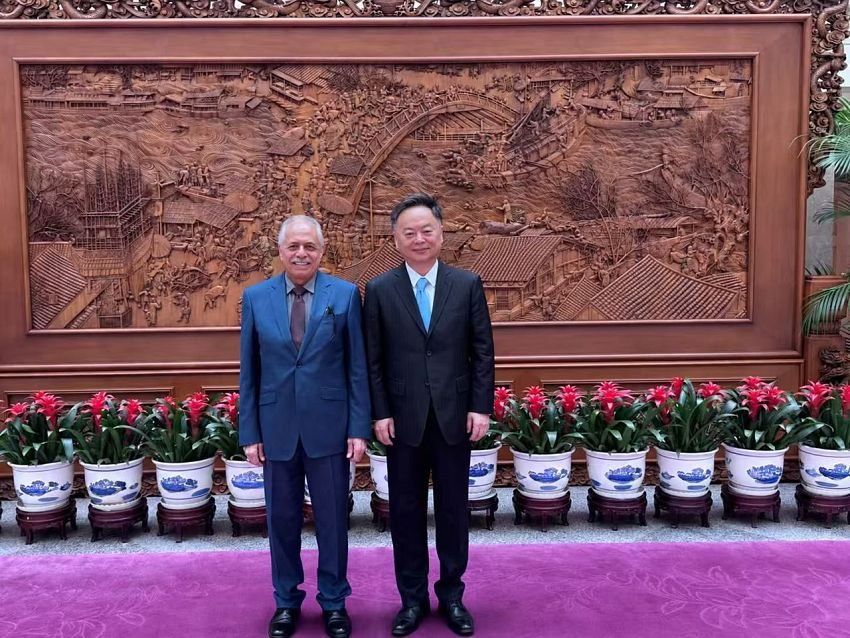
BEIJING, China — Yemen’s ambassador to China met a senior Chinese foreign ministry official on Monday to discuss Houthi military escalation and the safety of shipping in the Red Sea.
Ambassador Mohammed al-Maytami held the talks with Chen Weiqing, director of the West Asia and North Africa Department at China’s Ministry of Foreign Affairs, the state news agency Saba reported.
The two also discussed bilateral relations and the passage of international shipping through the Bab al-Mandab Strait, according to the agency.
Al-Maytami asked Beijing to increase humanitarian and development assistance, Saba said. He called for cooperation programmes to be activated through the China International Development Cooperation Agency, the body that administers Chinese foreign aid.
Chen said China supported Yemen’s sovereignty, unity and territorial integrity, according to the agency. He said Beijing wanted security and stability in Yemen and the wider region.
The account rests on Saba, which is run by the internationally recognised government. Yemen Herald found no independently published account of the meeting, and no readout has appeared from the Chinese foreign ministry. Saba rendered the Chinese official’s name as Chen Wei Cheng; Yemen’s own foreign ministry spells it Chen Weiqing.
Saba described the humanitarian situation as the product of what it called the Houthi militia’s coup and war. The Houthis reject that characterisation and blame the Saudi-led coalition and the government for the country’s economic collapse.
The meeting followed a month of attacks on Saudi territory.
Saudi authorities said a Houthi strike on King Khalid International Airport in Riyadh killed 12 people and wounded about 300 on Oct. 10, in accounts reported by Al Jazeera and CNN. An earlier attack on the airport killed three Saudi nationals. A further strike on Oct. 12 killed one person and injured 11, the authorities said.
Yemen’s cabinet approved a draft law on Oct. 12 designating the Houthis a terrorist organisation.
China’s own dealings over the shipping lane have drawn attention. Reuters reported on July 28 that Chinese officials had been in direct contact with the Houthis to secure safe passage for tankers carrying Saudi crude to China. The agency cited six people with knowledge of the matter, none of them named.
Those sources included a senior Iranian official, two people close to the Houthis, two Chinese trade sources and two regional officials briefed by Tehran, according to the report. Both sides kept Iran informed of the arrangements.
The Houthis had declared on July 20 that they would block access to Saudi ports, Reuters said. In the week before that announcement they struck two Saudi oil tankers with missiles and drones.
At least four tankers loaded crude at Saudi terminals for delivery to China and passed through Bab al-Mandab after the restrictions took effect, according to ship-tracking data from Kpler, LSEG and MarineTraffic cited in the report. Chinese officials cleared each vessel individually with the Houthis, two of the sources told the agency.
Two supertankers, the New Champion and the New Prime, turned back out of the Gulf of Aden. Their Hong Kong-based operator, Associated Maritime, did not respond to a request for comment, Reuters said.
The route matters to Chinese buyers. A voyage from the Saudi terminal at Yanbu to Asia through Bab al-Mandab takes about 16 days. The alternative around southern Africa takes about 50.
Beijing’s interest lies in keeping Saudi exports from the Red Sea terminal at Yanbu flowing while Iran’s effective closure of the Strait of Hormuz constrains supplies from the Gulf, Reuters said. China is among the largest buyers of Saudi crude.
Beijing has not confirmed the contacts. China’s transport ministry, the Houthis’ media office and Iran’s foreign ministry did not respond to the agency at the time.
Al-Maytami has met the same Chinese department before. In December 2025 he briefed Chen on Yemen’s political and security situation and on what the Yemeni government described as unilateral actions by the Southern Transitional Council, according to Yemen’s Ministry of Foreign Affairs.
The Yemeni government reaffirmed its commitment to de-escalation at that meeting, the ministry said.
At that meeting the ambassador called for military forces to withdraw from Hadramawt and al-Mahra governorates. Chen said China would keep backing political efforts toward a comprehensive settlement, the ministry said.
Yemen’s four-year truce collapsed in July.
The United Nations migration agency said more than 201,000 people have been displaced inside Yemen since September, with Taiz governorate worst affected.
The United Nations humanitarian plan published in March put more than 22 million Yemenis in need of assistance. It recorded 18.3 million people as acutely food insecure and more than 2.2 million children under five as acutely malnourished, 516,157 of them severely.
The plan counted 5.2 million internally displaced people and sought $2.16 billion to reach 12 million of them.
China is a permanent member of the United Nations Security Council, which has met this year on the risk of wider conflict around the Red Sea chokepoint.
An assistant secretary-general told the United Nations Security Council this year that a Houthi advance toward the key Red Sea chokepoint raised the risk of a wider conflict.
The China International Development Cooperation Agency was created in 2018 to coordinate Beijing’s foreign aid.
About the Author