Yemen’s agriculture ministry signs food security agreement with World Food Programme
 Yemen Herald News
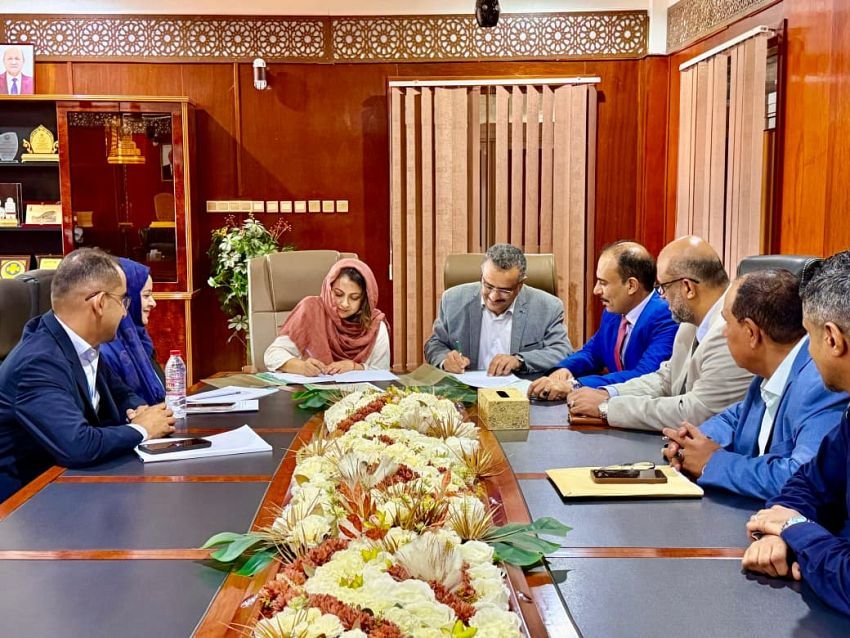
ADEN, Yemen — Yemen’s agriculture ministry signed an agreement with the World Food Programme on Tuesday to work together on food security and on the farming and fisheries sectors.
The memorandum of understanding was signed in Aden, the temporary capital.
Ahmed al-Zamaki, undersecretary of the Ministry of Agriculture, Irrigation and Fisheries for irrigation and land reclamation, signed for the government. The World Food Programme was represented by its deputy country representative in Yemen.
The account rests on the ministry’s own announcement, carried on Tuesday by Saba, the news agency run by the internationally recognised government. No independent confirmation of the signing has been published.
The memorandum covers four areas, according to Saba.
The first is sustainable agriculture and resilience to climate change.
The second is sustainable management of natural resources, including land and water.
The third is the development of food systems and agricultural value chains.
The fourth is support for small farmers and local markets.
Saba gave no funding figure, no duration and no direct statement from either signatory.
The World Food Programme’s own operations in Yemen are split by the front line. Its activities in areas run by the Houthi de facto authorities are suspended, in line with a United Nations-wide pause ordered by the Secretary-General, the agency says on its country page.
In government-held areas it delivers emergency food aid in rotating cycles that combine rations and cash. Cash transfers are used in southern Yemen, where markets are stable enough to cover basic food needs, with amounts set by household size.
The agency also distributes specialised nutritious food for young children and for pregnant and breastfeeding women and girls, to treat and prevent moderate acute malnutrition. It trains health ministry staff and volunteers and works with UNICEF and the Nutrition Cluster.
Primary-school children receive fortified biscuits on the days they attend. A Healthy Kitchen project provides meals made from locally sourced produce.
The agency runs the United Nations Humanitarian Air Service, supplies fuel to other aid organisations and leads the logistics and telecommunications clusters. It says funding shortfalls have narrowed the programme.
Its current interim country strategic plan runs from 2023 to 2026.
Yemen’s food supply has been strained throughout the war.
The United Nations humanitarian response plan for 2026 recorded 18.3 million people as acutely food insecure.
More than 22 million needed assistance of some kind, and 5.2 million were displaced.
More than 2.2 million children under five were acutely malnourished, 516,157 of them severely.
The plan sought 2.16 billion dollars to reach 12 million people.
Reaching rural areas has been difficult. About 10 million Yemenis, roughly half of those in need at the time, lived in areas affected by access constraints, the aid group Humanity & Inclusion said in a report published in May 2022. Sixteen of the country’s 21 governorates were considered hard to reach.
Other agricultural programmes are running alongside the memorandum.
The European Union announced on 8 October that it was providing 10 million euros, about 11.4 million dollars, under an agreement with the United Nations Development Programme and the Food and Agriculture Organization.
That project, named Sanabel, runs for 42 months.
It is intended to strengthen agricultural value chains and link them to markets, help farmers take up climate-smart practices and improve water management, support local food processing and job creation, and manage natural resources, particularly water.
The announcement said agriculture supports millions of Yemenis and that displacement is expected to rise. It gave no target figure for the number of people the project will reach.
Saba reported earlier this month that the agriculture minister had discussed preparations for a new fisheries development project with the World Bank.
Fighting has disrupted supply lines.
Yemen’s war is generally dated to the Houthis’ capture of Sanaa in 2014, according to a House of Commons Library briefing published on 5 October. A Saudi-led coalition intervened the following year.
A six-month national ceasefire took hold in 2022 and front lines stayed largely stable afterwards, the briefing said.
That changed this year. The Houthis announced a new phase against Saudi Arabia in June, aimed at lifting the blockade of ports they control.
In July they declared a sea and air blockade on Saudi Arabia and launched drone and missile attacks on Saudi sites, their first since 2023, according to the briefing. A prisoner exchange planned for the same month stalled.
Saudi Arabia resumed air strikes in mid-2026, its first since 2022, and assembled a maritime coalition. Houthi forces then took several stretches of Red Sea coastline.
The Bab al-Mandab strait, which the briefing said carries about 7% of the world’s seaborne oil, is now disputed.
Britain announced defensive support for Saudi Arabia in September, including one RAF Voyager refuelling aircraft.
The south shifted earlier in the year. A Saudi-backed counter-offensive in January reversed gains made by the Southern Transitional Council, the briefing said. The council announced its own dissolution, a step some of its members disputed, and later relaunched under the name Transitional Council of South Arabia.
The United Arab Emirates withdrew most of its forces in 2020 and said in January that it would pull out those remaining.
Aid operations have been disrupted too. The United Nations moved its main Yemen office to Aden in September 2025, after Houthi authorities detained United Nations and other aid staff, the briefing said.
Neither the ministry nor the World Food Programme said when the memorandum takes effect.
About the Author