Yemen’s ambassador briefs Austrian Parliament President Walter Rosenkranz on war and aid needs
 Yemen Herald News
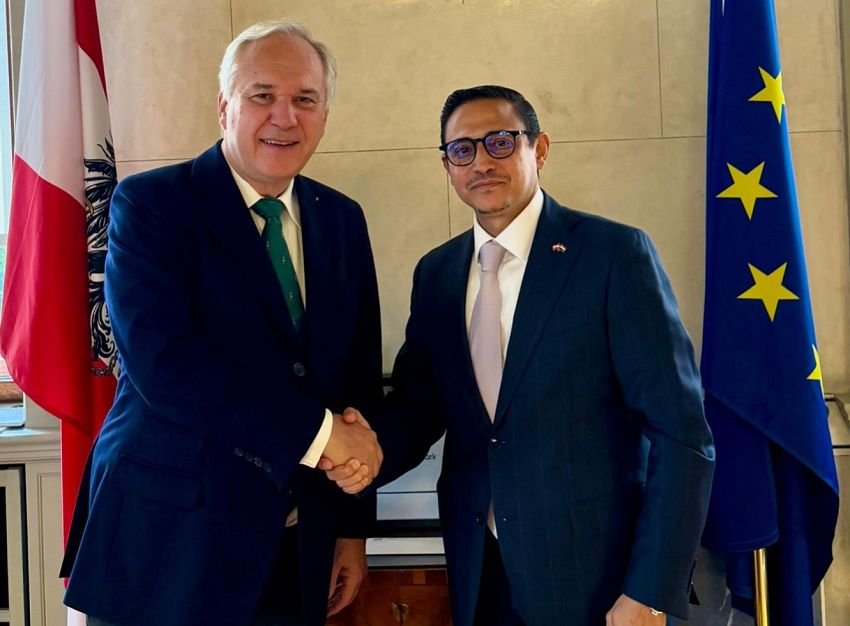
VIENNA, Austria — Yemen’s ambassador to Austria briefed the president of the Austrian Parliament on the government’s military offensive and the war’s humanitarian toll on Tuesday, Yemen’s state news agency said.
Haitham Shujaaldeen met Walter Rosenkranz in Vienna, the agency, Saba, reported.
The two discussed recent developments in Yemen and ways to strengthen cooperation between the two countries’ legislatures, according to the agency.
Saba said they also reviewed bilateral relations.
The account of the meeting rests on the Yemeni state news agency. No independent confirmation of it has been published.
Shujaaldeen briefed Rosenkranz on Operation Fajr al-Yemen, or Dawn of Yemen, the offensive the internationally recognised government launched against Houthi forces, Saba said.
The agency said the operation aims to restore state institutions and end what it called a coup by the Houthis.
The Houthis, who hold Sanaa and much of northern Yemen, reject that account of the war.
The ambassador said the group threatens commercial shipping in the Red Sea and the Bab al-Mandab strait, according to the agency.
He raised what he described as Houthi violations against civilians, Saba reported.
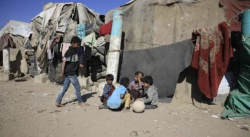
He also raised the siege of Taiz governorate and the conditions of people displaced by the fighting, the agency said.
Shujaaldeen asked Austria for more humanitarian aid, according to Saba.
He sought broader Austrian and international backing for government efforts to restore state institutions and security, the agency said.
Saba did not describe Rosenkranz’s response.
The two men met in Vienna once before, in May 2025, according to an account published by Yemen’s foreign ministry.
At that meeting Shujaaldeen raised the security risks of Houthi attacks on global trade, the ministry said.
He also raised the pressure on the government from attacks on oil export facilities in Hadramout and Shabwa, according to the same account.
He conveyed greetings from the speaker of Yemen’s parliament, Sultan al-Burkan, to his Austrian counterpart, the ministry said.
The briefing follows a month in which the war returned to several fronts.
UN Special Envoy Hans Grundberg told the Security Council on Oct. 9 that Yemen had “slid back into full-scale war, with hostilities spreading across multiple frontlines.”
Grundberg said Houthi forces had advanced on Mokha and the coast along Bab al-Mandab.
The government then launched what he described as a large-scale counter-offensive and reported retaking areas around the strait, he said.
Fighting continued in the highlands west and south of Taiz city and into Lahj, according to his briefing.
It had also intensified in Marib, al-Jawf and Hajjah, he said. Aerial attacks continued across the country.
Grundberg called Taiz Yemen’s most populous governorate and said its humanitarian situation was “rapidly deteriorating.”
Civilians, “especially women and children, are once again bearing the brunt of escalating violence,” he said.
He said Houthi forces had attacked civilian and energy infrastructure in Saudi Arabia, including Abha International Airport and King Khalid International Airport in Riyadh, and that civilians had been killed and injured.
Grundberg echoed the UN secretary-general’s condemnation of those attacks and repeated his call on the group “to cease these attacks.”
He said Houthi threats against Saudi-linked commercial ships undermined freedom of navigation for all countries.
Those threats were becoming enmeshed with a wider confrontation over maritime trade routes and “the stresses on the international energy market,” he said.
Regional security, freedom of navigation and the protection of international trade were “legitimate concerns that must be addressed,” Grundberg told the council.
He said parties to the conflict “must also respect and protect medical facilities, humanitarian personnel and operations.”
The envoy said he had met the government, the Houthis and regional and international partners in Riyadh, Muscat, Cairo and Washington over the previous month.
“Gains on the battlefield cannot substitute for the negotiations that will be required to settle the conflict,” he said.
He said war and diplomacy were “not mutually exclusive.”
“Unless war is to become Yemen’s permanent reality, the time to consider political strategies is now,” Grundberg said.
Grundberg said evolving military calculations were shaping how the parties weighed the value, timing and terms of political engagement.
He said his role was to create space for a settlement owned by Yemenis, whose shape and timing were for them to determine.
He asked the council to maintain its unity behind mediation and called for a political process based on its own resolutions and on past negotiations.
The UN humanitarian plan for Yemen published in March said more than 22 million people needed assistance, and put the number of acutely food insecure at 18.3 million.
More than 2.2 million children under five were acutely malnourished, the plan said, 516,157 of them severely.
It recorded 5.2 million internally displaced people and sought $2.16 billion to reach 12 million.
The International Organization for Migration has said displacement caused by the escalation on Yemen’s west coast has passed 200,000 people.
Grundberg said 72 UN staff remained in Houthi detention and that meaningful progress towards their release had yet to be made.
He welcomed the release of one UN detainee as “a positive step.”
Detained staff from non-governmental organisations, civil society and diplomatic missions included many with serious health problems, he said.
Yemen is ranked by the International Monetary Fund as the world’s poorest country, according to his briefing.
About the Author