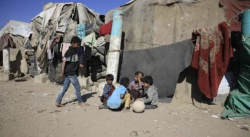
Yemen’s central bank governor joins IMF meeting of regional finance officials in Bangkok
 Yemen Herald News
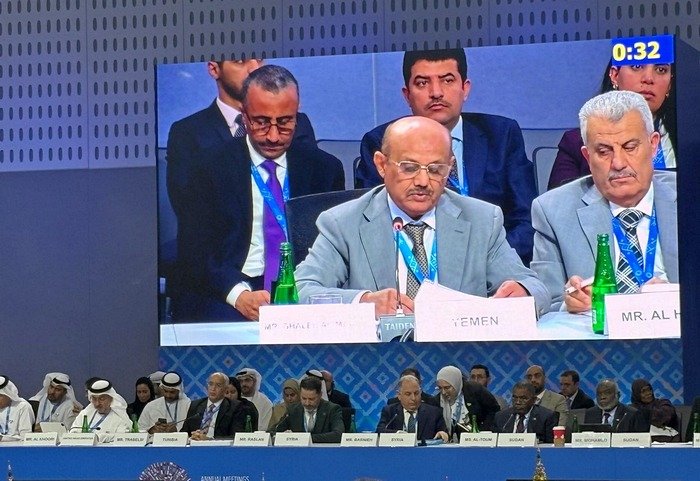
BANGKOK, Thailand — Yemen’s central bank governor joined a meeting of Middle East and North African finance officials convened by the IMF’s managing director, the state news agency said.
Ahmed Ghaleb al-Mabaqi took part in the session held by the fund’s managing director, Kristalina Georgieva, the agency, Saba, reported.
The meeting brought together central bank governors and finance ministers from the region.
It was held on the sidelines of the annual meetings of the IMF and the World Bank Group.
Those meetings ran in Bangkok from Oct. 12 to Oct. 18, according to the fund. They draw representatives of 191 member countries.
The fund holds the annual meetings outside Washington every third year, in a city of another member country.
The account of Yemen’s participation rests on Saba. No independent confirmation of what was said has been published.
Al-Mabaqi set out the main economic and monetary developments in Yemen, the agency reported.
He cited the effects of the war and of what the government describes as a recent escalation by the Houthis. The Houthis dispute government accounts of the fighting.
He also pointed to the effects of regional conflicts on the economy and on living and humanitarian conditions, according to Saba.
Al-Mabaqi said Yemeni authorities were pressing ahead with economic, financial and monetary reforms, the agency reported.
He said that was happening despite difficult conditions and a shortage of resources.
He did not name any individual measure.
The governor called on international partners to increase support, according to Saba. He singled out regional and international financial institutions.
The stated aims were to strengthen the resilience of state institutions, to consolidate economic and monetary stability, and to help institutions meet their obligations, the agency said.
Saba reported no response from Georgieva or from the fund.
It gave no figure for any support discussed.
Al-Mabaqi has been governor of the Central Bank of Yemen since December 2021.
The bank operates from Aden, the seat of the internationally recognised government. A rival monetary authority operates in Sanaa, which Houthi forces hold.
Yemen’s delegation held other meetings on the same sidelines.
The planning minister, Mohammed al-Faqmi, and al-Mabaqi met World Bank officials on Tuesday, Saba reported at the time.
Al-Faqmi is minister of planning and international cooperation and Yemen’s governor to the World Bank Group.
Those talks covered cooperation to increase international support for government efforts to maintain economic and financial stability, according to the agency.
The two sides also discussed public financial management and the banking sector, Saba said.
Support for electricity projects and for the Hassan Dam in Abyan governorate was raised, according to the agency.
The World Bank set out Yemen’s position in a report published in May.
Real gross domestic product contracted 1.5 percent in 2025, the bank said in its Spring 2026 Yemen Economic Monitor.
It projected a further contraction of 0.5 percent in 2026.
Government revenues fell to 5.6 percent of gross domestic product in 2025, according to the report.
The bank estimated that nearly three-quarters of the population lived below the poverty line.
It said the rial appreciated sharply in August 2025 and had since steadied, helped by central bank measures and Saudi financial support.
Dina Abu-Ghaida, the World Bank Group country manager for Yemen, said the economy had “limited buffers to absorb new shocks”.
The report was published before the current escalation in Taiz and on the western coast.
Fighting in Taiz and along Yemen’s western coast has intensified in recent weeks.
President Rashad al-Alimi said on Oct. 14 that the government offensive it calls the Dawn of Yemen operation would continue.
Prime Minister Shaya al-Zindani urged traders this week to keep food and fuel moving during the offensive, Saba reported.
Yemen’s social affairs ministry appealed in the same period for urgent humanitarian aid for Taiz, according to the agency.
The health ministry said on Saturday that medicines, medical supplies and fuel at health facilities in Taiz were nearing depletion.
Yemen’s interior ministry said at least six civilians were killed and 18 wounded in shelling of residential areas in the governorate in the 24 hours to Tuesday.
The International Organization for Migration recorded 217,303 people, or 36,216 families, displaced inside Yemen between Aug. 1 and Oct. 12.
Those figures come from the organisation’s Displacement Tracking Matrix. Taiz governorate accounts for 55 percent of that total.
The UN Office for the Coordination of Humanitarian Affairs reported a similar scale on Oct. 12, citing the organisation.
The United Nations humanitarian response plan for Yemen, issued in March, said more than 22 million people needed assistance.
The plan recorded 18.3 million people as acutely food insecure.
It counted more than 2.2 million children under five as acutely malnourished, including 516,157 with severe acute malnutrition.
The plan put the number of internally displaced people at 5.2 million.
It sought 2.16 billion dollars to reach 12 million of them.
The Presidential Leadership Council has governed the internationally recognised side of the conflict since it replaced former president Abd Rabbu Mansour Hadi in 2022.
The United Nations moved its main Yemen offices to Aden in September 2025.
Saba did not say which other countries were represented at the meeting with Georgieva.
It did not say how long the session lasted.
About the Author