Yemen’s former prime minister says Taiz will decide the war’s next phase
 Yemen Herald News
ADEN, Yemen — Yemen’s former prime minister said the next phase of the war will be decided in the hills around Taiz, and appealed for more Western military help.
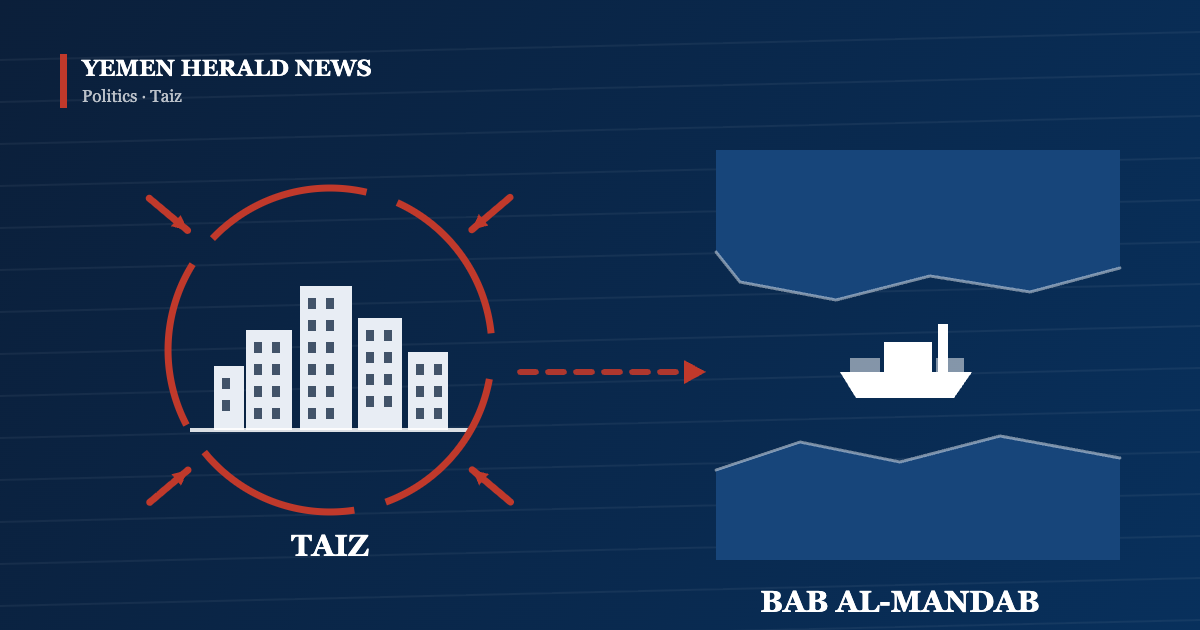
Maeen Abdulmalik Saeed, now an adviser to President Rashad al-Alimi, told The Guardian that the city’s fall would open the way to the Bab al-Mandab strait and the road to Aden.
“In a matter of days there will be a full siege and they will try to enter the city,” Saeed said in the interview, published on Friday.
He said losing Taiz would cost the government control of the surrounding highlands, the coastal city of Mocha and access to the Gulf of Aden.
“If Taiz is lost, access to the strait will be lost,” he said.
Taiz has more than 500,000 residents, according to Saeed. He said Houthi forces were attacking from four axes while still allowing some fuel and goods into the city.
The group was expanding its hold on rural areas and smaller towns around Taiz, he said.
Saeed said government units in the area carried only light weapons. He acknowledged poor coordination among them.
He predicted residents would resist Houthi rule, describing Taiz as a non-tribal city with a democratic tradition. He said any siege would be worse than the one imposed in 2015.
Saeed described Taiz as the war’s new front line. He urged Western governments to weigh the consequences of a Houthi takeover of the city.
The account rests on Saeed’s interview with The Guardian, conducted by its diplomatic editor, Patrick Wintour. Yemen Herald found no independent confirmation of his assessment of the military position around Taiz.
Saeed was prime minister from October 2018 until February 2024, when the Presidential Leadership Council removed him. Ahmad Awad bin Mubarak succeeded him. Saeed has also served as a negotiator with the Houthis.
Saeed said Iran stood behind the Houthis and wanted to “expand the chaos” in Yemen. He said Iranian specialists had trained the group from Sanaa by 2020, and that its missile production had grown since.
Those are the government’s characterisations. The Houthis present themselves as acting independently of Tehran, and Iran denies arming them.
Saeed said Iran was under pressure, with its airports and airlines unable to operate. He said 90 percent of Iranian oil passes through the Strait of Hormuz. He gave no source for that figure.
Tehran’s investment in the Houthis could become a template for threatening shipping elsewhere, he said.
Saeed said Gulf states needed to reconsider their air defences, arguing the war required different systems from the ones they hold.
He said Saudi Arabia had not planned early enough for the current escalation. He pointed to rivalry among Gulf governments and slow responses to the Houthis’ long-range drone capability.
He said intelligence indicated the group was already seeking territory in the south, naming the former Soviet camp at al-Sabiha in Lahj governorate, and eventually Aden.
Saeed said the Houthis would impose Zaydi education, financial and tax systems quickly if they took Taiz. The group has not set out such plans publicly.
The Houthi campaign on Yemen’s Red Sea coast began in September 2026. It ended four years of relative calm that followed a truce brokered by the United Nations in 2022.
Saeed pointed to earlier long-range attacks. A Houthi ballistic missile struck Aden airport in December 2020 as a newly formed cabinet arrived, in an attack The Guardian said killed 28 people and wounded 107. The newspaper said the missile travelled 186 miles.
Missiles hit oil tanker trucks in Abu Dhabi in January 2022, more than 900 miles from Houthi-held territory. Strikes targeted the Nushayma oil terminal and al-Dhabba port in October 2022. The United States struck Houthi targets in March 2025.
Conditions inside Taiz have worsened in recent days. The Yemeni Network for Rights and Freedoms said it documented 43 violations by Houthi forces in the governorate over 24 hours, which it said killed five civilians and wounded 17.
That tally rests on the network’s own field reporting. Al Jazeera and Middle East Eye both carried it, each attributing it to the network, and Yemen Herald found no origin for the figures independent of the group.
Al Jazeera’s correspondent in the area, Abdullah Qatran, reported mortar shelling of the al-Ikhwa district on 13 October with an undetermined number of dead and wounded.
Saba, the state news agency, said a Houthi attack struck al-Safwa Hospital in Taiz early on Tuesday. Al Jazeera cited the agency for that account.
The United Nations said in its humanitarian plan for 2026, issued in March, that more than 22 million Yemenis need aid and that 18.3 million face acute food insecurity.
The plan counted 5.2 million internally displaced people. It sought 2.16 billion dollars to reach 12 million of them.
Aidarous al-Zubaidi, the exiled leader of the Southern Transitional Council, called on Tuesday for southern forces to mobilise against the Houthis. He tied the appeal to a demand for a referendum on secession within two years.
Tens of thousands of his supporters rallied the following day.
The Guardian said al-Zubaidi’s return would be unwelcome in Riyadh. It carried no Saudi response.
Saeed did not say how many troops the government had around Taiz. He gave no timetable for the help he was requesting.
About the Author