WHO says suspected cholera cases in Yemen nearly tripled in three weeks
 Yemen Herald News
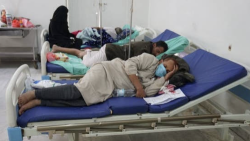
GENEVA, Switzerland — Suspected cholera cases in Yemen nearly tripled in three weeks as fighting drove more than 200,000 people from their homes, the World Health Organization said.
Weekly suspected cases rose from 217 in the week of Sept. 6 to 12 to 647 in the week of Sept. 27 to Oct. 3, according to the agency.
WHO set out the figures in a statement issued on Tuesday.
Yemen has recorded 8,034 suspected cases and 27 deaths since the start of the year, the agency said. About a quarter of this year’s suspected cases were reported in the past four weeks.
“Families fleeing conflict are now facing another threat from diseases that can be prevented and treated,” said Annette Heinzelmann, WHO’s emergency director for the region.
Heinzelmann said outbreaks “could spread rapidly among already vulnerable communities” without urgent funding and access to safe water, vaccination and essential health services.
The agency said it has secured $3.78 million of the $31 million it needs for a 90-day emergency response in Yemen.
That money would pay for disease surveillance at displacement sites, rapid response teams, cholera treatment and infection prevention, WHO said.
WHO did not say how much of the $3.78 million it has received had been spent.
The agency flagged measles and other preventable diseases alongside cholera.
It said the rising disease burden is adding pressure to health facilities that are already treating thousands of people wounded in the fighting.
This account of the caseload rests on WHO’s own surveillance reporting. Yemen Herald could not independently verify the figures, and no second body has published a separate count.
The International Organization for Migration said on Monday that more than 217,000 people have left their homes since the fighting escalated.
That figure covers people displaced since the escalation began and does not include those forced from their homes in earlier years.
WHO says the risk is concentrated at displacement sites. Crowding, interrupted water supply and damaged sanitation are common at such sites.
Cholera spreads mainly through contaminated water and food. Untreated, it can kill within hours. Most patients recover with oral rehydration salts.
The salts are inexpensive and can be given at home. Severe cases need intravenous fluids delivered at a treatment centre.
Treatment centres are usually kept separate from general hospital wards to limit transmission.
Surveillance teams test samples and trace the source of local clusters.
Yemen’s Ministry of Public Health and Population said on Oct. 10 that medicines, intravenous fluids, medical supplies and fuel at health facilities in Taiz city were nearing depletion.
The ministry issued that warning as supply routes into the city were cut.
Saba, the Yemeni state news agency, reported that an attack early on Tuesday shattered windows at al-Safwa Hospital in Taiz, injured at least one person and caused panic among patients and staff. The Houthi authorities have not commented on that account.
The Yemeni Network for Rights and Freedoms said it documented 43 violations by Houthi forces in Taiz over 24 hours this month, which it said killed five civilians and wounded 17. The group said more than 180 projectiles were fired at residential areas. Yemen Herald could not independently confirm that tally.
The Yemeni government and the European Union have both described the situation in Taiz as a Houthi siege. The Houthi authorities reject that account.
Taiz is Yemen’s third-largest city and has been a front line for much of the war. Fighting around it has intensified since the government launched an offensive this month that it calls Dawn of Yemen.
Yemen has experienced repeated cholera outbreaks since 2016. Aid agencies have warned for years that the country’s water and sanitation networks cannot absorb large movements of people.
Aid access depends on approvals from the authorities controlling each area. Those are split between the internationally recognised government based in Aden and the Houthi administration in Sanaa.
The United Nations humanitarian response plan for Yemen, published in March, estimated that more than 22 million people needed assistance.
The plan put the number of acutely food insecure at 18.3 million.
It said more than 2.2 million children under five were acutely malnourished, including 516,157 with severe acute malnutrition.
The plan recorded 5.2 million internally displaced people and sought $2.16 billion to reach 12 million of those in need.
Those figures were compiled before the current escalation and do not account for the displacement reported since August.
WHO said its 90-day plan is designed to cover the immediate response period rather than the full year.
WHO has separately warned of a funding gap across its wider health response in Yemen.
The 27 deaths recorded this year represent a case fatality ratio of about 0.3 percent of suspected cases.
The IOM figure was issued on Monday, a day before WHO published its statement.
Heinzelmann listed vaccination alongside safe water and essential health services among the measures needed to hold back an outbreak.
The agency’s regional office for the Eastern Mediterranean, which oversees the Yemen response, is based in Cairo.
WHO did not name the governorates where the recent clusters were recorded.
Its weekly figures count suspected cases, which are recorded on clinical signs rather than laboratory confirmation.
About the Author