Planning Minister Mohammed al-Faqmi tells World Bank governors Yemen must shift to recovery
 Yemen Herald News
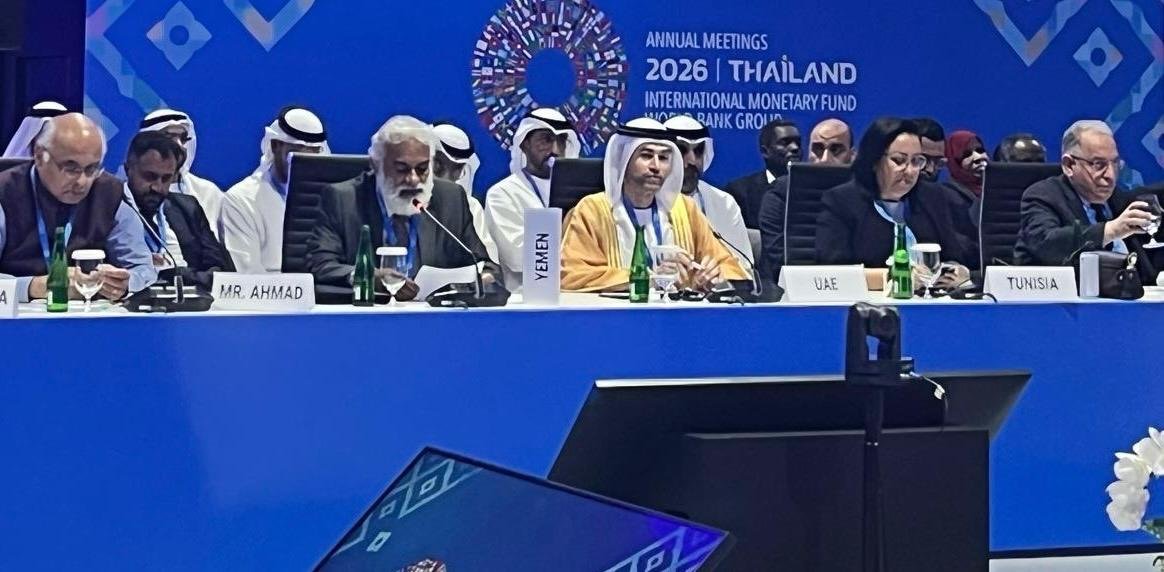
BANGKOK, Thailand — Yemen’s planning minister told a meeting of Arab governors at the World Bank Group that the country must shift from crisis management to recovery.
Mohammed al-Faqmi spoke at the meeting in Bangkok, the state news agency Saba reported on Oct. 16.
Al-Faqmi is minister of planning and international cooperation. He serves as Yemen’s governor at the World Bank Group.
World Bank Group President Ajay Banga attended the meeting, according to Saba.
Al-Faqmi said Yemen had to move from crisis management toward recovery after more than a decade of war.
He asked the bank to align its work in Yemen with national priorities and to speed up projects already under way.
He also called for strengthening state institutions and for investment in electricity, water, food security and employment for young people and women.
Yemen was selected as one of five countries to implement a joint cooperation framework between the World Bank Group and the United Nations Development Programme, Saba said.
The framework is intended to coordinate development work, strengthen institutions, attract investment and create jobs.
It is meant to support Yemen’s Economic, Social Development and Recovery Plan for 2027 to 2029.
About $450 million is active across seven joint World Bank and UNDP projects in Yemen, according to the agency’s account of the meeting.
Al-Faqmi urged that the Hassan Dam project in Abyan governorate be completed before the flood season.
He raised clearing Yemen’s arrears with the Kuwait Fund for Arab Economic Development and the Islamic Development Bank so that development financing could resume.
The account of al-Faqmi’s remarks rests on Saba, Yemen’s state news agency. Yemen Herald found no independent confirmation of what he said, though the meeting of Arab governors itself was separately reported.
Qatar’s delegation also took part in the meeting of Arab governors with the World Bank chief, The Peninsula reported on Oct. 16.
The gathering took place alongside the 2026 annual meetings of the International Monetary Fund and the World Bank Group in Thailand.
The World Bank Group approved a new country partnership framework for Yemen in June. It covers the 2026 to 2030 financial years.
The bank announced $285 million across four operations under that framework.
They include a health, nutrition, water and sanitation project worth $94 million and a water management and irrigation project worth $153.6 million.
A third additional financing tranche of $21 million went to the Integrated Urban Services Emergency Project, and $20 million to a project on modernising public institutions and systems.
“Yemen’s future has to be built now,” Stéphane Guimbert, the bank’s division director for Egypt, Yemen and Djibouti, said when the framework was launched.
Khawaja Aftab Ahmed, division director for the Levant, Iraq and Yemen at the International Finance Corporation, was also quoted in that announcement.
The bank’s most recent economic monitor for Yemen recorded a third consecutive year of contraction. Real output fell 1.5 percent in 2025, and the bank projected a further 0.5 percent contraction this year.
Consumer prices rose about 20 percent on average in government-held areas in 2025, down from 33.9 percent the year before, the monitor said.
The rial averaged 2,091 to the dollar in Aden across 2025, according to the same report. In Houthi-held areas the rate has been held near 535.
Government revenue fell to 5.6 percent of gross domestic product in 2025 from 8.6 percent, the bank said, mainly because grants dropped to 0.8 percent of output from 3.6 percent.
Oil exports have been blocked since late 2022 and have earned no foreign exchange since, according to the monitor.
Seaborne exports of all kinds came to about 392,000 metric tons in 2025, down 15 percent on the year and 83 percent below the 2022 level.
The monitor estimated that close to three-quarters of Yemenis live below the monetary poverty line.
The Hassan Dam lies in Wadi Hassan, in Khanfar district of Abyan governorate, and is designed to hold 19.5 million cubic metres of water.
It is intended to capture seasonal floodwater for irrigation across the Abyan delta, covering more than 14,000 hectares and recharging 75 wells.
The Abu Dhabi Fund for Development is financing the scheme. Work resumed in May 2023 on a first phase scheduled to run 36 months.
Al-Faqmi and central bank governor Ahmed Ghaleb al-Mabaqi met the head of the OPEC Fund for International Development in Bangkok to discuss rescheduling Yemen’s debt, Saba reported separately.
Abdulhamid al-Khalifa leads that fund.
The United Nations Development Programme lists a financial market infrastructure and inclusion project among its operations in Yemen, and runs a separate green economic recovery programme there.
Yemen Monitor reported in June that the World Bank was providing Yemen with $285 million in financing for 2026 to 2030.
Yemen’s humanitarian plan for 2026 estimated that more than 22 million people in the country need assistance, and sought $2.16 billion to reach 12 million of them.
The first phase of the Hassan Dam was more than 60 percent complete at the time of the most recent public report on it.
Yemen’s 20 percent share of the dam’s cost, about $15.6 million, was waived by the financier.
The World Food Programme said on Oct. 14 that fighting had put 800,000 people across Yemen beyond its reach.
Yemen’s internationally recognised government is based in Aden. The Houthi authorities administer Sanaa and much of the north.
About the Author