Foreign Minister Afrah al-Zouba discusses education ties with Indonesian deputy minister in Baghdad
 Yemen Herald News
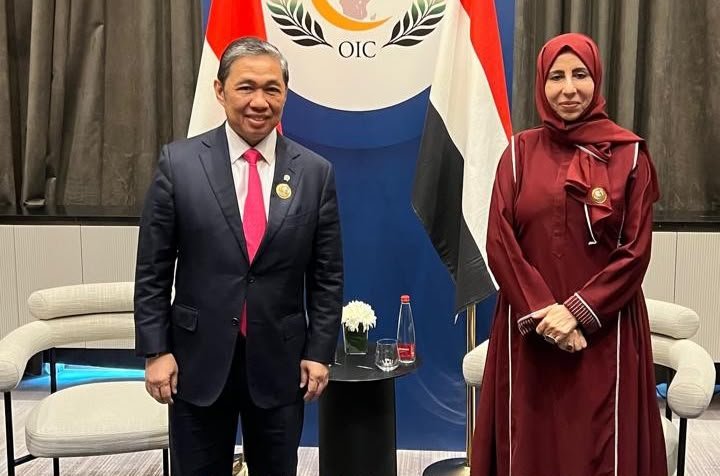
BAGHDAD, Iraq — Yemen’s foreign minister discussed expanding educational and cultural cooperation with Indonesia’s deputy foreign minister on the sidelines of an Islamic bloc meeting, the state news agency Saba reported.
Afrah al-Zouba met Muhammad Anis during the 52nd session of the Organization of Islamic Cooperation’s Council of Foreign Ministers in Baghdad, the agency said.
Yemen Herald could not independently verify the account of the talks. Saba is the Yemeni government’s own news agency, and no independent account of the meeting has been published.
The two discussed increasing student exchanges and scholarship places, Saba said.
They also talked about building links between universities and cultural institutions in the two countries, according to the agency.
Al-Zouba framed the relationship around what she called long-standing cultural, civilizational and humanitarian ties, the agency reported.
Saba did not say how many scholarship places were under discussion.
The agency did not report any agreement signed at the meeting.
She briefed Anis on what she described as escalating Houthi attacks on state institutions and civilian facilities, Saba said.
She warned those attacks threatened shipping in the Red Sea, the Bab al-Mandab Strait and the Gulf of Aden.
The Houthis dispute such characterisations and say their operations target military objectives.
Al-Zouba called for closer coordination in regional and international forums, and for support for government efforts to end the Houthi takeover, the agency said.
Anis reaffirmed his government’s commitment to the partnership and its support for security and stability in Yemen, according to Saba.
Indonesia is the world’s most populous Muslim-majority country.
Al-Zouba became Yemen’s foreign minister on July 23, 2026. She is the first woman to hold the post.
She had served as minister of planning and international cooperation since February 2026.
Before entering the cabinet she ran the Executive Bureau for Accelerating Aid Absorption and Supporting Policy Reforms, a donor-facing body, from 2021.
She advised then Prime Minister Maeen Abdulmalik on humanitarian relief and development in 2019.
She was first deputy secretary-general of the National Dialogue Conference between 2013 and 2015, and later sat on the Constitution Drafting Committee.
Her earlier career was in development work, including with the Yemeni organisation SOUL for Development and with USAID on governance and conflict mitigation.
The United Nations invited her to peace consultations in Kuwait in 2016 and 2017, among a group of Yemeni women.
She holds a pharmacy degree from Sanaa University and a master’s degree in community health and health economics from a university in Malaysia.
She is from al-Bayda, in central Yemen.
Critics have questioned whether she brought enough diplomatic experience to the ministry, Al Jazeera reported in July.
The Baghdad session was the first time the OIC council had met in the Iraqi capital in 45 years, The National reported.
Fifty-five member states took part, according to Iraqi News. The organisation has 57 members.
The OIC was founded in 1969 and has its headquarters in Jeddah, Saudi Arabia. The council meets annually.
Its theme was “Dialogue and Solidarity: Two Essential Pillars for Promoting Peace and Sustainable Development.”
Ismail Ould Cheikh Ahmed, the OIC secretary-general, called Houthi attacks on Saudi Arabia a “flagrant violation of the kingdom’s sovereignty and of the sanctity of the Islamic holy sites.”
He said the organisation would strengthen preventive diplomacy and activate its mediation unit.
Ould Cheikh Ahmed served as the UN special envoy for Yemen from 2015 to 2018.
Iranian Foreign Minister Abbas Araghchi told the session a military solution was not an option in Yemen and offered to help ease the conflict.
Al-Zouba rejected that offer, saying Tehran was a party to the war and that those who arm the Houthis could not act as mediators, Arab News reported.
Araghchi has led Iran’s foreign ministry since August 2024.
Iraqi Prime Minister Ali Al Zaidi used the session to propose linking member states’ energy grids, railways and transport networks.
The meeting followed a UN Security Council statement on Oct. 16 condemning Houthi attacks on Saudi Arabia.
Greece held the council presidency for October, with Aglaia Balta as its permanent representative. The statement described strikes on Riyadh’s airport as reckless and affirmed Saudi Arabia’s right to self-defence.
It also condemned Houthi attacks and threats against commercial shipping in the Red Sea and the Bab al-Mandab Strait.
A Houthi missile and drone attack on the presidential palace in Aden on Oct. 15 killed five people and wounded 16, Yemen’s health minister said in remarks reported by Al Arabiya.
The palace struck was Maashiq, the government’s seat in Aden. Al Jazeera and CNN reported the attack on Oct. 15.
Yemen’s war began in 2014, when Houthi forces seized Sanaa. A Saudi-led coalition intervened the following March on the side of the government.
The internationally recognised government has operated from Aden and from Riyadh for much of the conflict.
The UN Office for the Coordination of Humanitarian Affairs said in March 2026 that more than 22 million Yemenis needed humanitarian assistance.
That plan listed 18.3 million people as acutely food insecure and more than 2.2 million children under five as acutely malnourished, 516,157 of them severely.
It counted 5.2 million displaced people and sought $2.16 billion to reach 12 million of those in need.
The Baghdad session ran for two days.
About the Author