Parliament Speaker Sultan al-Barakani praises Kuwait’s aid to Yemen in Riyadh meeting
 Yemen Herald News
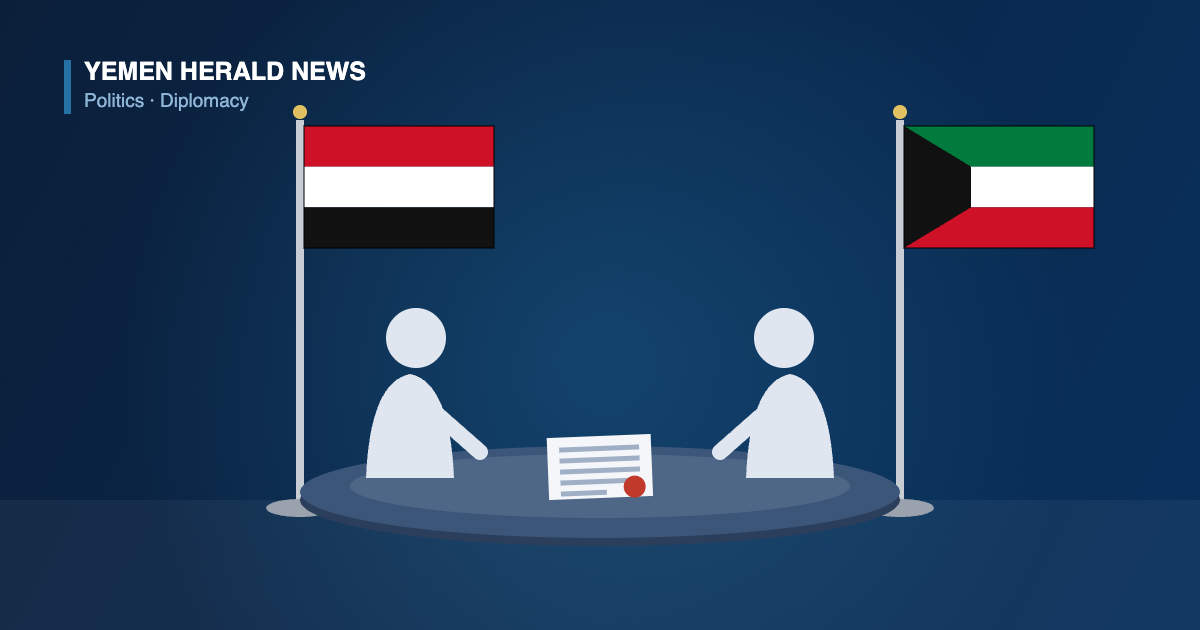
RIYADH, Saudi Arabia — Yemen’s parliament speaker praised Kuwait’s humanitarian and development aid in a meeting with Kuwait’s ambassador on Sunday, the state news agency Saba reported.
Sheikh Sultan al-Barakani, speaker of Yemen’s House of Representatives, met Falah al-Mutairi, Kuwait’s ambassador to Yemen, in the Saudi capital, the agency said.
Yemen Herald could not independently verify the account of the meeting. Saba is the Yemeni government’s own news agency, and no independent confirmation of the talks has been published.
Al-Barakani praised what he called the historic and fraternal relations between the two countries, according to Saba.
He commended Kuwait’s long-running humanitarian and development support in education, healthcare and other sectors.
Al-Mutairi reaffirmed Kuwait’s support for Yemen’s internationally recognised government and its people, the agency reported.
He pledged continued humanitarian and relief assistance.
The ambassador also pledged further cooperation aimed at reducing civilian suffering and supporting peace and stability, Saba said.
Al-Barakani condemned what he described as continued Houthi escalation and attacks on civilians.
He singled out the repeated shelling and the siege of Taiz, and praised the steadfastness of the city’s residents.
The Houthis dispute such characterisations and say their operations target military objectives.
Al-Barakani also condemned Houthi attacks on Saudi Arabia. He said the kingdom’s security and stability were vital to Yemen and to the wider Arab region.
Taiz is Yemen’s third city and al-Barakani’s home governorate. He was born in 1956 in Al-Maafer District, in Taiz governorate.
Houthi forces have encircled the city for much of the war, and aid agencies have repeatedly reported difficulty moving supplies through the front lines.
Al-Barakani belongs to the General People’s Congress, the party founded under former president Ali Abdullah Saleh.
The party has been split between factions aligned with the government and with the Houthis since Saleh was killed in 2017.
He was elected speaker on April 13, 2019, at a session held in Seiyun, a town in Hadramout governorate in eastern Yemen.
That sitting was the first of a parliament loyal to the internationally recognised government since the war began. He succeeded Yahya Ali al-Raee.
Kuwait has a long involvement in Yemeni diplomacy. It hosted UN-mediated talks between the Yemeni government and the Houthis in 2016.
Those negotiations ran from April to August that year and ended without an agreement.
The talks foundered over the sequence of a security handover and a political transition.
Kuwait is a member of the Gulf Cooperation Council, which has backed the Yemeni government through the conflict.
The council hosted Yemeni consultations in Riyadh in 2022 that produced the Presidential Leadership Council, the body that replaced former president Abdrabbuh Mansur Hadi.
Rashad al-Alimi chairs that council.
Kuwait’s assistance to Yemen has largely run through UN agencies. The Kuwait Fund for Arab Economic Development gave UNICEF $1.5 million in December 2024 for primary healthcare services.
Peter Hawkins, then UNICEF’s representative in Yemen, said at the time that the agency appreciated the partnership.
Kuwait provided $10 million to the International Organization for Migration for its Yemen operations in 2018, and pledged $100 million for the country in 2017.
The meeting came days after the UN Security Council condemned escalating Houthi attacks on Saudi Arabia.
That statement was released by the Council president, Evangelos Sekeris of Greece, in mid-October. It described strikes on Riyadh’s airport as reckless.
The Council also condemned Houthi attacks and threats against commercial shipping in the Red Sea and the Bab al-Mandab Strait.
It affirmed Saudi Arabia’s inherent right to self-defence under international law.
Riyadh’s international airport had been targeted 20 times since the start of October, Al Arabiya reported.
The Saudi-led coalition said it intercepted a missile near Medina.
A Houthi missile attack on the presidential palace in Aden killed five people and wounded 16, Yemeni Health Minister Qasim Buhaibeh said in remarks reported by Al Arabiya.
Yemen’s war began in 2014, when Houthi forces seized Sanaa. A Saudi-led coalition intervened the following March on the side of the government.
The internationally recognised government and much of its leadership have operated from Aden and from Riyadh since.
The UN Office for the Coordination of Humanitarian Affairs said in March 2026 that more than 22 million Yemenis need humanitarian assistance.
That plan put the number of acutely food insecure people at 18.3 million.
It listed more than 2.2 million children under five as acutely malnourished, including 516,157 severe cases.
OCHA counted 5.2 million internally displaced people and sought $2.16 billion for the year to reach 12 million people.
Yemen’s House of Representatives was elected in 2003 and has not held a general election since. Al-Barakani has led it for more than seven years.
Yemen’s foreign minister, Afrah al-Zouba, asked the Organisation of Islamic Cooperation on Saturday to designate the Houthis a terrorist organisation.
She made the request in a speech to the bloc’s foreign ministers in Baghdad. The 52nd session of the OIC Council of Foreign Ministers opened there on Oct. 17.
The organisation groups 57 member states.
The World Food Programme warned this month that fighting in Yemen was blocking aid deliveries, cautioning of a potential humanitarian catastrophe.
Saba did not say whether the two men discussed any new Kuwaiti funding.
About the Author