Yemen’s human rights minister asks Germany to back EU terrorist designation of Houthis
 Yemen Herald News
BERLIN, Germany — Yemen’s human rights minister asked Germany to support an EU-wide terrorist designation of the Houthis in talks with a German foreign ministry official, Saba reported.
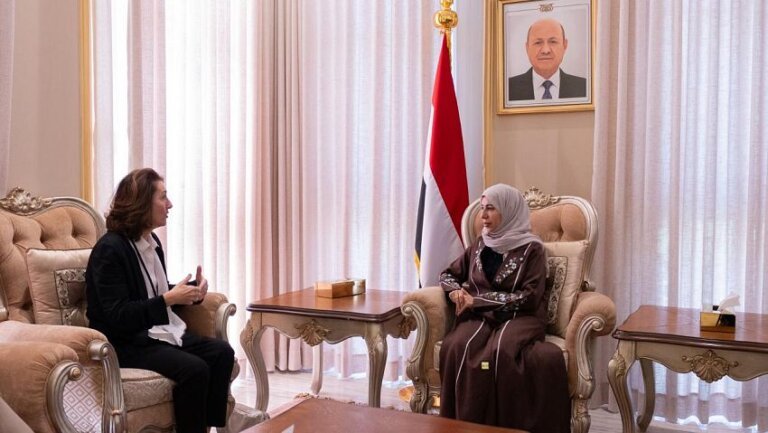
Mashdal Mohammed Omar met Christian Reich, who handles Middle East affairs at Germany’s Federal Foreign Office, the Yemeni state news agency said on October 19.
The account of the meeting rests on Saba. No independent confirmation of the talks has been published, and Germany’s foreign ministry has not issued its own account.
Saba said the two discussed the human rights situation in Yemen and German backing for listing the Houthi movement as a terrorist organisation.
Omar asked Germany to support a designation across the European Union, according to the agency.
The minister raised abductions, torture, killings and forced displacement, which he attributed to the Houthis, Saba said.
The Houthis reject that characterisation of their conduct and describe their campaign as a response to attacks on Yemen.
Omar also raised attacks on the Maashiq presidential palace in Aden and on Aden International Airport, the agency said.
The two discussed measures to protect civilians and to hold those responsible for violations to account, according to Saba.
They also discussed the humanitarian needs of displaced families and the ministry’s plans for a national human rights strategy, the agency said.
Saba said Reich expressed concern about the violations and restated Germany’s solidarity with affected civilians. Yemen Herald could not verify that account independently.
The meeting followed a similar appeal in Brussels. On October 14 Omar urged the European Parliament to designate the Houthis a terrorist group, Yemen Monitor reported.
He met Hana Jalloul, vice-chair of the European Parliament’s committee on foreign affairs, according to that report.
Yemen’s cabinet approved a draft law on October 11 designating the Houthi group a terrorist organisation and criminalising its activities and financing, Anadolu reported.
Prime Minister Shaya al-Zindani chaired that meeting in Aden. The cabinet instructed officials to complete the procedures needed for ratification.
The statement issued afterwards said a Houthi attack on Riyadh’s airport the previous day had killed 12 people and injured 309.
The cabinet said Yemen was at a decisive stage in restoring sovereignty and ending what it called a Houthi coup financed and directed by Iran.
Iran denies arming the Houthis.
Al-Zindani told executive authorities to move from reacting to events toward proactive action.
The Houthis had not commented on the proposed designation on the day it was approved.
Yemen’s foreign ministry has said a European Union designation is its leading request of the bloc.
The European Union has condemned the Houthi attacks on Saudi Arabia.
The palace attack Omar raised took place on October 15. A missile and drone strike hit the Maashiq compound in Aden and killed at least five people, CNN and Al Jazeera reported.
Yemen’s government blamed the Houthis for that attack. It asked the UN Security Council to condemn it in two letters to Secretary-General Antonio Guterres and the Council president for October.
The government had earlier asked the Council to condemn an attack on Aden International Airport.
The fighting has widened well beyond Yemen’s borders since September.
Houthi forces attacked three Saudi airports between October 6 and October 12, according to reporting by The Associated Press and the BBC.
Saudi authorities said at least 12 people were killed and about 300 wounded in a strike on Riyadh’s King Khalid International Airport on October 10. One man died of his injuries the next day.
Guterres said he was deeply shocked by that attack and that such strikes must cease immediately.
Hans Grundberg, the UN special envoy for Yemen, called the attacks a grave escalation. Grundberg has led UN mediation on Yemen since 2021.
Britain said on October 20 that RAF Typhoon fighters would fly defensive missions over Saudi cities. Its defence ministry said the jets would not attack the Houthis.
Saudi Arabia struck Sanaa International Airport on July 13. The Houthis then ended the 2022 UN-brokered truce, imposed a blockade on Saudi Arabia and launched offensives.
The group took control of Yemen’s Red Sea coastline in September, including the port city of Mocha, Al Jazeera reported.
Abbas Araghchi, Iran’s foreign minister, offered to mediate in the escalation.
The Houthis seized Sanaa in 2014, and the internationally recognised government has operated from Aden since.
Displacement has followed the fighting. The World Health Organization’s eastern Mediterranean office reported at least 250,000 people displaced since early August.
UNHCR said fighting on the western coast had displaced more than 100,000 people by mid-September and warned the figure could rise above 230,000.
Djibouti’s refugee office registered 3,807 Yemeni arrivals by sea, a count current to October 8.
About 5.2 million Yemenis were already internally displaced before the current fighting, according to UNHCR.
The UN Office for the Coordination of Humanitarian Affairs said in its plan for 2026 that more than 22 million people in Yemen need humanitarian assistance.
The same plan recorded 18.3 million people as acutely food insecure and more than 2.2 million children under five as acutely malnourished, 516,157 of them severely.
OCHA’s plan seeks $2.16 billion to reach 12 million people.
Germany was among the governments that condemned the Riyadh airport attacks.
The Federal Foreign Office is Germany’s foreign ministry, based in Berlin.
About the Author