Missile strike on Shabwa training camp kills dozens of security recruits, Yemeni officials say
 Yemen Herald News
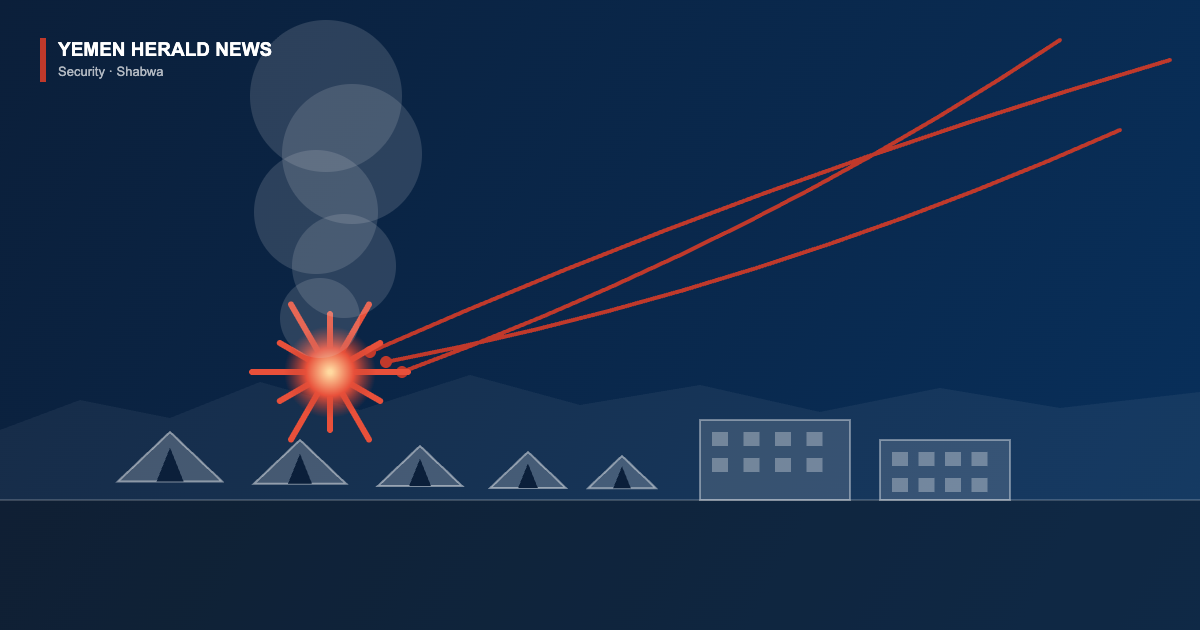
ATAQ, Yemen — Three Houthi ballistic missiles hit a government security training camp in Shabwa governorate on Monday, killing dozens of new recruits, Yemeni military and local officials said.
Col. Majed al-Nazili, a spokesman for the Yemeni military, said the missiles struck while a training exercise was under way, according to The Associated Press.
Casualty figures diverged through the day.
Yemeni military officials, speaking on condition of anonymity, told the AP that at least 20 soldiers were killed and about two dozen wounded.
Government officials and medical sources gave an initial toll of at least 18 dead and more than 30 wounded, Al Jazeera reported.
The local authority in Shabwa later put the count at 53 killed and more than 200 wounded, figures it described as preliminary.
Yemen Herald could not reconcile the three accounts.
Those at the camp were recruits to the internal security forces, enrolled in training and qualification programmes, the Shabwa authority said.
The AP identified the site as the al-Alam military camp in Jardan district, north of the provincial capital, Ataq.
Asharq Al-Awsat reported that the facility hit was the Martyr Ahmed al-Sulaimani Training Center, on the outskirts of Ataq.
The wounded were taken to the General Authority Hospital, the Maternity and Childhood Hospital and private hospitals in Ataq, Asharq Al-Awsat reported.
Local officials thanked residents who came forward to donate blood.
The Shabwa authority said the dead would be recorded as killed in the line of duty, with salaries assigned permanently to their families, and that the wounded would receive their entitlements.
It blamed the Houthis and called the attack an “extremely serious military escalation.”
Shabwa Governor Awad bin al-Wazir briefed Rashad al-Alimi, chairman of the Presidential Leadership Council, on the strike, Asharq Al-Awsat reported.
Al-Alimi ordered medical treatment for the wounded and support for the families of the dead, and told forces to “respond firmly to the sources of the attack.”
He said the Houthis turn to such attacks when they are under pressure, and said the deaths would not go unanswered.
The Houthis claimed responsibility.
Yahya Saree, the group’s military spokesman, said any site hosting a Saudi-backed military presence was a legitimate target, Al Jazeera reported.
The group described the camp as a Saudi-backed base.
Saba, the news agency run by the Houthi authorities in Sanaa, said the attack killed and wounded dozens without giving figures, according to the AP.
Government forces said they struck Houthi gatherings, vehicles and weapons at al-Aqroudh, al-Shaqab and al-Sarari, south of Taiz, on the same day, Al Jazeera reported.
Shabwa lies on Yemen’s southern coast, facing the Gulf of Aden, and holds much of the country’s oil and gas infrastructure, including the Balhaf liquefied natural gas terminal.
The strike came about six weeks into a renewed phase of a war that had been quieter since a UN-brokered truce in 2022.
The Houthis declared a naval blockade on Saudi-linked shipping through Bab al-Mandab in July and pushed coalition forces back from Mocha, Al Jazeera reported.
Fighting escalated in September, when the group seized the Mocha and Dubhab area and Mayyun Island in the strait, according to the same report.
Bab al-Mandab, at the southern entrance to the Red Sea, has taken on more traffic as Iranian attacks curtailed shipping through the Strait of Hormuz, Al Jazeera reported.
Saudi Arabia has leaned on the strait for oil exports during the war between Iran and the United States, according to the same report.
Both sides claim control of the shipping lanes there.
Al-Alimi announced an offensive on Oct. 4 to “restore state authority.”
The government calls the operation Dawn of Yemen and says it aims to retake all remaining Houthi-held territory, including Sanaa, which the group seized in 2014.
On Oct. 10 the government said it had carried out more than 2,750 strikes in 24 hours and “neutralised” more than 1,400 Houthi fighters, Al Jazeera reported.
Yemen Herald could not verify that claim independently.
Hans Grundberg, the UN special envoy for Yemen, told the Security Council on Oct. 9 that the country had slid back into “full-scale war.”
The United Nations recorded at least 46 civilians killed and more than 130 injured since August, many of them children, Al Jazeera reported.
The International Organization for Migration said more than 200,000 people had been displaced since the escalation began in September.
Houthi strikes on Riyadh’s international airport on Oct. 9 killed three Saudi citizens, including a pilot, Saudi aviation authorities said.
Several airlines suspended flights to the kingdom after that attack.
Houthi attacks in recent weeks have also targeted installations of the Saudi state oil company Aramco.
The Gulf Cooperation Council condemned the attacks on Saudi Arabia on Oct. 18, Al Jazeera reported.
Saudi authorities warned residents of Riyadh of a “hostile aerial threat” on Monday.
Fuel has grown scarce in Taiz and prices there have risen, according to the same broadcaster.
More than 22 million people in Yemen needed assistance before the escalation, according to the UN humanitarian needs and response plan published in March.
That plan recorded 18.3 million people as acutely food insecure and more than 2.2 million children under five as acutely malnourished, among them 516,157 with severe acute malnutrition.
It counted 5.2 million people displaced inside the country.
The appeal sought $2.16 billion to reach 12 million of them.
About the Author