Iran Vows a Heavy Price After Israeli Strikes Hit Nuclear Sites and Steel Plants
 Yemen Herald News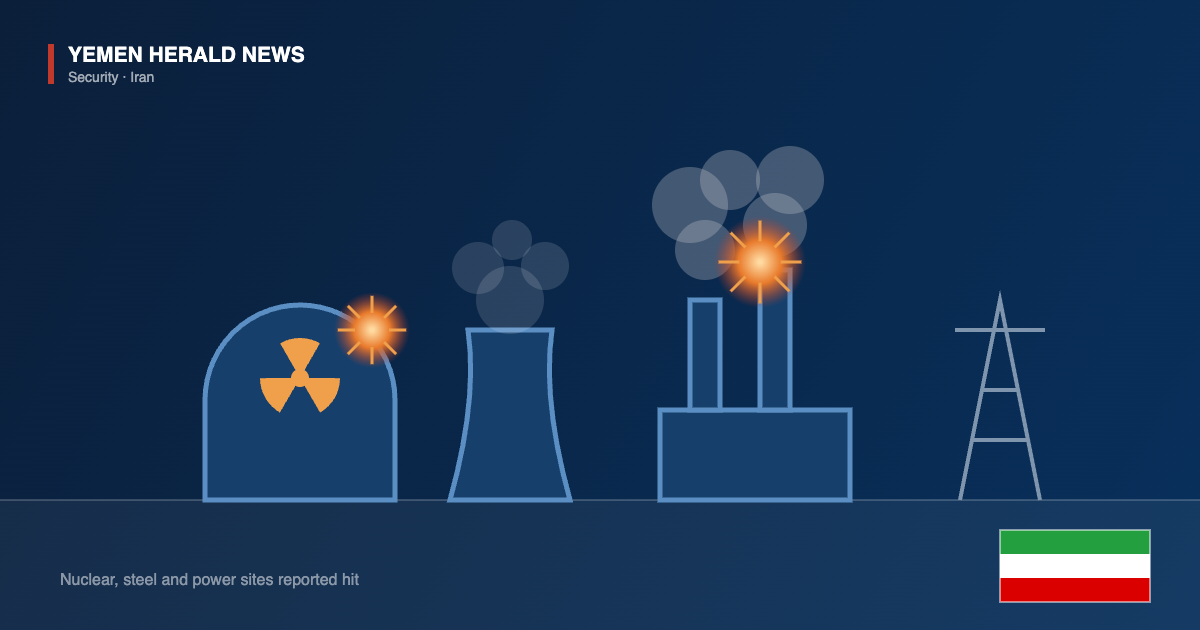
Iran warned in late March 2026 that it would exact a “heavy price” after a wave of strikes on its civilian nuclear sites and heavy industry. Foreign Minister Abbas Araghchi attributed the attacks to Israel and said Tehran would respond, in remarks that marked one of the sharpest Iranian statements of the fifth week of the war.
Iran’s Atomic Energy Organization said at the time that the Shahid Khondab Heavy Water Complex at Arak and the Ardakan yellowcake production plant in Yazd province had been targeted. Araghchi said the strikes had also hit two of Iran’s largest steel factories and a power plant, framing the pattern as a deliberate move against civilian and industrial infrastructure rather than military targets.
The Atomic Energy Organization said the strikes caused no casualties and presented no risk of radioactive contamination. Both facilities named sit within Iran’s declared nuclear programme and have been subject to international monitoring, and the absence of any reported release was one of the few points on which Iranian and outside assessments broadly aligned in the days that followed.
Arak has long occupied a particular place in the nuclear file. The heavy water reactor project there was the subject of extended negotiation under the 2015 nuclear agreement, which required the original core to be removed and the facility redesigned so that it could not produce weapons-usable plutonium in significant quantities. Ardakan, by contrast, sits at the front end of the fuel cycle, processing uranium ore concentrate. Striking both put the entire span of the declared programme in play at once.
Araghchi said Israel had claimed it acted in coordination with the United States, and argued that the attack contradicted an extended deadline for diplomacy that Washington had set. That sequencing became a central Iranian talking point: Tehran presented the strikes as evidence that the diplomatic track was being used as cover while military operations continued.
Iran’s armed forces issued their own warning to both the United States and Israel, describing their conduct as a dangerous provocation and, in the phrase carried by Iranian outlets at the time, as “playing with fire”. Iranian officials did not specify what form retaliation would take, and the statements stopped short of naming particular targets or a timeframe.
The humanitarian picture was harder to establish. The Iranian Red Crescent reported over the course of the conflict that it had pulled more than 7,200 people from rubble across the country. Wider damage assessments circulated by Iranian bodies during this period, including counts of affected civilian dwellings running into the tens of thousands, could not be independently verified, and outside agencies had limited access to strike sites.
Iranian officials used the strikes to argue a broader point about the treatment of safeguarded nuclear installations. Attacks on facilities under international monitoring have been contentious in international law for decades, and Tehran pressed that argument at the International Atomic Energy Agency and the United Nations in the weeks that followed. Israel, for its part, has consistently maintained that Iran’s programme is directed at weapons development, a characterisation Iran rejects.
The strikes also exposed a widening rift inside the Western alliance. Around the same period, United States President Donald Trump publicly attacked NATO members over what he cast as their unwillingness to support the campaign against Iran, calling the alliance a “paper tiger” and saying he was seriously considering pulling the United States out of it. Secretary of State Marco Rubio said Washington might “re-examine” the relationship once the conflict ended.
European governments took a markedly different view. Allies described the war as a conflict of choice on which they had not been consulted beforehand, and were reluctant to commit forces — particularly to any operation aimed at reopening the Strait of Hormuz, which had become the sharpest point of friction between Washington and its European partners.
On the diplomatic side, Trump announced an extension of the pause on strikes targeting Iran’s energy infrastructure, pushing it out by a further ten days to 6 April 2026. The carve-out for energy sites, while strikes on other categories of target continued, reflected the degree to which oil and gas facilities had become a distinct bargaining chip separate from the wider military campaign.
That extension ran almost exactly up to the point at which the fighting stopped. After more than five weeks of open conflict, the United States and Iran agreed a ceasefire on 7 and 8 April 2026 that also covered Israel. The truce did not hold cleanly: Gulf states reported drone activity within hours of the announcement, and the arrangement frayed repeatedly over the months that followed.
For Yemen, the relevance of this phase lay less in the nuclear file than in the maritime one. The Red Sea and the Bab al-Mandab strait remained under pressure throughout the war, with attacks on shipping continuing and insurance and routing costs rising for vessels serving Yemeni ports. Any escalation touching Iranian energy infrastructure carried a direct read-across to the sea lanes on which Yemen’s imports depend.
Read from a distance, the late-March strikes marked the point at which the war moved decisively beyond military installations and into the industrial base of a state — nuclear facilities, steel, power generation. That shift is what gave Araghchi’s warning its weight, and what made the following fortnight, with its energy-strike pause and eventual ceasefire, the most consequential stretch of the conflict.
About the Author