Jordan Says It Intercepted Two of Three Iranian Missiles Fired at the Kingdom
 Yemen Herald News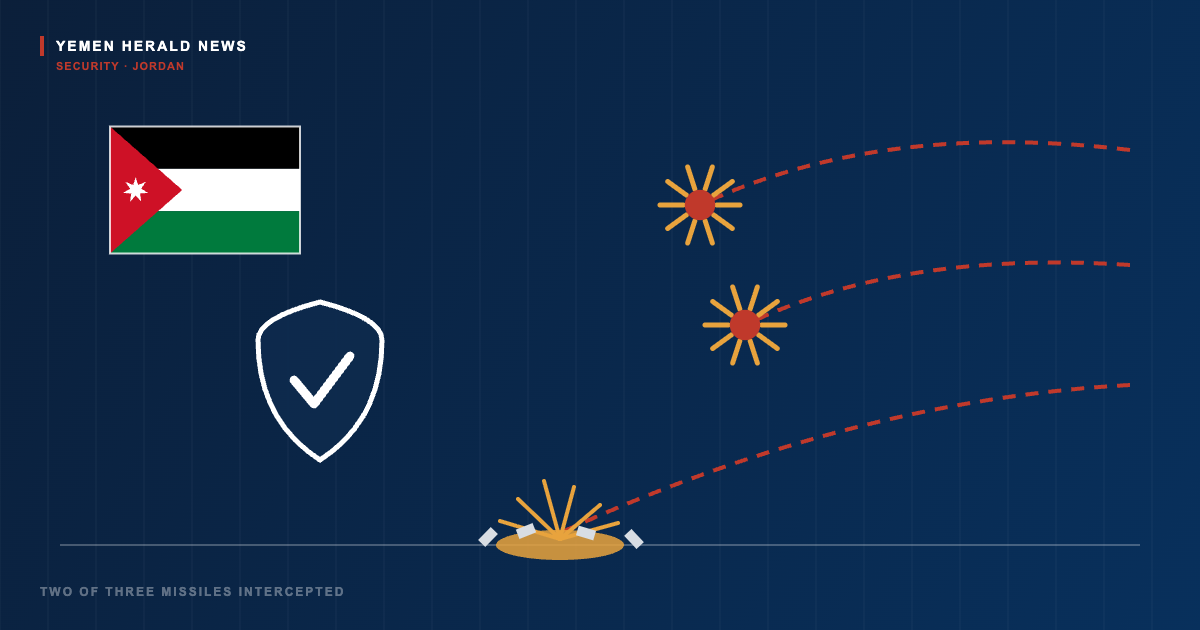
The Jordanian Armed Forces said on Friday that the kingdom had been targeted by three missiles launched from Iran within a 24-hour period. The Royal Jordanian Air Force intercepted and destroyed two of them, according to the statement issued at the time. The third was not neutralised and came down in eastern Jordan.
The Public Security Directorate’s spokesman said specialised units had responded to four separate reports of falling debris and projectiles. No injuries were recorded, though the directorate confirmed material damage. Authorities warned the public against gathering near or tampering with suspicious objects and missile fragments, and urged people to follow official safety instructions and to report any find to the security services rather than approach it.
Those warnings are not a formality. Debris from an intercepted missile is scattered across a wide area, and the pieces that reach the ground can include sections of rocket motor holding residual propellant, fragments of warhead casing, and jagged structural metal. Items that appear inert can remain hazardous, and crowds forming at an impact site both put civilians at risk and obstruct the teams sent to make the area safe. Security services across the region issued similar instructions during the campaign for the same reasons.
The Public Security Directorate handles civil emergency response in Jordan, and its involvement alongside the armed forces reflected how these incidents were managed in practice. The air force engaged incoming projectiles, while police and civil defence units dealt with what came down afterwards: cordoning impact sites, recovering fragments and assessing damage to property. Four call-outs in a single 24-hour window gives a sense of how widely the remains of two interceptions and one impact were distributed.
The episode was one entry in a longer sequence. The wider confrontation opened on 28 February 2026, when the United States and Israel began military operations against Iran. Tehran responded with missile and drone salvoes aimed at Israel and at what it described as American sites and interests across the region. From the outset, projectiles crossed Jordanian airspace and were engaged by Jordanian forces and by United States forces stationed in the country.
Jordan’s exposure is partly a function of geography. The kingdom lies between Iraq and Iran to the east and Israel to the west, so launches directed at Israeli targets follow trajectories that pass over Jordanian territory whether or not Jordan is the intended recipient. Jordanian statements during the campaign described the kingdom as having been targeted, while the same geography meant that debris from projectiles merely transiting the country would also fall on Jordanian soil. The distinction between the two mattered politically and was not always resolvable from the public record.
Amman’s position through the period was consistent. Jordan has a peace treaty with Israel and hosts United States forces, and Jordanian officials have repeatedly said the kingdom will not permit its airspace to become a battleground or a corridor for attacks on its neighbours. Intercepting projectiles over its own territory was presented as the defence of Jordanian sovereignty and of Jordanian civilians rather than as participation in the confrontation on either side.
Interceptions continued well beyond March. The Jordanian Armed Forces reported downing two missiles and two drones on 5 April, and further engagements were announced through the following months, including a night in July when Jordanian air defences reported destroying five missiles fired from Iran towards the kingdom. Read against that series, the March statement describes a phase of the campaign rather than an isolated attack.
Jordan was not alone. Bahrain’s Defence Force reported intercepting scores of missiles and hundreds of drones over the campaign’s first weeks. Kuwait reported strikes on its international airport, including damage to the airport’s radar system, and on two of its ports. The United Arab Emirates reported its own interceptions of ballistic missiles and drones. Across the region the pattern was the same: repeated launches, a high reported interception rate, and a residue of leakage that reached the ground.
The economic and psychological effects of a campaign like this are not captured by casualty figures. Recurrent alerts, closed or restricted airspace and the diversion of commercial flights impose costs on states that are not formally at war, and Jordan’s tourism-dependent economy is sensitive to perceptions of instability. Governments across the region weighed those costs against the risk of escalation when deciding how loudly to respond to each individual launch.
The effects of a campaign like this are not captured by casualty figures. Recurrent alerts, restricted airspace and diverted commercial flights impose costs on states not formally at war, and Jordan’s tourism-dependent economy is sensitive to perceptions of instability.
For Yemeni readers the shape of the episode is familiar. Yemen’s own conflict, running since 2015, has made missile and drone launches across borders a recurring feature of the region, and the Houthi movement has previously fired on neighbouring states and on commercial shipping. Gulf and Arab governments cited that record repeatedly when describing the 2026 campaign as the continuation of a longer pattern rather than a departure from it.
The Jordanian statement did not identify the location in eastern Jordan where the third missile came down, nor did it quantify the material damage beyond confirming that some had occurred. Authorities said at the time that assessments were continuing and repeated their request that residents report debris rather than handle it.
About the Author