Israeli Strike on Marked Press Car Kills Three Journalists in South Lebanon
 Yemen Herald News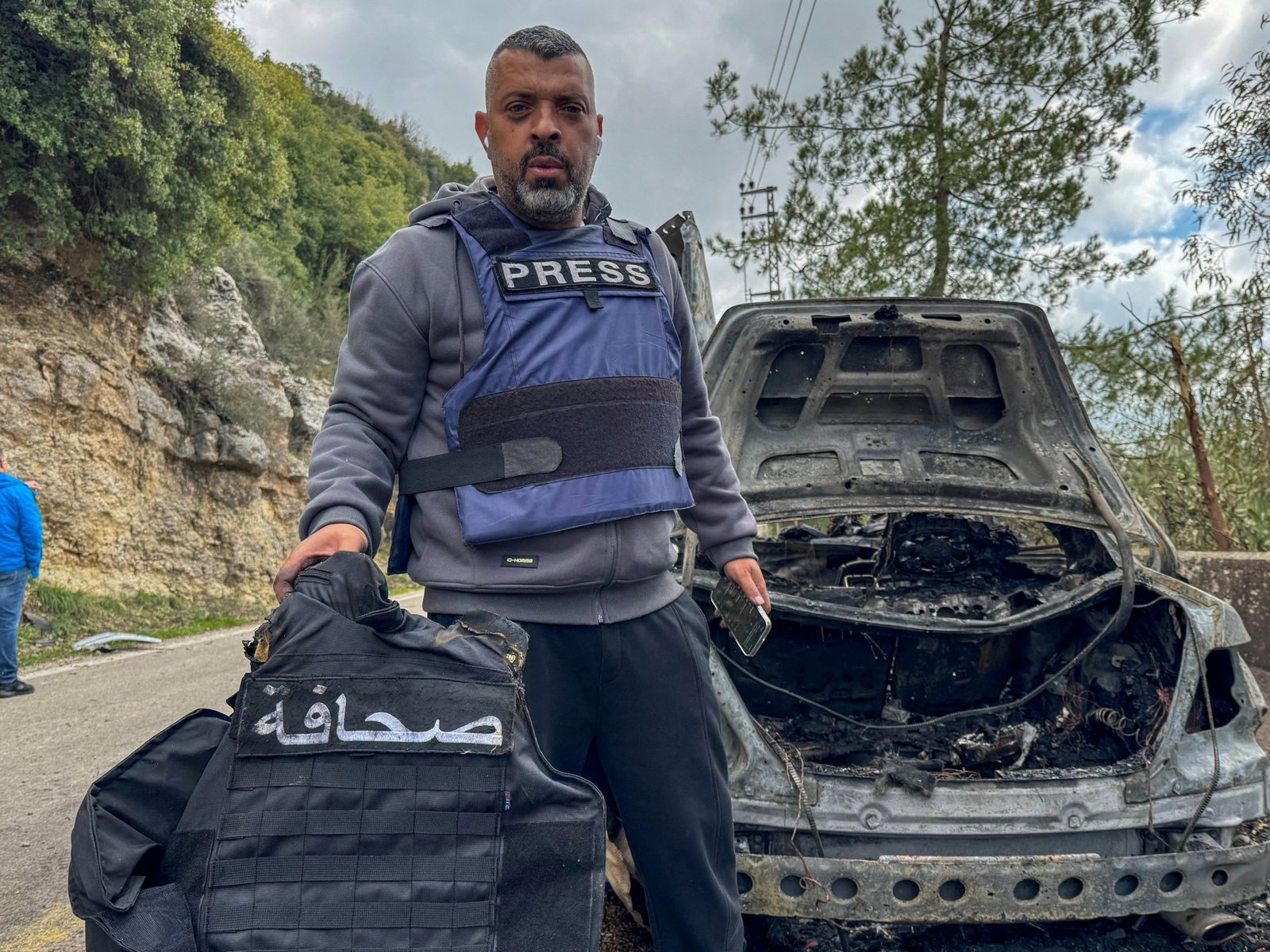
An Israeli airstrike on a clearly marked press vehicle in the Jezzine district of southern Lebanon killed three Lebanese journalists on Saturday, 28 March 2026, on one of the deadliest single days for media workers and emergency responders since the current escalation began. Those killed were Ali Shuaib, a veteran correspondent for the Hezbollah-run broadcaster Al-Manar; Fatima Ftouni of Al Mayadeen; and her brother Mohammed Ftouni, a video journalist. Several other reporters travelling with the group were wounded. Colleagues said Fatima Ftouni had filed a live report from southern Lebanon shortly before the car was hit on the Jezzine road.
The Israeli military confirmed it had carried out the strike and said it had targeted Shuaib, describing him as an operative embedded with a Hezbollah intelligence unit and involved in tracking the movements of Israeli troops. It did not publish evidence for that characterisation. Hezbollah, which owns Al-Manar, rejected the accusation as false and called the strike a crime. Al Mayadeen said its staff had been carrying out ordinary professional duties in districts they had covered for years. Shuaib had reported from south Lebanon for Al-Manar for close to three decades and was among the best-known war correspondents working the border area.
Lebanon’s leadership condemned the attack within hours. President Joseph Aoun described it as a violation of international law. Prime Minister Nawaf Salam called it a blatant breach of humanitarian principles. Under international humanitarian law, journalists in conflict zones are treated as civilians and may not be lawfully targeted unless they take a direct part in hostilities. Press-freedom organisations argue that this threshold demands published evidence, and that during the present conflict such claims have more often been asserted than demonstrated. Marked press vehicles and visible PRESS insignia are intended precisely to establish that protection.
The same Saturday brought heavy losses among Lebanon’s emergency services. Lebanon’s health ministry said nine paramedics were killed, taking the toll among health workers since the escalation began to 51. The World Health Organization, counting slightly differently, recorded eight paramedics killed and seven wounded across five separate attacks on health care in southern Lebanon that day. WHO Director-General Tedros Adhanom Ghebreyesus said the strikes had severely disrupted health services across the south, with hospitals and primary health centres closing outright or operating at reduced capacity, and with ambulance crews unable to reach casualties in the areas hardest hit.
The attacks fell within a wider escalation that began on 2 March 2026, when Hezbollah started firing rockets into northern Israel following the United States-Israeli attack on Iran and the killing of Iran’s Supreme Leader, Ali Khamenei. Israel extended its air campaign into Lebanon, combining airstrikes and artillery with ground incursions, with the heaviest operations reported in Nabatieh, the Bekaa valley, Baalbek and the southern suburbs of Beirut. Israeli forces pushed further into border villages through late March, while Hezbollah claimed a series of operations against Israeli units on the ground.
Casualty tallies circulating at the end of March put the Lebanese death toll above 1,140 with more than 3,300 wounded since the fighting intensified. The United Nations human rights office subsequently documented at least 1,029 people killed and 2,786 injured during the first three weeks of the escalation alone, an indication of how quickly the toll accumulated in early March. Lebanese authorities and UN agencies reported that more than a million people had been displaced by the middle of the month, with schools, unfinished buildings and public halls pressed into service as collective shelters.
For Lebanon’s medical and media workers, the risks compounded one another. Ambulance crews responding to strikes were themselves hit in follow-up attacks, a pattern that humanitarian organisations have repeatedly flagged, while journalists attempting to document those responses travelled the same roads at the same hours. The International Committee of the Red Cross had already voiced concern for the safety of humanitarian personnel in the south after a volunteer was killed in Tyre while carrying out aid work earlier in the month.
The Committee to Protect Journalists has recorded a sharp deterioration in conditions for reporters across the region, noting that Israeli strikes have accounted for a substantial share of journalist deaths worldwide over the past two years. The organisation and other press-freedom groups have called for independent investigations into strikes on identifiable media vehicles and on the premises of broadcasters, arguing that without accountability the designation of journalists as legitimate targets risks becoming routine.
Al-Manar and Al Mayadeen are both aligned with Hezbollah and its regional allies, and their reporting is contested by Israeli officials and by critics inside Lebanon. Media-freedom bodies have nonetheless been consistent that editorial affiliation does not remove a journalist’s civilian protection, and that any claim of direct participation in hostilities must be established case by case rather than inferred from an outlet’s politics.
The deaths in Jezzine underscored a broader point about coverage of the conflict. Much of what is known about conditions in southern Lebanon reaches the outside world through local reporters who live in the districts they cover, and through the paramedics and civil defence volunteers who arrive first at each strike site. As those two groups sustain losses, the flow of independently gathered information out of the worst-affected areas narrows, leaving competing official accounts harder to test. Lebanese authorities said investigations into the strike were under way, though no findings had been published.
About the Author