Yemen’s prime minister offers condolences to Jordan over Karak church attack
 Yemen Herald News
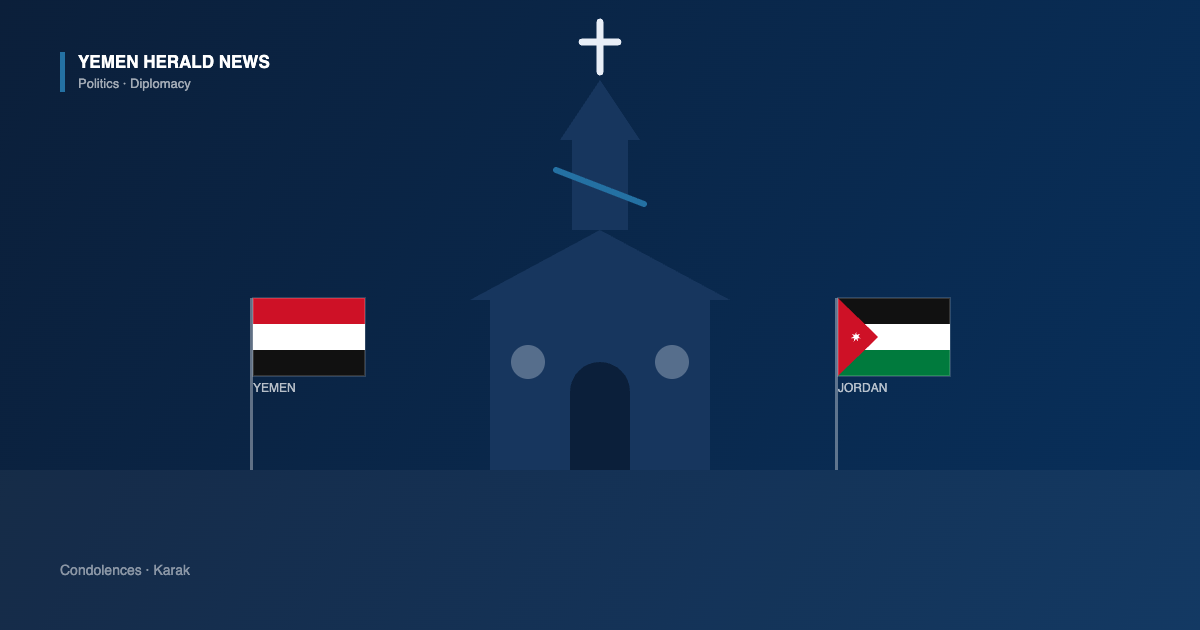
ADEN, Yemen — Yemen’s prime minister offered condolences to Jordan on Saturday over a church shooting in Karak governorate that Jordanian authorities say killed eight people.
Shaya al-Zindani posted the message on X. Saba, the state news agency of the internationally recognised government, carried it from Aden on Saturday.
He extended condolences to Jordan’s king, its government and its people, and wished the injured a speedy recovery, the agency said.
Al-Zindani called the targeting of places of worship “a horrific crime that undermines the values of coexistence and tolerance,” according to Saba.
He described terrorism as a cross-border threat that requires a unified Arab and international response, the agency reported.
The Yemeni government faces the same approach against civilians and innocent people and stands in full solidarity with Jordan, he said.
He also said Yemen supports Jordanian efforts to combat terrorism and extremism.
The account of the Yemeni statement rests on Saba. No independent confirmation of it has been published, and roundups of Arab and international reaction compiled by other outlets do not name Yemen.
Gunmen opened fire on mourners at a Greek Orthodox church in the village of Hammoud, in southern Jordan, on Friday. A funeral was under way at the time.
A survivor said the shooting began about 15 minutes after the funeral started, Arab News reported. A witness estimated that 150 to 200 people were inside and around the church.
Jordan’s health ministry put the toll at eight dead, seven of them killed at the scene and one who died hours later, the state news agency Petra reported.
Earlier counts had given seven dead. Reported injury figures ranged from 34 to 40, with 27 people still receiving hospital treatment.
Health Minister Ibrahim al-Budour said two of the wounded were in a critical condition. The director of the Prince Ali Military Hospital in Karak said one person was in a critical condition after surgery.
A witness said most of those killed were between 50 and 70 years old.
The gunmen fired for about five minutes before fleeing in a vehicle, The National reported. It said security camera footage showed three attackers firing from a pavement and taking cover behind trees and a low wall.
Footage also showed two of the attackers apparently carrying handguns and a third carrying a rifle, his head covered, according to Arab News.
Accounts of the number of attackers differ. One mourner, Dorgham Halasa, said others at the scene told him there were four.
The state broadcaster Al-Mamlaka reported that security forces were pursuing two suspects who had arrived by vehicle.
No arrests have been reported, and no group has claimed responsibility.
Interior Minister Mazen al-Faraya called it a terrorist attack carried out by a group of extremists, without naming an organisation.
Government spokesman Mohammad Momani, who is also communications minister, attributed the attack to what he called extremist takfiri ideology. He said investigators were still checking whether the attackers had organisational links.
Prime Minister Jafar Hassan declared three days of national mourning from Friday. Flags were lowered to half-staff at ministries, government departments and public institutions.
King Abdullah II visited the injured at Karak Government Hospital. He pledged what he called the “harshest” retaliation for the attack and said Jordanian unity would prevail.
The king also ordered a review of security procedures for responding to attacks, Al Jazeera reported.
Theophilos III, the Greek Orthodox Patriarch of Jerusalem, called the attack vile and cowardly and said it would not undermine national unity. Queen Rania described it as a heinous crime.
Karak has a sizeable Christian population. The Greek Orthodox community is the largest Christian community in Jordan, and attacks on Christians in the country are rare.
Condolences came from the United Arab Emirates, Egypt, Saudi Arabia, Iraq, Syria, Qatar, Bahrain, Oman, Kuwait and Lebanon.
Canada, Germany, the European Union and the United States embassy in Amman issued statements. UN Secretary-General Antonio Guterres condemned the attack through his spokesman.
Arab League Secretary-General Nabil Fahmy and the Organisation of Islamic Cooperation also condemned the attack, the Syrian news agency Sana reported.
Yemen and Jordan have expanded contacts this year.
Foreign Minister Afrah al-Zouba visited Amman in early October and met Deputy Prime Minister Ayman Safadi, the Jordanian outlet Jordan News reported, citing Petra.
The two sides agreed to activate political consultations under a memorandum signed in 2022 and to prepare the 15th session of their higher joint committee, according to that report.
Al-Zouba described Jordan as a treatment destination for Yemeni patients. She listed health, higher education, training and investment as areas of cooperation.
She said Yemen’s priorities were salaries, food, medicine, electricity and water, and that nearly 200,000 people had been newly displaced by the end of September.
Al-Zindani has led the government since 6 February 2026. The Presidential Leadership Council named him on 15 January, and he succeeded Salem Saleh bin Braik.
He served as foreign minister from March 2024 until July 2026, when al-Zouba replaced him.
He was Yemen’s ambassador to Jordan from 2010 to 2015.
He had earlier served as ambassador to the United Kingdom and to Italy, and later as ambassador to Saudi Arabia and permanent representative to the Organisation of Islamic Cooperation.
About the Author