Saudi-led coalition says it downed 10 ballistic missiles, a cruise missile and a drone on Sunday
 Yemen Herald News
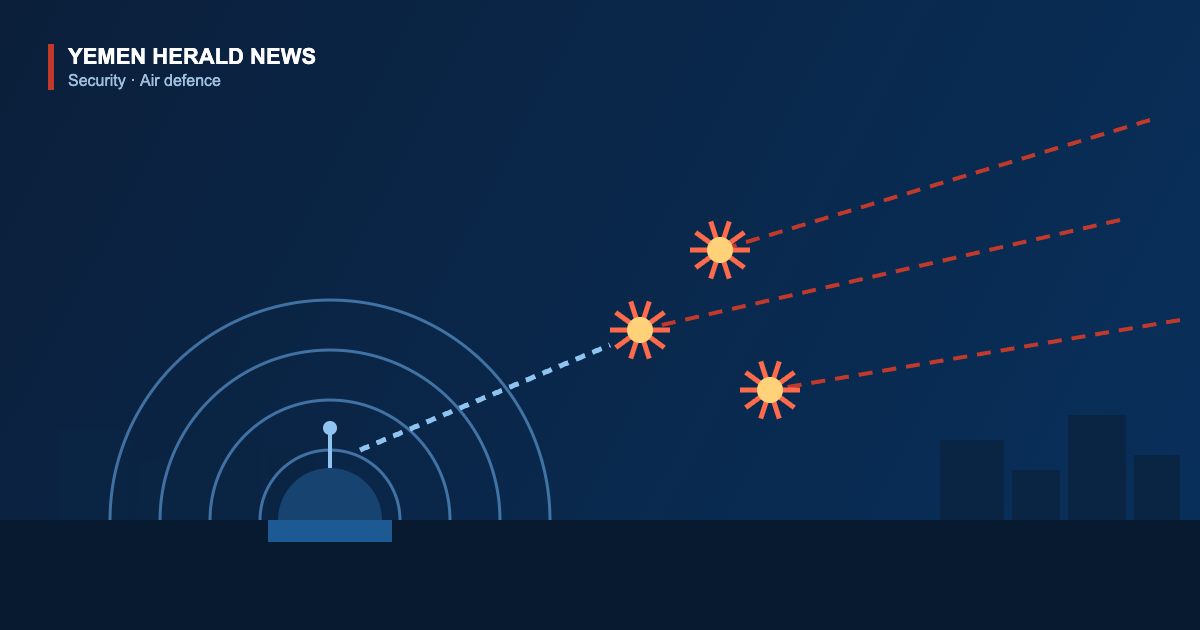
RIYADH, Saudi Arabia — Saudi air defences intercepted 10 ballistic missiles fired at the kingdom’s southern region on Sunday, the Saudi-led coalition said.
The coalition said it also destroyed a ballistic missile aimed at Riyadh and a drone over the capital region.
A cruise missile launched toward Khamis Mushait, in the southwest, was intercepted and destroyed, the coalition said in a separate statement.
Explosions were heard in Riyadh before dawn. News agency journalists in the capital reported hearing three blasts.
Residents had received alerts on their mobile phones shortly beforehand. The messages warned of an air threat and told people to take shelter.
Coalition spokesman Maj. Gen. Turki al-Maliki announced the Riyadh interception.
The tallies come from coalition statements. Yemen Herald found no independent confirmation of the interception counts, although journalists in Riyadh reported the explosions.
The coalition’s statements did not say which systems carried out Sunday’s interceptions, or where the debris from them fell.
Saudi Civil Defence issued alerts through its National Early Warning Platform for the city of Abha and the governorate of Khamis Mushait.
It was the second warning for Khamis Mushait that morning.
Civil Defence said later that the danger had passed. It urged residents to follow safety instructions and to avoid gathering at or filming the sites.
The coalition said two interceptions on Saturday had sent debris falling on Makkah, Jeddah, Taif and Rabigh.
Saudi Civil Defence responded to falling debris in the Mecca and Madinah regions that day, after two missiles were intercepted.
The Houthis denied targeting Makkah or Madinah. The movement called the Saudi account a “huge lie”.
The group said on Saturday that it had struck three Saudi airports, including one in Riyadh, as well as energy installations, a pipeline and an airbase.
The coalition has not published a figure for the total number of missiles and drones fired at the kingdom since the campaign resumed.
King Khalid International Airport in Riyadh reopened two of its terminals on Sunday.
The airport announced the reopening late on Saturday. It said international flights would resume from Terminal 2 the following day.
Terminal 1 resumed domestic flights. Terminal 2 took international services.
The airport had been closed since October 10, when a Houthi missile attack killed 13 people and wounded more than 300.
That attack halted all operations at the airport for about two weeks.
Houthi military spokesman Yahya Saree said the airport remained unsafe and was still a military target.
Saree warned airlines, airport staff and travellers against using it. He said Saudi Arabia would bear responsibility for the consequences of resuming operations.
The United States warned its citizens on Saturday against travelling to Saudi Arabia, citing terrorism.
The advisory said Houthi attacks on the kingdom had the potential to escalate rapidly beyond the immediate area. It told Americans not to travel to the Yemeni border.
Washington ordered some diplomats and their families to leave Saudi Arabia earlier in the week.
Interceptions over Saudi territory have been reported on each of the past three days.
On Friday the coalition said it destroyed a ballistic missile headed for Riyadh shortly after 4 a.m., and a second aimed at Khamis Mushait. Al-Maliki announced those interceptions on X.
The coalition said two armed drones directed at the southern region were intercepted the same day.
On Saturday it reported two ballistic missiles fired at Taif and Yanbu. It said no casualties or damage resulted.
Saudi Civil Defence issued danger warnings for four western regions that day, including Taif, Yanbu and Mecca, and told residents to move to the nearest safe place. The alerts were withdrawn shortly afterwards.
The coalition intervened in Yemen’s war in 2015 at the request of the internationally recognised government.
A UN-brokered truce agreed in 2022 held until this year. The coalition resumed its air campaign in September.
The current escalation began on September 3.
Fighting has continued inside Yemen. Houthi forces advanced on Sunday toward Jabal Sabr, the mountain overlooking Taiz.
The movement seized territory along the Red Sea coast from government-aligned forces in September.
Yemeni government forces said on Saturday that they had carried out more than 700 operations against Houthi positions and killed more than 300 fighters. The Houthi movement did not confirm those figures and Yemen Herald could not verify them.
The UN human rights office has verified 251 civilian casualties since the escalation began, including 57 people killed and 194 injured. Half of those killed were children, the office said.
The UN refugee agency has said more than 250,000 people have been displaced inside Yemen since August.
Coalition aircraft struck Sanaa and the Red Sea port of Mocha on Saturday. Houthi-run media reported the raids, and residents told the Xinhua news agency that successive strikes shook the capital.
The coalition did not comment on those reported strikes.
The Houthis have besieged Taiz and cut the main road linking the city to Aden.
The United Nations said time was running out to deliver aid to about 800,000 people trapped in the city.
Abha and Khamis Mushait lie near the Yemeni border, in the southwest of the kingdom.
Civil Defence asked residents in the south to keep clear of falling debris.
About the Author